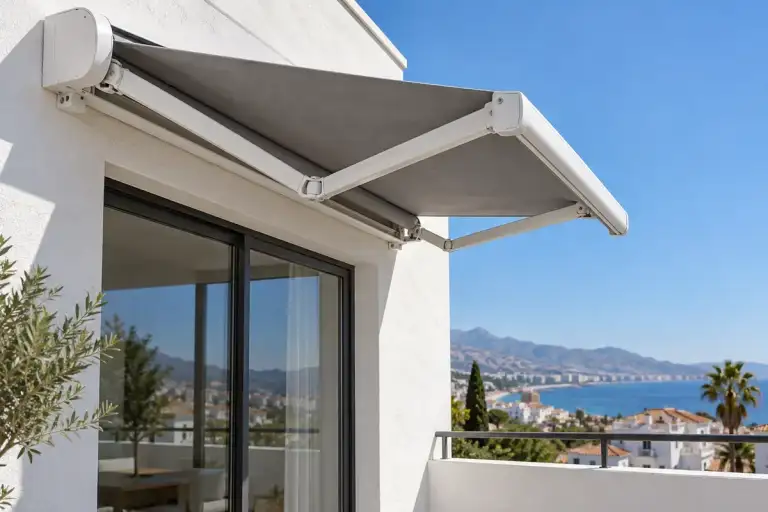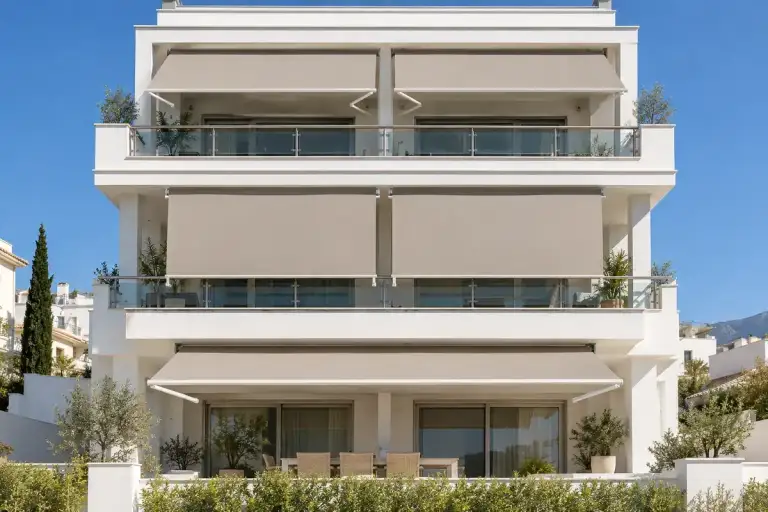
Choosing the right awning motor is what separates an awning you use every day from one that stays rolled up because you can’t face getting the winding handle out. With a good motor, opening and closing the fabric takes a matter of seconds, the awning always works at the right tension and, if you add a wind sensor, it protects itself when the wind gets up, even when you’re not at home.
In this guide we explain how an awning motor works, what types there are, how to choose the right one for each size of awning and why a wind sensor is almost essential on the coast of Malaga and Granada. We also tell you when an awning you already have can be motorised and what we check before we do it.
What an awning motor is and how it works
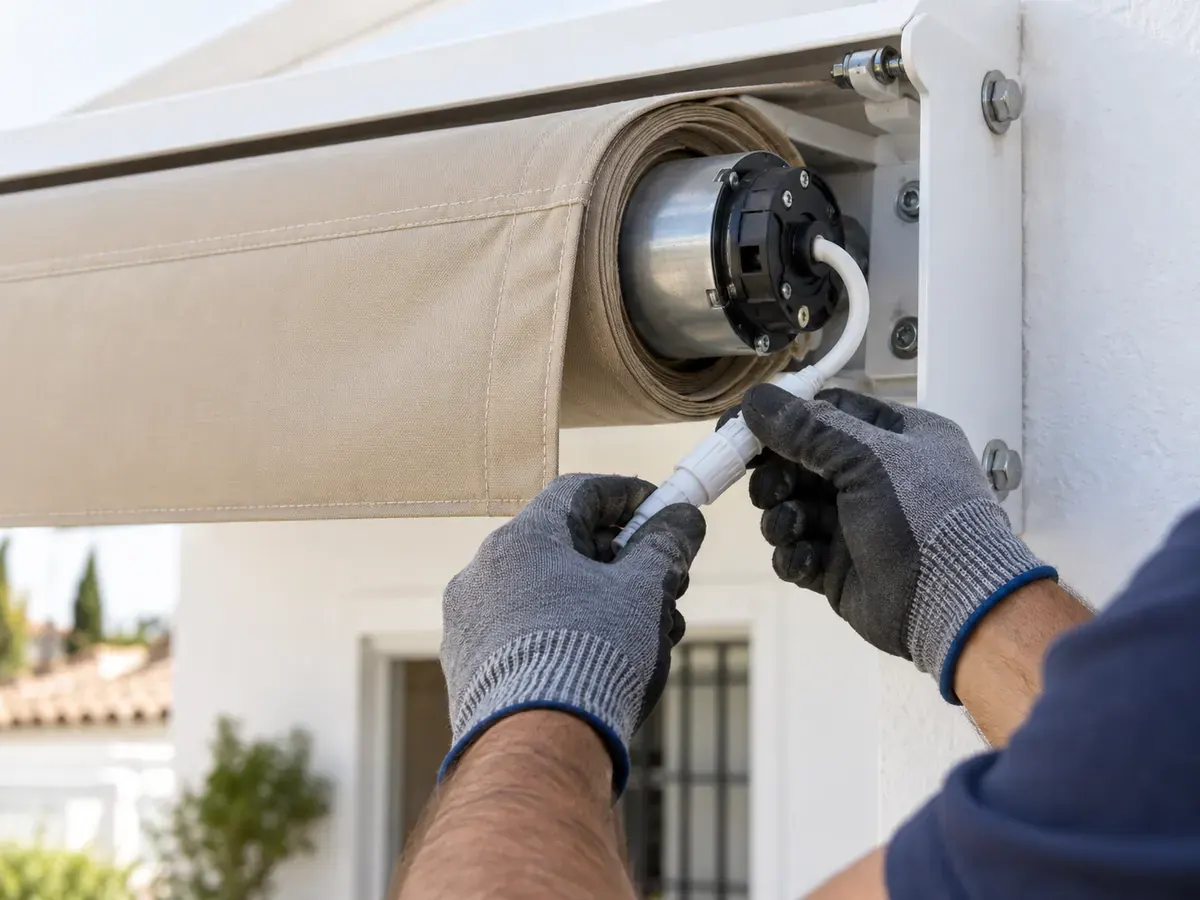
The awning motor used in homes is almost always a tubular motor: a long cylinder hidden inside the roller tube that the fabric winds around. You can’t see it from the outside. As it turns, the motor rotates the roller tube and the fabric extends or retracts, just as it would with the winding handle, but with no effort and always at the same speed.
Inside the motor housing there are three parts worth knowing about, because they decide how your awning will behave for years to come:
- The electric motor and its gearbox: they turn the current into a slow, powerful rotation, strong enough to move the fabric and the arms.
- The brake: it holds the awning wherever you stop it, so the fabric doesn’t unroll on its own.
- The limit switches: they tell the motor where to stop when it opens and closes.
Limit switches: the key to properly tensioned fabric
The limit switches are programmed during installation. They set the closing point, so the front bar sits snugly against the bracket or the cassette, and the opening point, so the fabric reaches its full projection with just the right tension. A badly set limit switch leaves the fabric slack, so it forms pockets of water, or makes the motor strain against the cassette every time you close it. That’s why the programming matters as much as the motor itself.
Manual versus motorised
A manual awning is operated with a winding handle that turns a gearbox. It’s simple and doesn’t need electricity, but on large awnings it’s hard work and, in practice, many families end up opening it less often than they’d like. An awning motor takes away that effort and opens the door to automation such as a wind sensor or a sun sensor, which a manual awning can’t have.
Types of awning motor by how you control them
Every awning motor does the same job, rolling the fabric in and out, but the way you control it varies a great deal. This is the difference you’ll notice most from day to day.
Motor with a wall switch
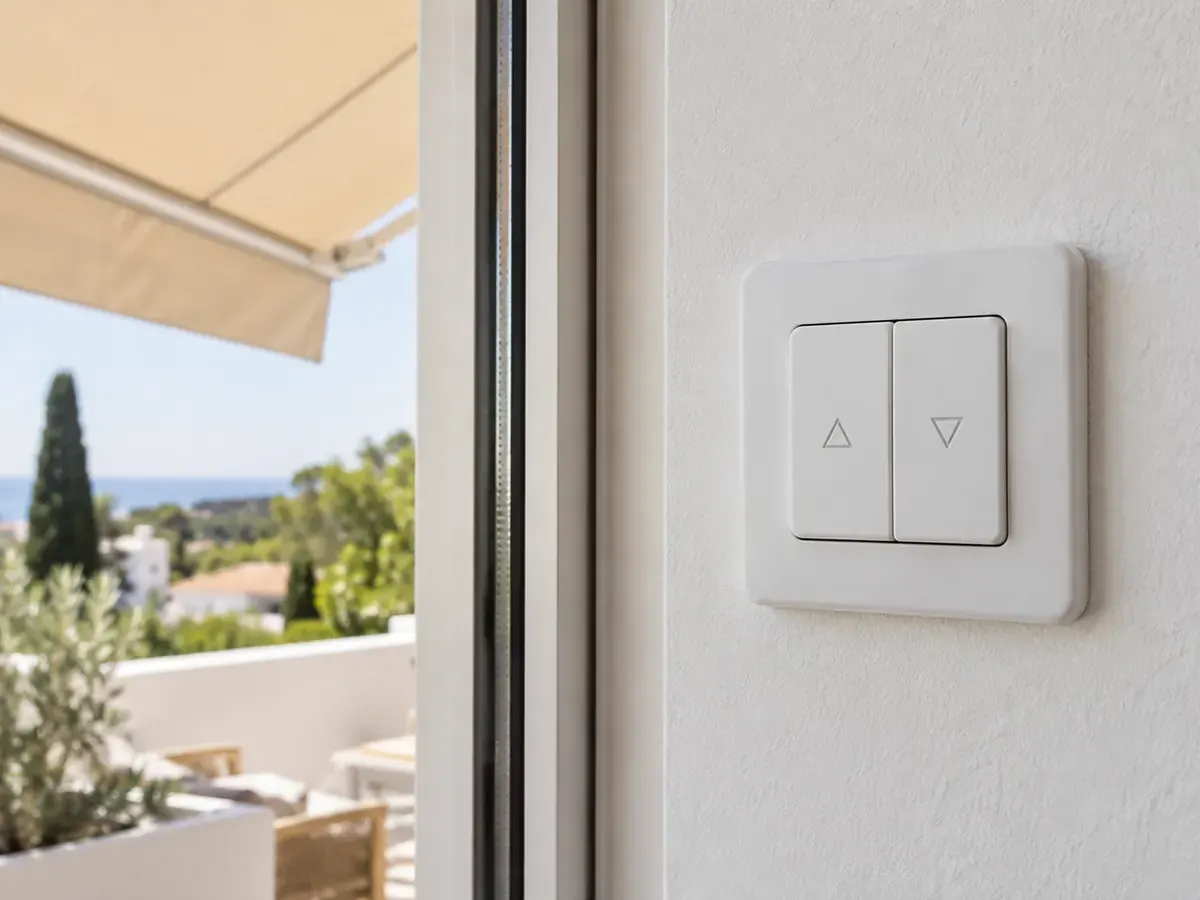
It’s operated with an up/down switch fixed to the wall, usually next to the door onto the terrace. It’s the simplest and most affordable option, and it works very well when there’s only one awning and you always operate it from the same spot. Its limitation is that the switch is wired, so a cable has to run from the motor to the switch.
Radio motor with a remote control
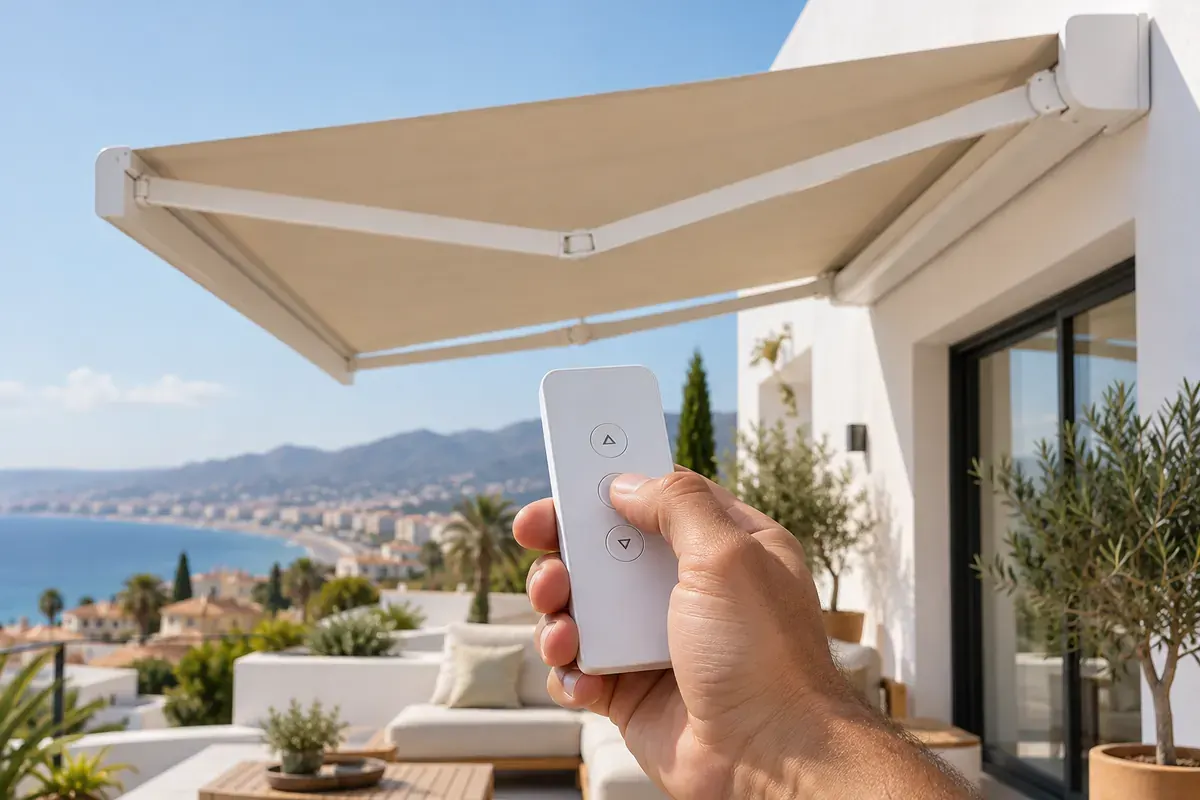
It has a built-in receiver and is controlled with a remote. It’s the most widely installed today because it lets you operate several awnings with the same remote, create groups (for example, all the awnings on one facade) and add a wireless wind sensor or sun sensor without any building work. It can also be combined with a wireless wall switch.
Motor with smart home control
Depending on the model, some motors integrate with smart home systems. That way you can operate the awning from your phone, set schedules or create scenes together with your shutters and lights.
Motor with manual override
It includes a mechanism that lets you retract the awning with a winding handle if the power goes off. It makes sense in homes where the awning stays open for many hours, in areas with power cuts or on very large awnings where you don’t want to rely on electricity alone.
| Type of control | How you operate it | Takes sensors | Best for |
|---|---|---|---|
| Wall switch | Wired switch | Limited | A single awning always operated from the same spot |
| Radio with remote | Remote control and wireless wall switch | Yes, wind and sun sensors with no cables | Most homes and several awnings |
| Smart home | Phone, schedules and scenes | Yes, depending on the system | Smart homes or holiday homes |
| With manual override | Motor plus a back-up winding handle | Depending on the model | Large awnings or areas with power cuts |
How to choose an awning motor
There’s no such thing as a one-size-fits-all awning motor. One that works brilliantly on a balcony awning falls short on a terrace awning with a large projection, and an oversized one makes the installation more expensive without adding anything. These are the criteria we check at every home visit.
1. The motor’s torque
Torque is measured in newton metres (Nm) and is the force with which the motor turns the roller tube. It depends on the width of the awning, the weight of the fabric, the diameter of the roller tube and, above all, the projection and the strength of the arms. An awning motor without enough torque works under strain, overheats and fails sooner, which is why we always choose it after measuring the awning, never by eye.
2. The diameter of the roller tube
The motor has to fit inside the roller tube. Each tube diameter takes a specific range of motors, with their adapters (the crown and the drive wheel). If your current awning has an unusual roller tube, we check it before we quote.
3. The type of control
Think about how you’ll use the awning: if you always operate it from the living room, a switch may be enough; if you have several awnings or want sensors, it’s best to go for a radio motor from the start, because changing it later costs more.
4. The sensors you want to add
If the awning is in an exposed spot, a wind sensor isn’t an extra, it’s protection. Choosing an awning motor that’s compatible with wireless sensors lets you add one now or later on without changing the motor.
5. The quality of the manufacturer
The awning motor is the part that works hardest. At QUBRE we install Cherubini motors, from an Italian manufacturer that specialises in motors for awnings and shutters, and we choose the specific model according to the size and use of each awning.
Not sure which motor your awning needs? We come to your home, measure up for free and give you a written quote, with no obligation and a fixed price, in under 24 hours. Get a free quote or call us on +34 694 57 17 33.
Awning motor with a wind sensor: the best protection on the coast
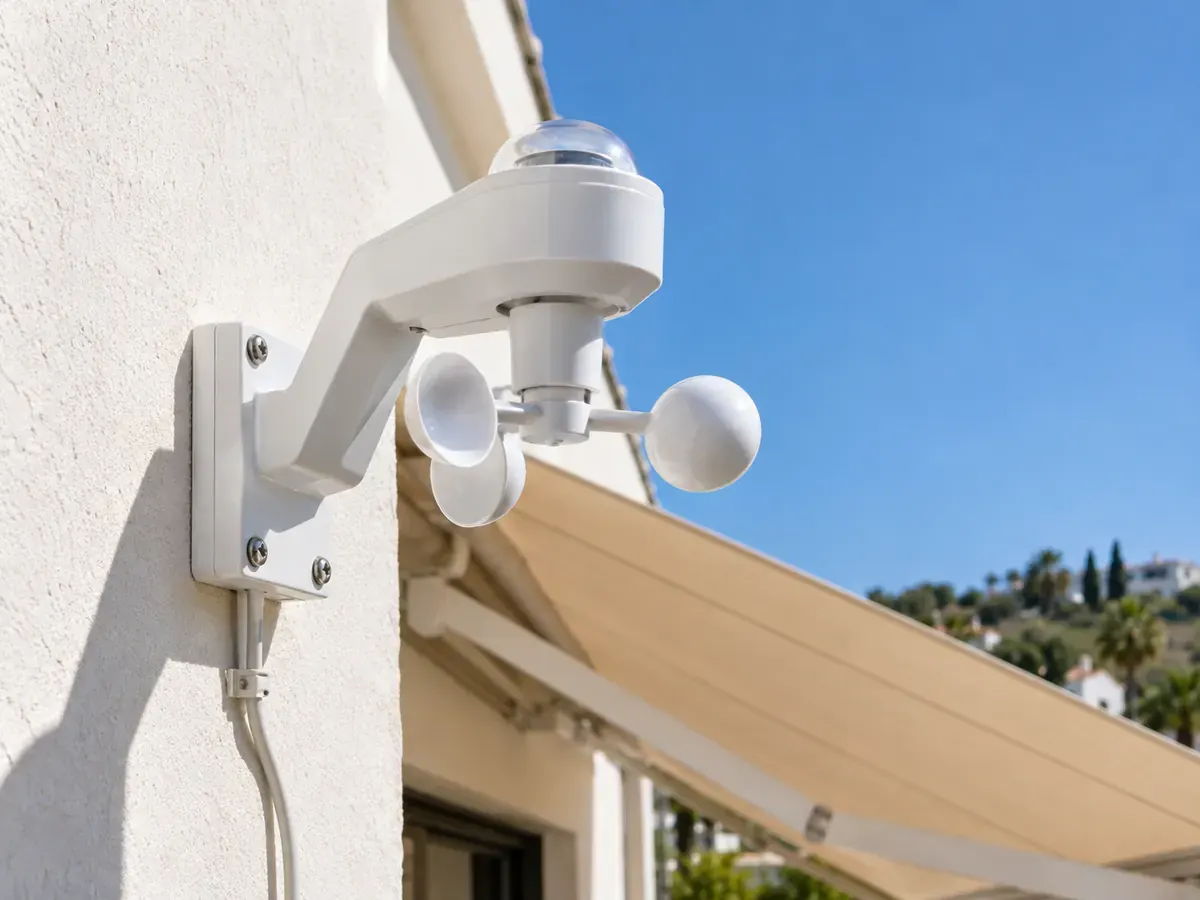
Wind is the most common cause of broken arms, brackets and fabric. In the Axarquia, on the Costa del Sol and on the Costa Tropical, days of levante (the strong easterly wind) and poniente (the westerly) often arrive without warning, and an open awning can take a real beating in just a few minutes. A wind sensor is designed for exactly that: it detects the wind and tells the motor to retract the awning automatically, whether you’re at home or not.
How a wind sensor works
There are two main types, and each one suits a different kind of awning:
- Vibration or motion sensor: it’s fitted to the front bar of the awning and detects the swaying caused by the wind. It’s the most common type on folding-arm and cassette awnings, and many models are battery-powered and talk to the motor by radio.
- Anemometer: small cups that spin in the wind and measure its speed. It’s fixed to the facade, in a spot where it picks up a representative amount of wind, and it’s very useful for vertical awnings, zip screens and large installations.
In both cases, the wind sensor is set to a sensitivity threshold. We adjust it during installation to suit how exposed your terrace is: not so sensitive that it retracts the awning in a light breeze, and not so slack that it waits for a dangerous gust.
Sun sensor: the awning works for you
A sun sensor measures the light, extends the awning when the sun is strong and retracts it when the sun goes. It’s very useful for keeping the heat out of your home even when you’re out all day, or for keeping a holiday home cool. Combined with a wind sensor, the awning gives shade when it’s needed and protects itself when the wind blows hard. If you’d like to bring the temperature down on your terrace, we recommend reading which awning keeps the heat out best.
Can you motorise an awning you already have?
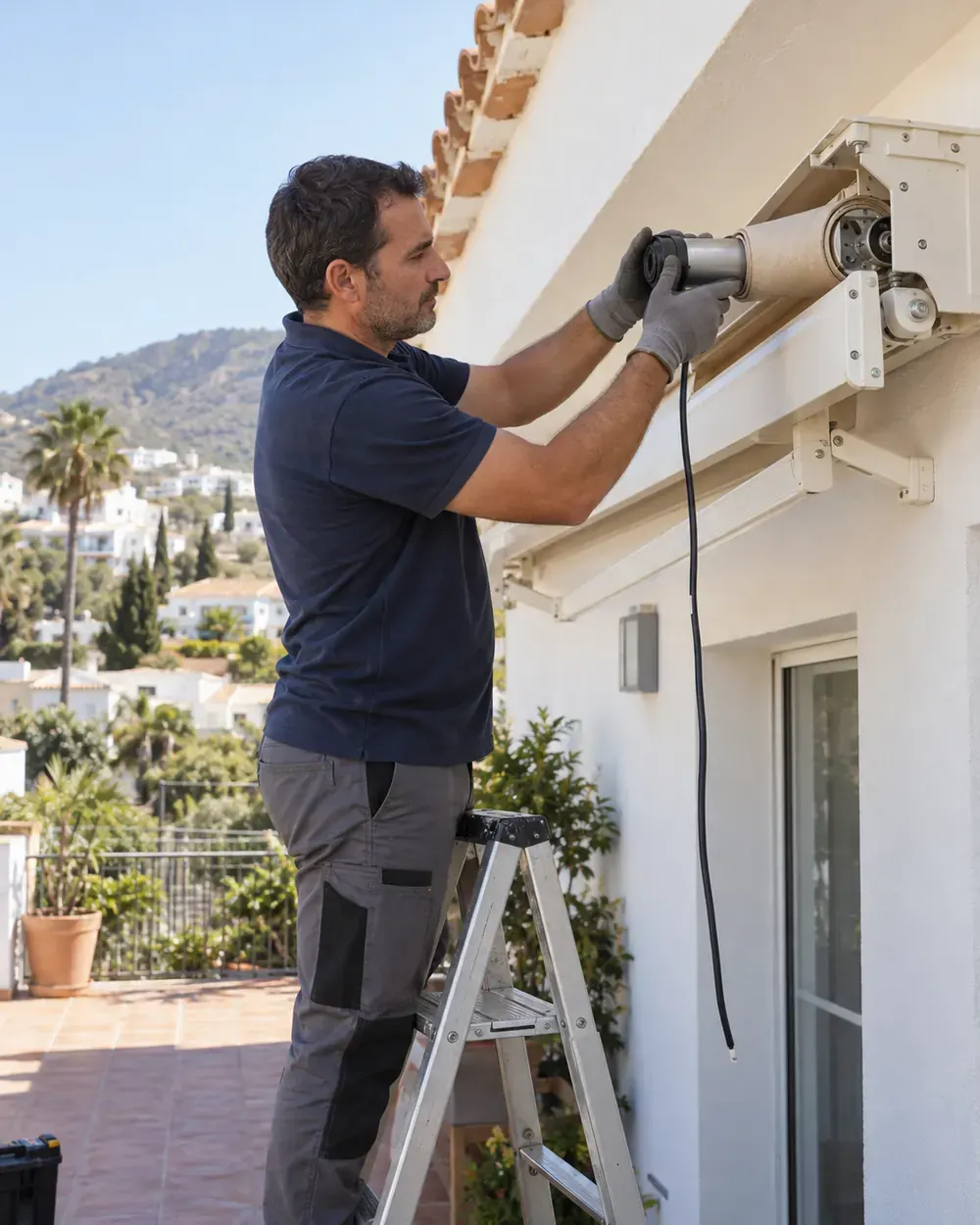
Yes, in most cases. Motorising an existing awning is one of the upgrades you notice most from day to day, and it doesn’t mean replacing the whole awning. The gearbox and winding handle are swapped for a tubular motor inside the roller tube, and the control system of your choice is added.
What we check before motorising an awning
- The roller tube: that it’s straight, free of dents and that its diameter will take the right motor.
- The arms and brackets: that they work properly and are secure. An arm with play in it or a loose bracket needs fixing first.
- The fabric: if it’s very worn or torn, it’s worth replacing the awning fabric on the same visit and making the most of the trip.
- The power point: the motor needs an electricity supply close to the awning.
How an awning is motorised, step by step
- The awning is retracted and the tension in the arms is released safely.
- The roller tube is taken down and the winding gearbox removed.
- The awning motor is slid inside the roller tube with its adapters.
- The roller tube is refitted and the motor is connected to the power supply.
- The limit switches, the remote and any sensors are programmed.
- The awning is tested several times and we show you how to use it.
If the awning is in very poor condition, sometimes it makes more sense to install a new one, for example a cassette awning, which comes ready for a motor. We’ll tell you plainly once we’ve seen it. You’ll find more information on our awning motorisation in Malaga page.
Choosing an awning motor for each type of awning
Every system has its own quirks, and the awning motor is chosen with them in mind:
- Retractable awning: the arms have very powerful springs, so the motor’s torque has to match the projection. It’s the type that benefits most from a wind sensor on the front bar.
- Cassette awning: it has to close perfectly against the casing, so programming the closing limit switch is essential here.
- Monobloc awning: because of its size, it usually needs a higher-torque motor and, often, a manual override.
- Drop arm awning: smaller motors; very convenient when there are several awnings on the same facade operated as a group.
- Roller and vertical awnings and zip screens: the motor lowers the fabric vertically; because a zip screen’s fabric runs in guides, it copes better with wind, but it’s still wise to protect it with an anemometer.
- Pergolas: pergolas with a sliding canopy and bioclimatic pergolas can be motorised too, with motors and automation designed for their system.
Electrical installation and safety
An awning motor needs a power point close to the awning, usually outdoors and protected from the weather. The electrical connection has to be made safely and in line with the Spanish low-voltage regulations, using junction boxes and cable glands suitable for outdoor use. On the coast, where humidity and salt air punish any connection, this detail makes the difference between a motor that lasts and one that causes problems.
If you choose an awning motor with a switch, it’s usually placed next to the door onto the terrace, where you can see the awning while you operate it. With a radio motor you can have both a remote control and a wireless wall switch, without running any new cables.
Maintenance and common motor faults
A quality awning motor, properly chosen and properly installed, needs very little maintenance. Even so, there are some signs worth keeping an eye out for:
- The awning stops too early or doesn’t close fully: this is usually the limit switches being out of adjustment, and they just need reprogramming.
- The motor is noisy or struggles to retract: the torque may be only just enough for the awning, or the arms or roller tube may have a mechanical problem.
- The remote doesn’t respond: first of all, check the batteries in the remote and in the wind sensor.
- The motor does nothing at all: check the power supply and the RCD; if all is well, the motor needs looking at.
Keeping the fabric and arms clean also extends the life of the whole system. We explain how in our guide on how to clean an awning. And if your awning was installed by another company, we can check it over too: our after-sales service also looks after installations by other installers.
Common mistakes when choosing an awning motor
- Buying the motor on price without measuring the awning: the torque is calculated from the real size and the projection of the arms.
- Doing without a wind sensor on an exposed terrace: it costs less than repairing a broken arm or torn fabric.
- Choosing a wall switch when you’ll have several awnings: a radio motor lets you control them together and add sensors without any building work.
- Motorising an awning with a damaged frame: repair the frame first, then motorise it.
If you’re thinking about a new awning and want to know which system to choose, our guides on the retractable awning and the roll-up awning will help.
We’ll tell you which motor and sensor your awning needs. Free home visit and measuring across the Axarquia, Malaga, the Costa del Sol and the Costa Tropical, with our own technical team and a fixed-price quote. Get a free quote or call us on +34 694 57 17 33.
Frequently asked questions about awning motors
Can you motorise a manual awning?
Yes, in most cases. If the roller tube and the frame are in good condition, the gearbox and winding handle are swapped for a tubular motor inside the roller tube, without replacing the whole awning.
Which motor does my awning need?
It depends on the size and weight of the awning: the bigger the fabric and the longer the arms’ projection, the more torque the motor needs. That’s why we choose it after measuring the awning at the home visit.
Is an awning motor with a wind sensor worth it?
Yes, especially on the coast. Wind is the most common cause of broken arms and torn fabric, and a wind sensor retracts the awning automatically even when you’re not at home.
What’s the difference between a wind sensor and a sun sensor?
A wind sensor retracts the awning when the wind blows hard, to protect it. A sun sensor extends it when the sun is strong and retracts it when the sun goes. Both can be combined in the same installation.
What happens if there’s a power cut while the awning is out?
A standard motor simply stays where it was. If you want to be able to retract it without power, there are motors with a manual override that let you do it with a winding handle.
Do I need building work to fit an awning motor?
Usually not. The motor goes inside the roller tube and, if you choose a radio motor, the remote and the sensors don’t need any cables. All you need is a power point close to the awning.
Which brand of awning motor do you install?
At QUBRE we install Cherubini motors, from an Italian manufacturer that specialises in motors for awnings and shutters.
Conclusion: a good motor means you’ll really use your awning
A well-chosen awning motor, with the right torque, correct programming and a well-placed wind sensor, turns your awning into something you use every day and that looks after itself. At QUBRE we measure your awning, recommend the motor and automation that make sense for your terrace and leave everything programmed, from Velez-Malaga to Marbella, Motril or Granada.
Book your free visit today and we’ll give you a written quote with a fixed price in under 24 hours.