Home › Awnings › Cassette awnings
Cassette awnings · Malaga, Axarquia and Costa TropicalCassette awnings in Malaga protected when you’re not using them
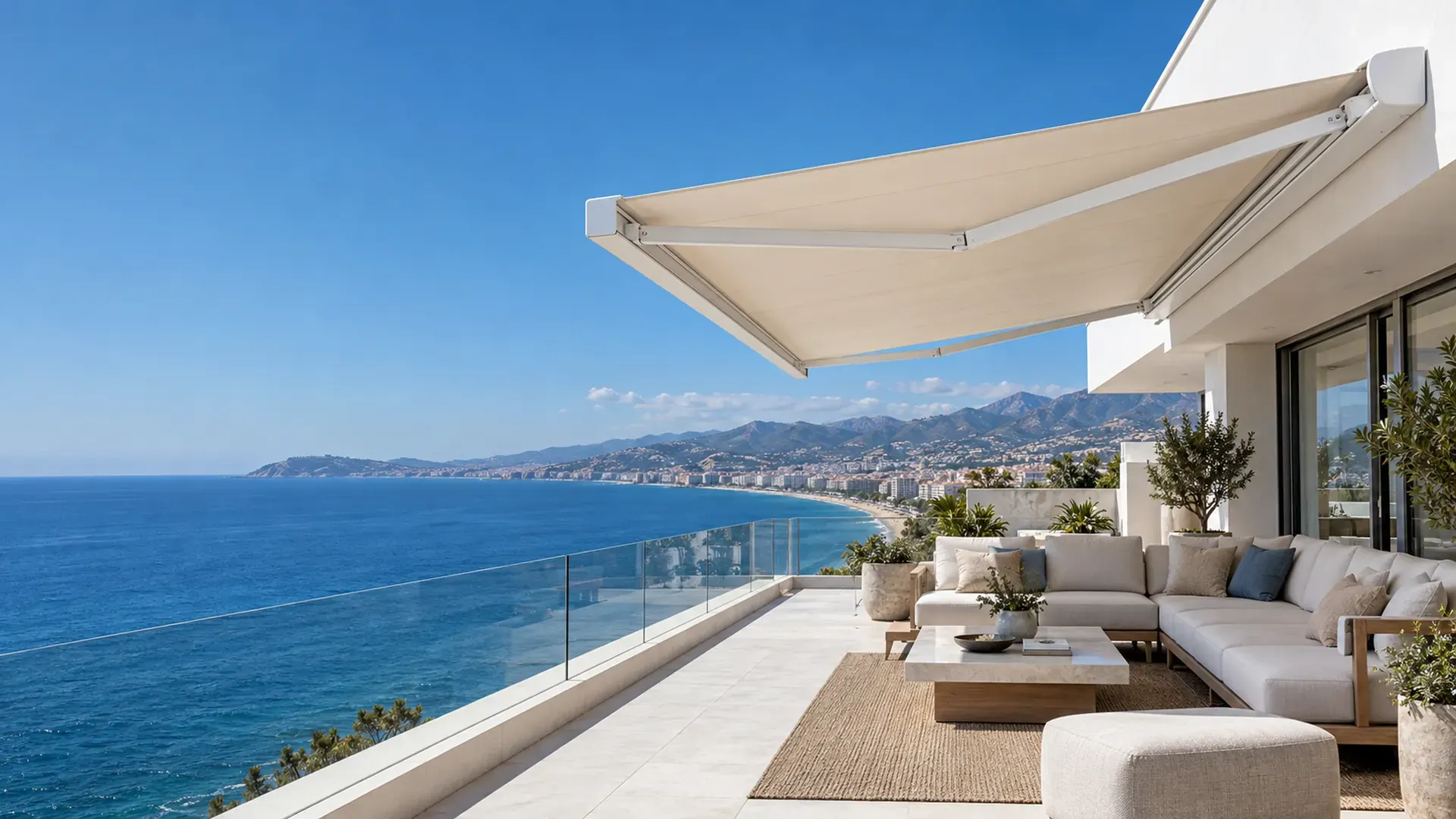
Cassette awnings in Malaga are the answer for exposed terraces, penthouses and seafront homes: when retracted, the fabric and arms are closed away in an aluminium case, safe from the sun, rain and salt air. With Cherubini motors, Sauleda and Dickson fabrics and installation by our own team.
- Our own team, no subcontractors
- Home visit and measuring free
- Fixed-price quote in under 24 hours
- Powder-coated aluminium and stainless fixings
- Guarantee and after-sales service
In short
A cassette awning in Malaga is a folding-arm awning that, when retracted, closes the fabric and arms inside an aluminium case, safe from the sun, rain and salt air. QUBRE fits it with a Cherubini motor, Sauleda or Dickson fabric and our own team, after measuring for free, with a fixed price in under 24 hours.
Updated · QUBRE technical team, Velez-Malaga
What is a cassette awning and why does it last longer?
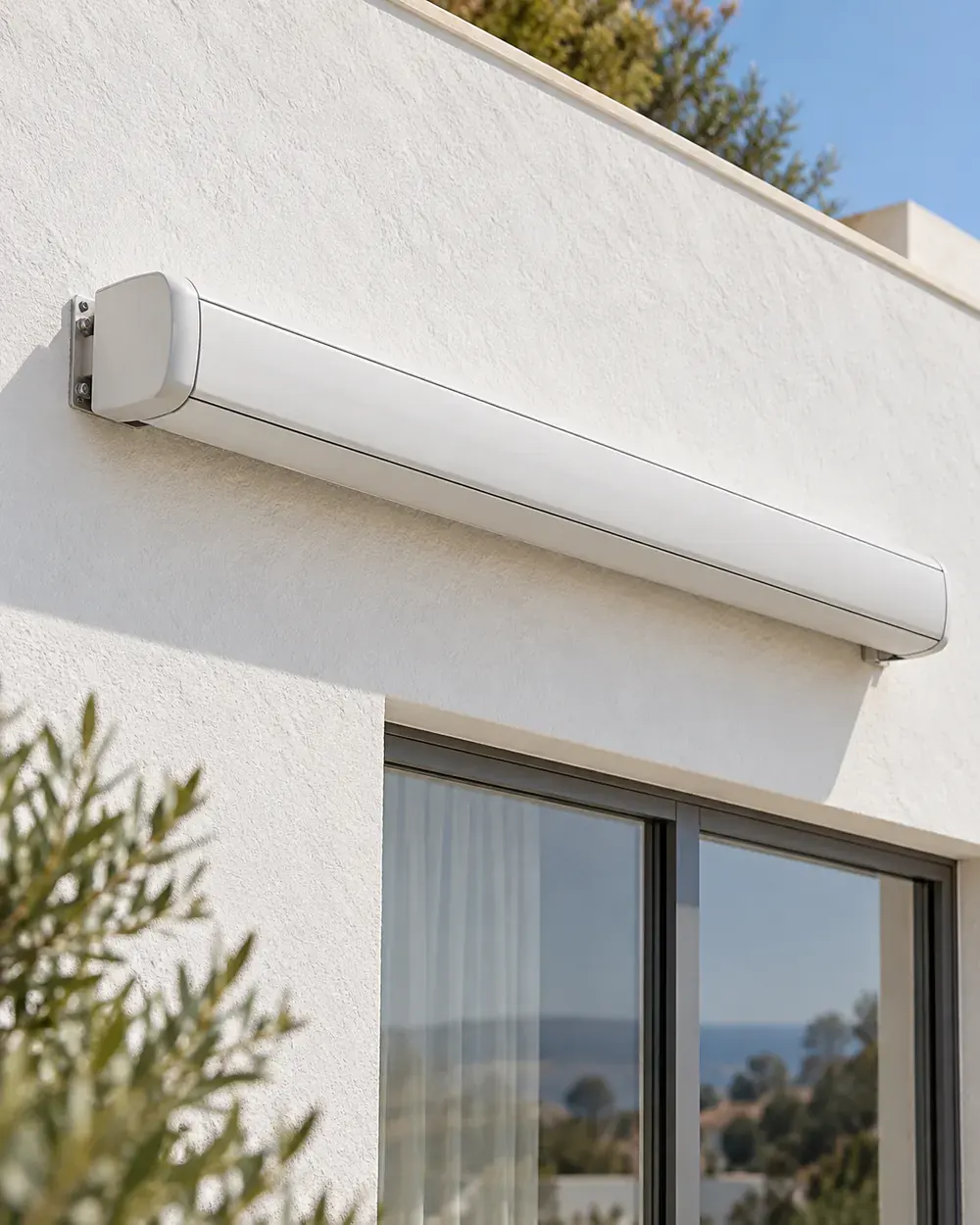
A cassette awning in Malaga is a folding arm awning with one key difference: the whole mechanism sits inside an aluminium case. When you extend it, the case opens and the arms push the fabric outwards. When you retract it, the fabric rolls up, the arms fold away and the case closes. All that’s left on the facade is a clean, compact profile.
That case is what makes a cassette awning last longer on the coast. An open awning spends many hours a year retracted but exposed to sun, rain, dirt falling from the floors above and salt air. Inside the cassette, the fabric holds its colour better, the arms suffer less, and birds and insects can’t nest in it.
It’s almost always installed as an electric cassette awning, with a Cherubini motor and remote control. Depending on the model, you can add a wind sensor so it retracts by itself when the levante (the easterly wind) blows in. That’s why it’s the awning we recommend most for penthouses, terraces with no overhang and homes near the sea.
Where does it make most sense?
- Penthouses with no overhang
- Beachfront homes
- Open terraces
- Community facades
- Villa porches
- Shops and restaurants


Full cassette, semi-cassette or cassette with a sensor
Three levels of protection and automation. We help you choose based on how exposed your terrace is and how you’ll use it.

Full cassette awning
When it retracts, the case closes top and bottom: the fabric and arms are completely stowed away. It’s the option for penthouses, open terraces and seafront homes.
Semi-cassette awning
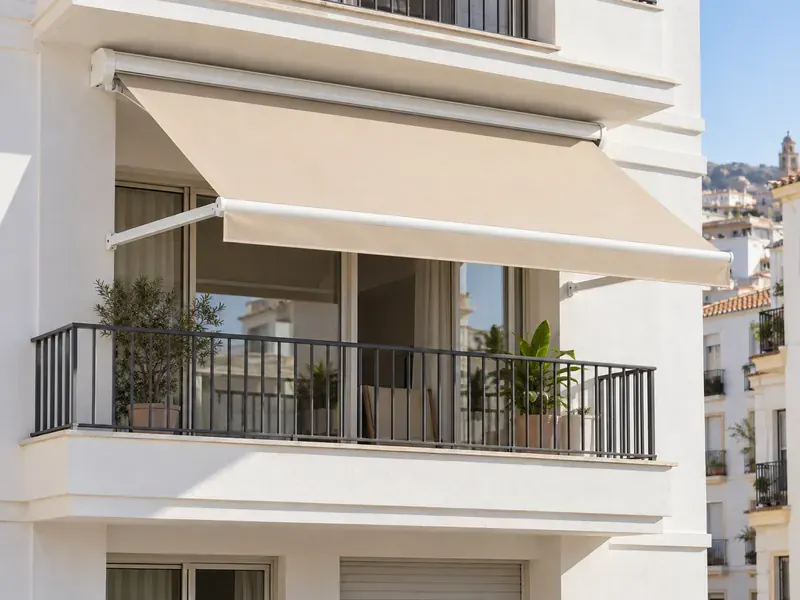
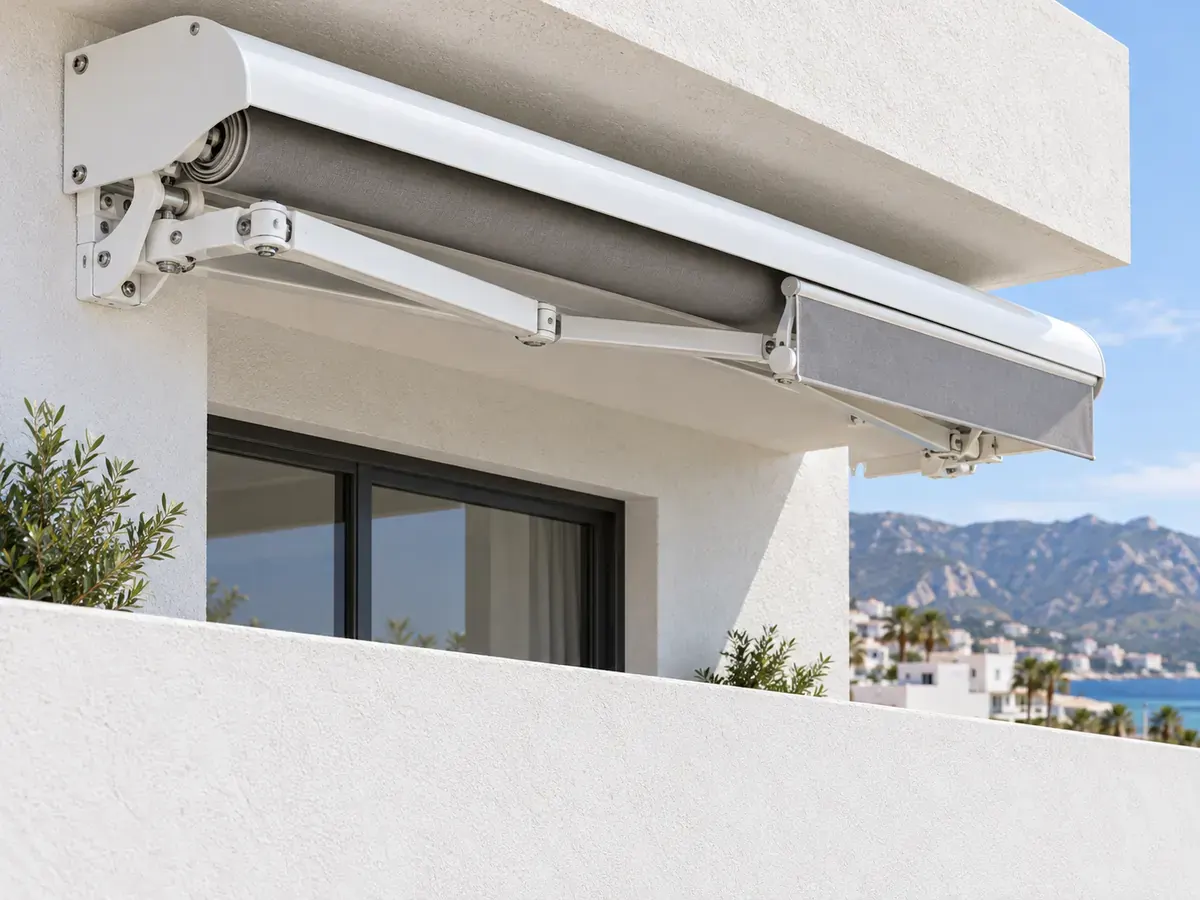
A top cover protects the rolled-up fabric from rain and dirt, but the arms stay visible. A good option when there’s already a balcony or overhang above.
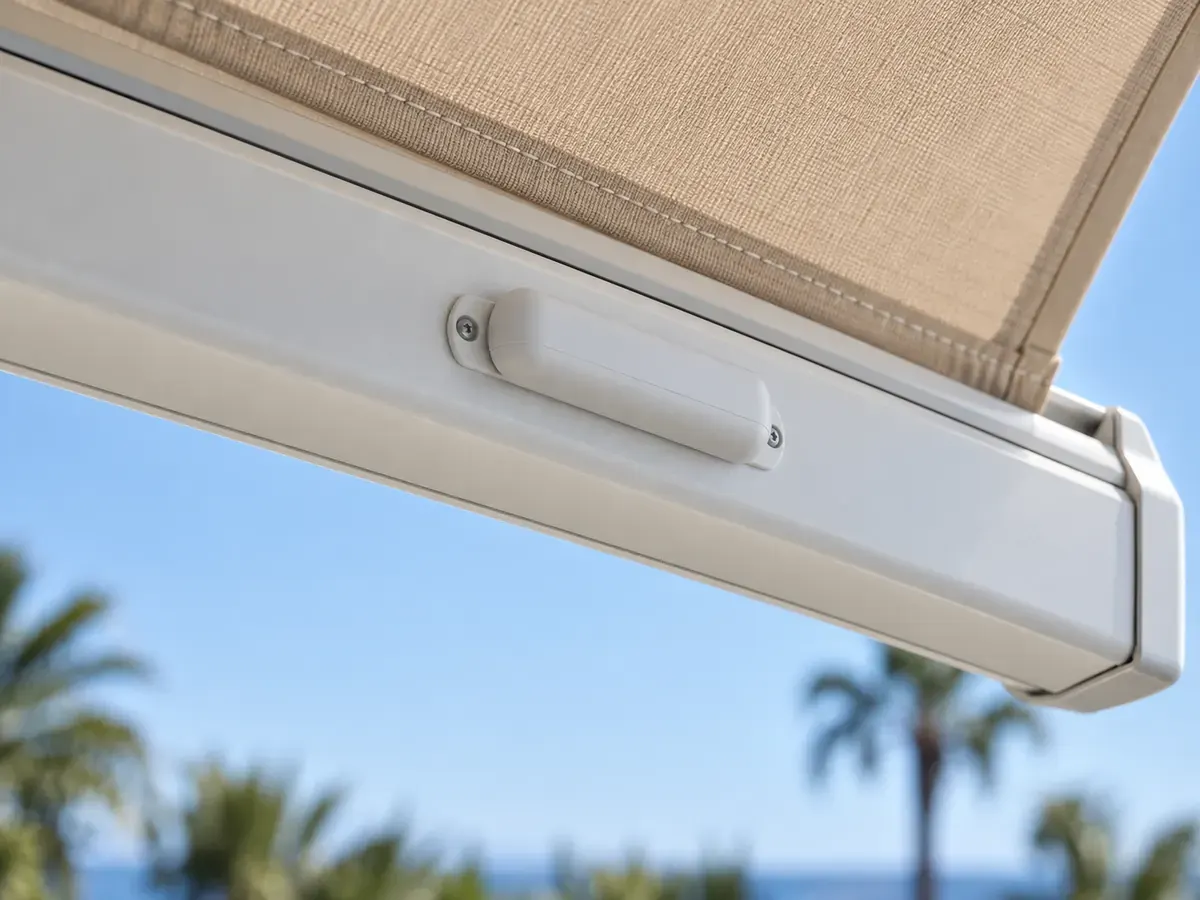
Cassette with a wind sensor
A Cherubini motor with a sensor that, depending on the model, retracts the awning by itself when it detects gusts, even when you’re out. Highly recommended where the levante and poniente blow. See motorisation.
If your terrace is under a balcony or eaves and you’re after a lighter option, take a look at the retractable awning without a cassette. For windows there’s also the drop arm awning with a cassette.
Design your cassette awning in 30 seconds
Choose the fabric, the case colour and the projection, then extend and retract it to see how neatly it closes on the facade. Add a Cherubini motor and ask for a quote with your design.
1. Type of awning
2. Sauleda or Dickson fabric Beige stripes
3. Frame colour White
5. Approximate size
Your design
A rough simulation with approximate colours: at the visit we show you the real fabric sample book and finalise sizes and finishes.
What’s included with your motorised cassette awning
We hand it over installed, adjusted and working. The same team that measures up is the one that fits it and looks after you afterwards.
- Free home visit, measuring and advice
- A look at the wall or ceiling for anchoring
- Made-to-measure powder-coated aluminium cassette
- Your choice of Sauleda or Dickson fabric
- Cherubini motor with remote
- Wind sensor, if you choose one
- Stainless fixings
- Installation by our own technical team
- Cassette closure adjustment and testing
- Guarantee and after-sales service
A well-adjusted cassette closes with no gaps. During installation we set the motor’s limits and the fabric tension so the case shuts completely. If it doesn’t close properly, water and dirt get in and it loses its whole point.
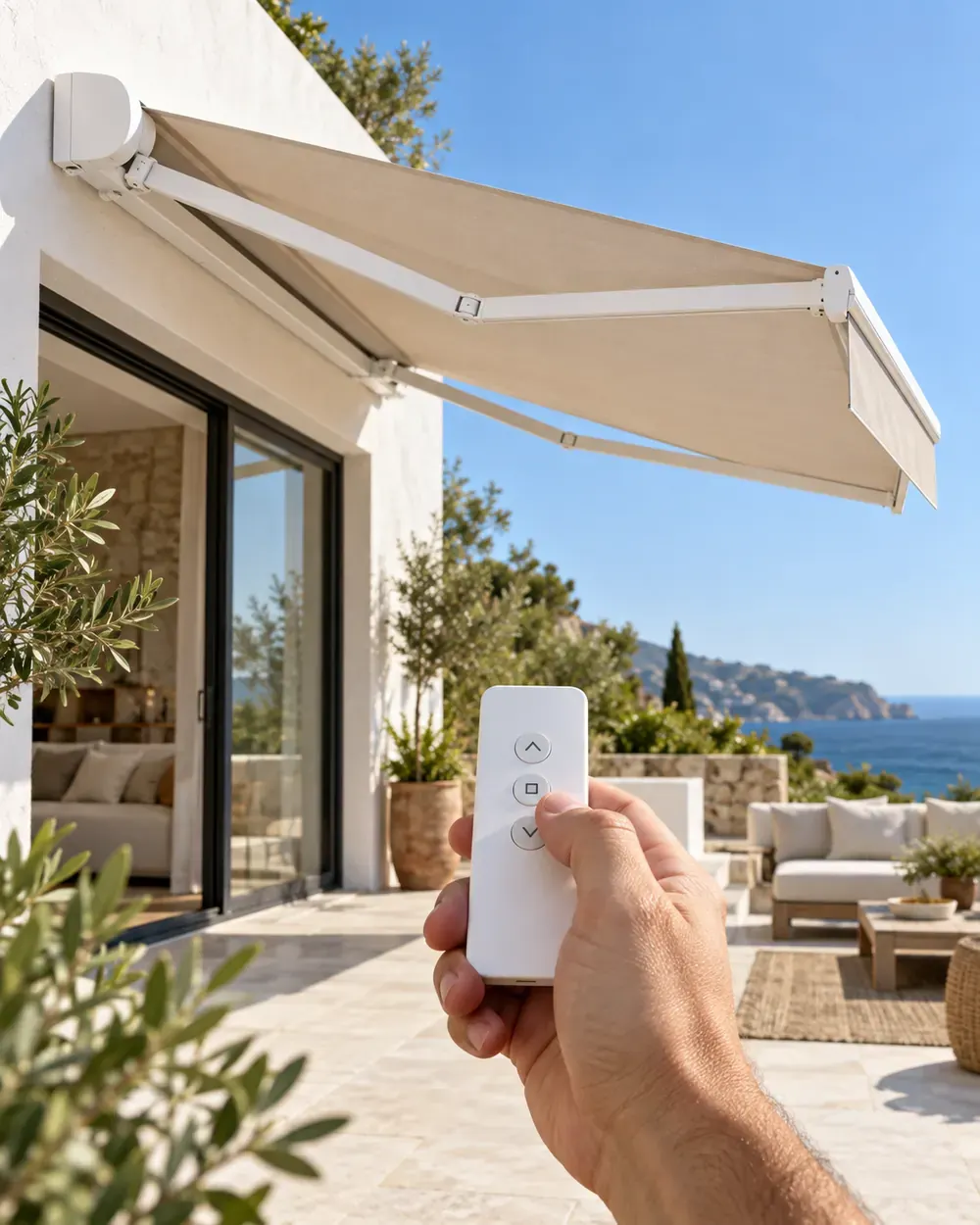
How we install your cassette awning
Six steps, one point of contact and a price that doesn’t change along the way.
- Home visit and measuringWe measure the width and projection, check the wall or ceiling and see where there’s power for the motor.
- Fabric and colourYou choose the fabric from the Sauleda and Dickson sample books and the colour of the cassette.
- Fixed-price quoteIn writing, with no obligation and a fixed price, often in under 24 hours.
- Made to measureWe order the cassette with your measurements, your fabric, your colour and the automation you’ve chosen.
- Installation by our own teamWe anchor it with stainless fixings, connect the motor and adjust how the case closes.
- Testing and handoverWe extend and retract it with you, programme the remote and sensor, and you have our guarantee and after-sales service.
Can you send us a photo of your terrace and where the awning would go? We’ll tell you whether a cassette suits it before we come to measure.
Send a photo on WhatsAppFull cassette or semi-cassette awning?
Both are folding arm awnings with protection. This is what changes day to day.
| Feature | Cassette awning | Semi-cassette |
|---|---|---|
| Retracted | Closed case: fabric and arms stowed away | Top cover: fabric protected from above, arms visible |
| Rain and dirt | Full protection | Protects from whatever falls from above |
| Salt air | The best protection for the seafront | Partial protection |
| Where it fits | Penthouses, open terraces, seafront | Flats with a balcony or overhang above |
| Looks | A clean, compact profile on the facade | Lighter, with the arms visible |
| Operation | Usually motorised | Manual or motorised |
| Investment | Higher | Between an open awning and a full cassette |
What about a retractable awning without a cassette? It works very well under an overhang or a balcony above. We explain it on our retractable awnings in Malaga page, and you’ll find every system in made-to-measure awnings.
Cassette awnings in Malaga: installed price and what affects it
We don’t give a "from" price for an installed cassette awning, because each one is made for a particular facade and size. This is what moves the quote:
A fixed-price quote, in writing, in under 24 hours
We’ll measure up for free, explain every option and give you a price that won’t change halfway through the job. No obligation.
Cassette awnings in Malaga, the Axarquia and the Costa Tropical
We install cassette awnings from Velez-Malaga right across the Axarquia, Malaga city, the Costa del Sol and the Costa Tropical. It’s the awning we recommend most for penthouses and seafront homes in Torre del Mar, Rincon de la Victoria, Nerja, Torremolinos and Fuengirola, where salt air and wind punish open awnings.
Malaga and Costa del Sol
Costa Tropical and Granada
Shall we fit you a cassette awning?
Tell us what you need in four quick steps and we’ll call you to arrange the visit. No obligation.
- Free home visit and measuring
- A fixed, written quote in under 24 hours
- Fitted by our own team, no subcontractors
- Guarantee and after-sales service close to you
Frequently asked questions about cassette awnings in Malaga
How much does a cassette awning cost installed in Malaga, and what affects the price?
A cassette awning is a retractable awning with an aluminium case around it, so its price is made up of two things: the awning itself and the cassette that protects it. The biggest factors are the width, which sets the length of the case, the tube and the fabric, and the projection, which determines the size and strength of the arms stored inside.
Then there’s motorisation and automation. Most cassettes are installed with a Cherubini motor and remote, and many customers add a wind sensor, depending on the model. The fabric you choose from the Sauleda and Dickson collections and the colour of the case also play a part, especially if your community requires a specific colour that has to be specially ordered.
Installation counts too: a cassette is heavier than an open retractable awning and has to be anchored properly. Fixing it to a concrete wall isn’t the same as fixing it to hollow brick, and fitting it on a ground floor isn’t the same as on a penthouse with no goods lift.
That’s why we don’t give fixed prices online. We’ll measure up for free and give you a written quote, with no obligation and a fixed price, often in under 24 hours. If you’d like to compare with other options, take a look at the retractable awning or book your visit using the form.
Full cassette or semi-cassette: which is worth it on a penthouse?
On a penthouse the answer is almost always a full cassette, and the reason is what’s above it: nothing. On a middle floor, the balcony above shelters the awning from rain and overhead sun; on a penthouse, the retracted awning takes the full force of the summer sun, the autumn downpours and, if you’re near the sea, the salt air carried on the wind.
A semi-cassette has a top cover that protects the rolled-up fabric from above, but leaves the underside and the arms exposed. It’s a good solution for flats with some cover above. A full cassette, on the other hand, closes the case underneath when the awning retracts: the fabric and arms stay inside, safe from dust, water and birds.
That protection shows over the years. The fabric holds its colour better, the arms suffer less corrosion and the facade looks neater, because all you see is a powder-coated aluminium case in the colour of your choice.
If you’re looking for a cassette awning in Malaga for a penthouse in Rincon de la Victoria or Torre del Mar, or for a seafront home in any town on the coast, a full cassette is the most sensible investment. If privacy or the afternoon sun is a concern, you can add a vertical awning at the side. We’ll look at it together at the free visit, or get in touch through our contact page.
How does the wind sensor on a cassette awning work?
The most common wind sensor on cassette awnings is a vibration or motion sensor. It sits on the front bar, the piece at the outer edge of the fabric, and detects when the awning starts moving more than it should because of the wind. When that happens, it sends a signal to the Cherubini motor and the awning retracts by itself into the cassette.
The clever part is that it works even when you’re not there. If you pop out to the shops with the awning extended and mid-afternoon the levante blows into Torre del Mar or the poniente (the westerly wind) picks up on the Costa del Sol, the awning retracts without you having to do a thing. It’s the most effective way to avoid bent arms, torn fabric or brackets ripped out of the wall. The sensitivity is set during installation, depending on the model, so it doesn’t trigger in a gentle breeze.
Other automation can be added depending on the model, such as a sun sensor that extends the awning when the heat builds up, or a multi-channel remote to control several awnings around the house.
The sensor is a help, not a substitute for common sense: if a storm is forecast, retract the awning. You’ll find all the information in awning motorisation and a practical explanation in how to choose an awning motor.
Can a cassette awning be manual or does it have to be electric?
Manual cassette awnings do exist, opened and closed with a crank handle, but they aren’t the usual choice. When it retracts, the cassette has to close completely, and on medium and large widths that takes considerable effort with a crank. That’s why most of the cassettes we install are motorised, and the manual version is kept for small awnings, depending on the model.
A motorised cassette awning has some clear advantages. You operate it with a remote or a wall switch, the case always closes perfectly because the motor’s limits are programmed, and you can add a wind sensor that retracts it automatically. On the coast, that last point is almost a necessity.
To motorise it we need a power point near the awning. If your terrace doesn’t have one, we’ll tell you at the visit so your electrician can plan for it, or explain in the quote how to sort it out. We work with Cherubini motors, a manufacturer specialising in automation for awnings and shutters.
If you already have a manual awning and want to switch to a motor, in many cases it can be adapted without replacing the whole awning. We explain how in awning motorisation. And if you can’t decide between a cassette and an open awning, compare the two systems on the retractable awning page.
Where is a cassette awning fixed: to the wall or the ceiling?
Both are possible, and the choice depends on your facade. The most common installation is on the wall, with brackets fixed above the terrace door or window. When there isn’t enough height on the wall, for example under a slab or an overhang, it can be fixed to the ceiling with special brackets, depending on the model.
What really matters is the material. A cassette awning weighs more than an open retractable awning and, with the fabric extended, its arms put a lot of force on the brackets. Concrete, solid brick, block and hollow brick all need different anchoring. At the visit we check the type of wall and choose the right plugs and stainless fixings for each case.
The usable height matters too. For the awning to give good shade and let the water run off, it needs a minimum pitch, and that requires some distance between the fixing and the railing or the heads of the people sitting underneath. If space is tight, we suggest the solution that best balances shade, headroom and looks.
If the facade can’t take fixings reliably, there are alternatives, such as resting the awning on support legs or opting for a wall-mounted pergola. We’ll assess it at no cost.
What happens if I retract my cassette awning while the fabric is wet?
Once is fine; making a habit of it causes problems. Inside the cassette the fabric is rolled up with no ventilation, so if you put it away damp and don’t take it out again for several days, the moisture has nowhere to go. The result is mould spots, a damp smell and, over time, a weaker fabric.
The rule is simple: if you’ve had to retract the awning in the rain, or with the dew of a damp spring night on the coast, extend it again as soon as the sun comes out and let it dry completely before closing it. With a motor and a remote it takes seconds, so it costs nothing and greatly extends the life of the fabric.
On the coast there’s another factor: salt air. The salt that settles on the fabric absorbs moisture from the air, so a salty fabric takes longer to dry. Rinsing it now and then with fresh water and mild soap helps a lot. You’ll find the steps in how to clean and maintain an awning.
If your fabric already has stubborn stains or has lost its colour, there’s no need to replace the whole awning. We carry out awning repairs and fabric replacement with Sauleda and Dickson fabrics, including on awnings installed by another company.
Can you replace just the fabric on a cassette awning?
Yes, and it’s the most common job once a cassette awning is a few years old. The case, arms and motor usually last much longer than the fabric, which takes the sun and rain every time the awning is extended. When the fabric is faded, torn or stained beyond cleaning, we replace the fabric and the awning looks as good as new.
On a cassette the job takes a bit more work than on an open retractable awning, because we have to reach the roller tube inside the case and then adjust the fabric so the cassette closes perfectly again. If the new fabric is slack or off-centre, the cassette won’t close properly and water and dirt get in. That’s why it’s always done by our own technical team.
We use the visit to check everything else: the arm tension, the condition of the joints, the brackets and, if it has one, the motor. If the awning is manual, it’s a good moment to think about motorising it. And if another company installed it, that’s no problem: our after-sales service also looks after installations by other installers.
You’ll choose the new fabric from the Sauleda and Dickson sample books, in the same colour if your community requires it. You’ll find all the information in awning repairs and fabric replacement, or book a visit through our contact page.
Can I install a cassette awning if my community requires a specific colour?
Yes. It’s very common for a community of owners to have approved a fabric colour, a frame colour or even a specific awning model so the facade looks uniform. A cassette awning suits these cases very well because, when retracted, it looks like a neat aluminium case, and the colour of that case can be chosen.
Before ordering, check what the community rules or the owners’ meeting resolutions say, or ask the administrator. If there’s an approved fabric colour, we’ll find a match in the Sauleda and Dickson collections. If it’s a frame colour, we order the corresponding powder-coat finish, depending on the model. There’s more detail in our article on awnings in communities of owners.
If several neighbours are interested, or the community wants matching awnings across the whole building, we can organise it as a joint project: we measure each home, set the same model and colour for everyone, and each owner gets their own quote. We explain how on our awnings for communities of owners page.
And if your case needs any paperwork with the town hall, we’ll tell you at the visit and help you with the documentation. That way you can install your cassette awning without any problems with the neighbours or the regulations, and with the peace of mind that everything is in writing.