Home › Awnings › Windbreak awning with side guides
Windbreak awnings · Malaga, Axarquia and Costa TropicalWindbreak awnings in Malaga with side guides, made to measure
A vertical fabric screen that runs down side guides and keeps out the levante, the poniente and the evening chill without taking away your light. We make and fit windbreak awnings in Malaga to measure with our own team, across the Axarquia and the Costa Tropical too, for bars, porches and home terraces.
- Our own team, no subcontractors
- Home visit and measuring free
- Fixed-price quote in under 24 hours
- Powder-coated aluminium and stainless fixings
- Guarantee and after-sales service
In short
A windbreak awning in Malaga is a vertical fabric screen that runs down side channels, with clear windows if you like, and stops the easterly and westerly winds without taking away the light. QUBRE fits them to measure on bars, porches and terraces in Malaga, the Axarquia and the Costa Tropical, with our own team and free measuring.
Updated · QUBRE technical team, Velez-Malaga
What is a windbreak awning with side guides and when do you need one?
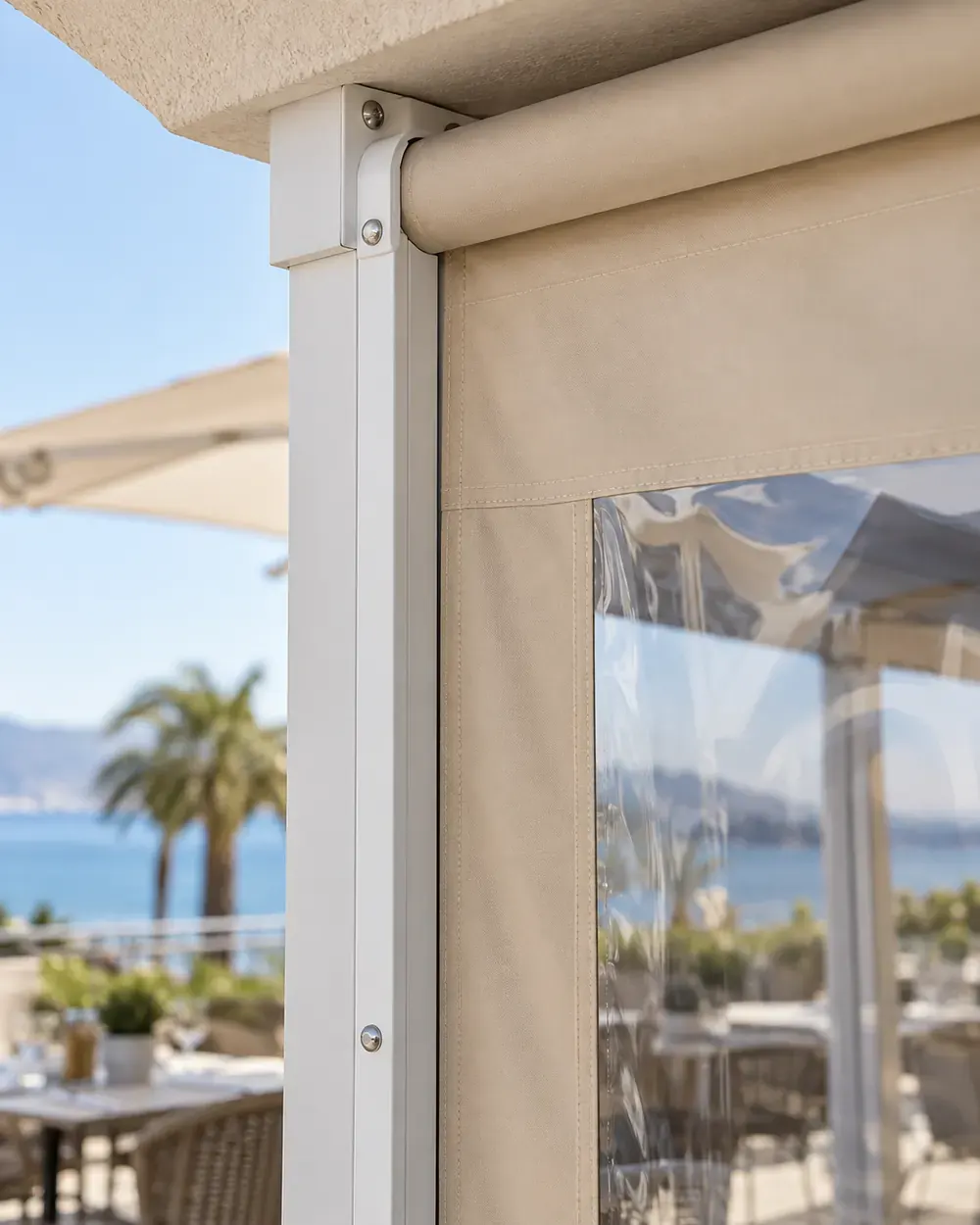
A windbreak awning with side guides is a vertical fabric screen that rolls up onto a top tube and comes down guided by two aluminium side guides. The guides hold the edges, so the fabric doesn’t flap or blow loose when the wind gets up. Lowered, it closes off the front of a terrace or works as a side awning; raised, it rolls away at the top and leaves the way clear. Choosing the right windbreak awning in Malaga starts with understanding where the wind gets in.
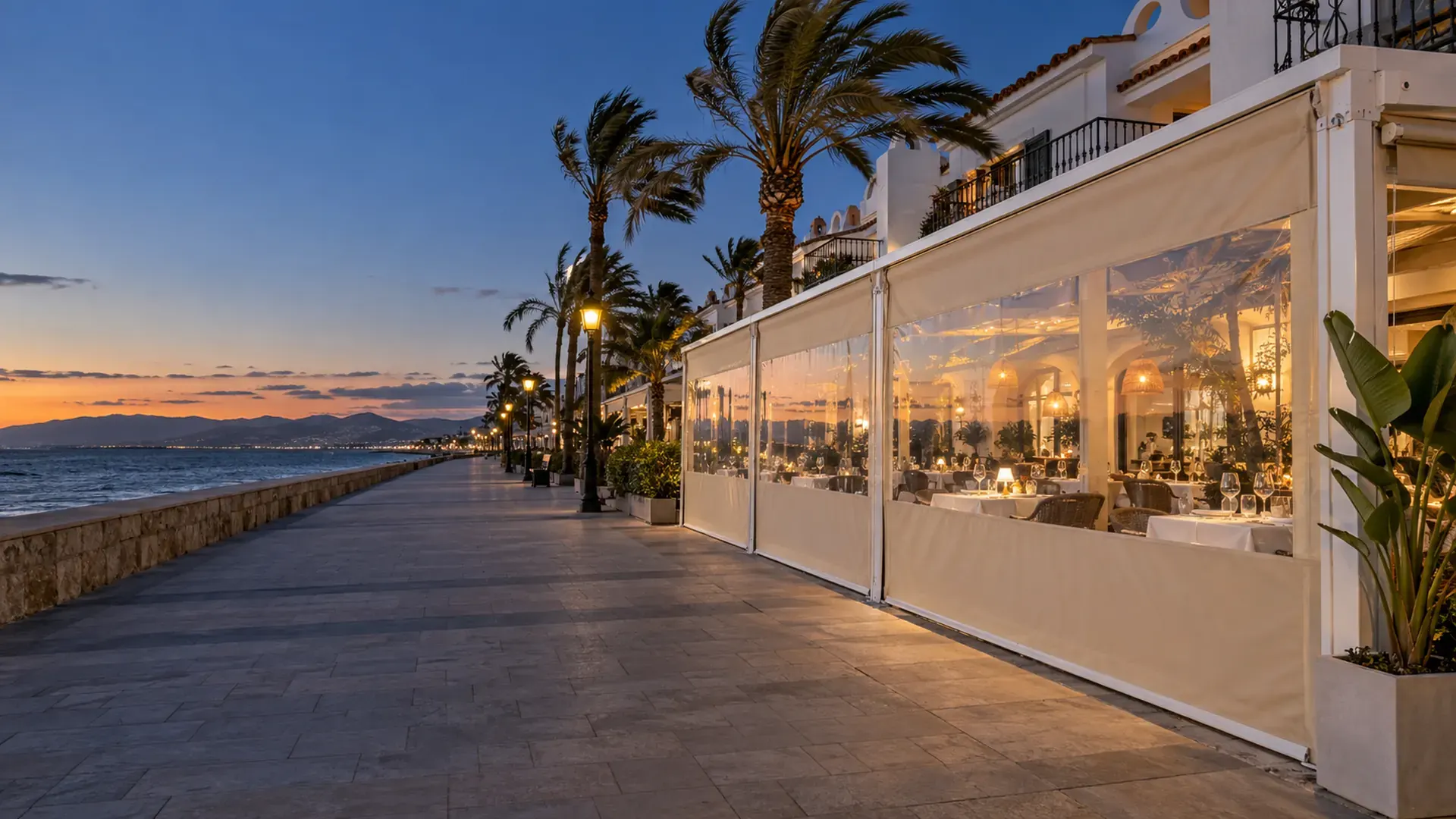
On the coast the problem is rarely just the sun. The levante (the easterly wind) sweeps in along the promenade, the poniente (the westerly) blows across terraces facing the beach and, as soon as evening falls, the damp and the chill empty the outdoor tables. A windbreak lets you keep using the terrace at those times, and with clear windows you lose neither the view nor the light.
At QUBRE we design it to fit the opening: we measure the real height, work out where to fix the guides (wall, posts, pergola or an existing structure) and choose the fabric that suits how you’ll use it. If what you’re after is a taut fabric that filters the sun, we’ll also explain the zip screen, which is a different system.
Where do we fit them?
- Bar or restaurant terraces
- Home porches
- Windswept penthouses
- Seafront promenades
- Outdoor dining areas
- The side of a pergola
Windbreak awnings in Malaga: three ways to use them on your terrace
The same system solves different problems depending on where you put it. These are the situations we see most often on the coast.
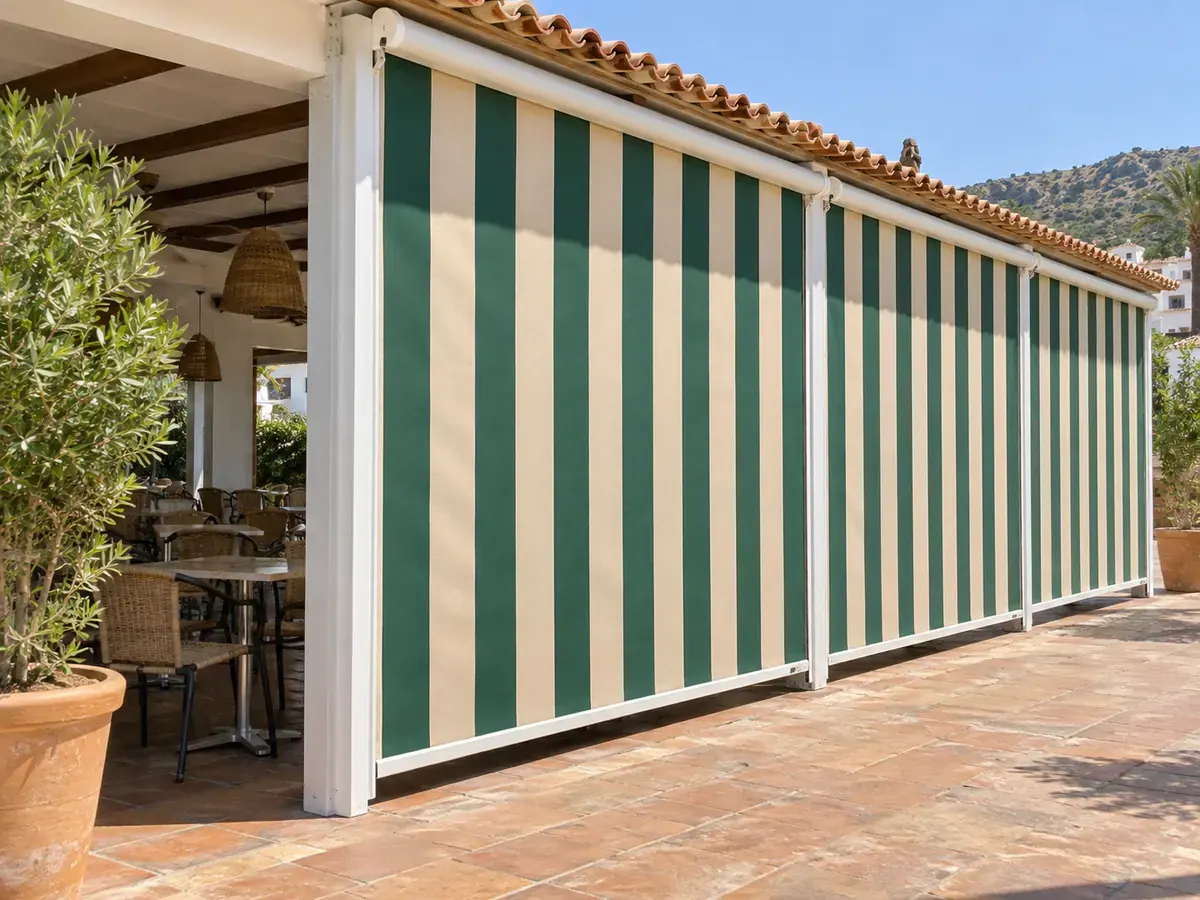
Windbreak screens for bar terraces
Close off the front and sides of the terrace so customers stay put even when it’s windy or turning chilly. With the fabric in your business colours and, if you like, combined with an overhead awning. More ideas on our awnings for bars and restaurants page.
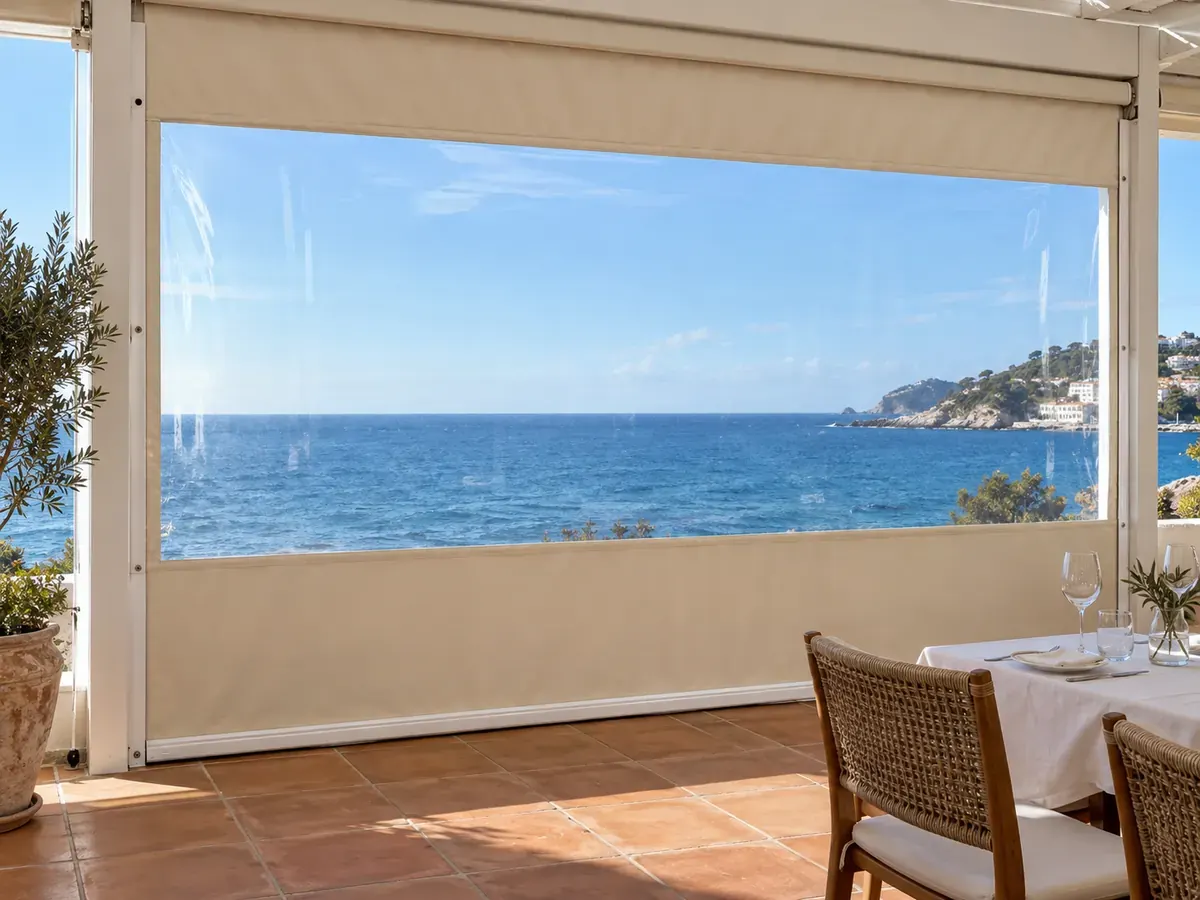
Clear PVC windbreak awning
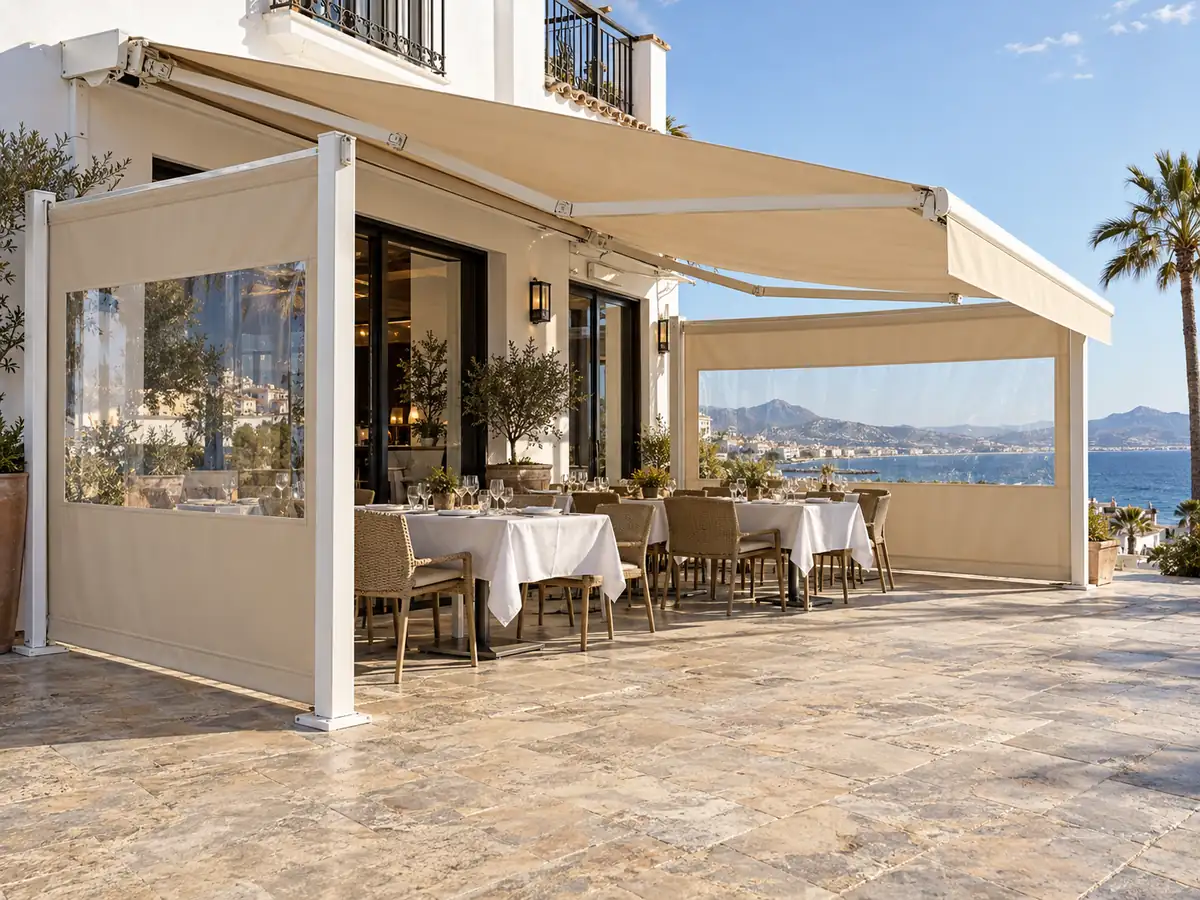
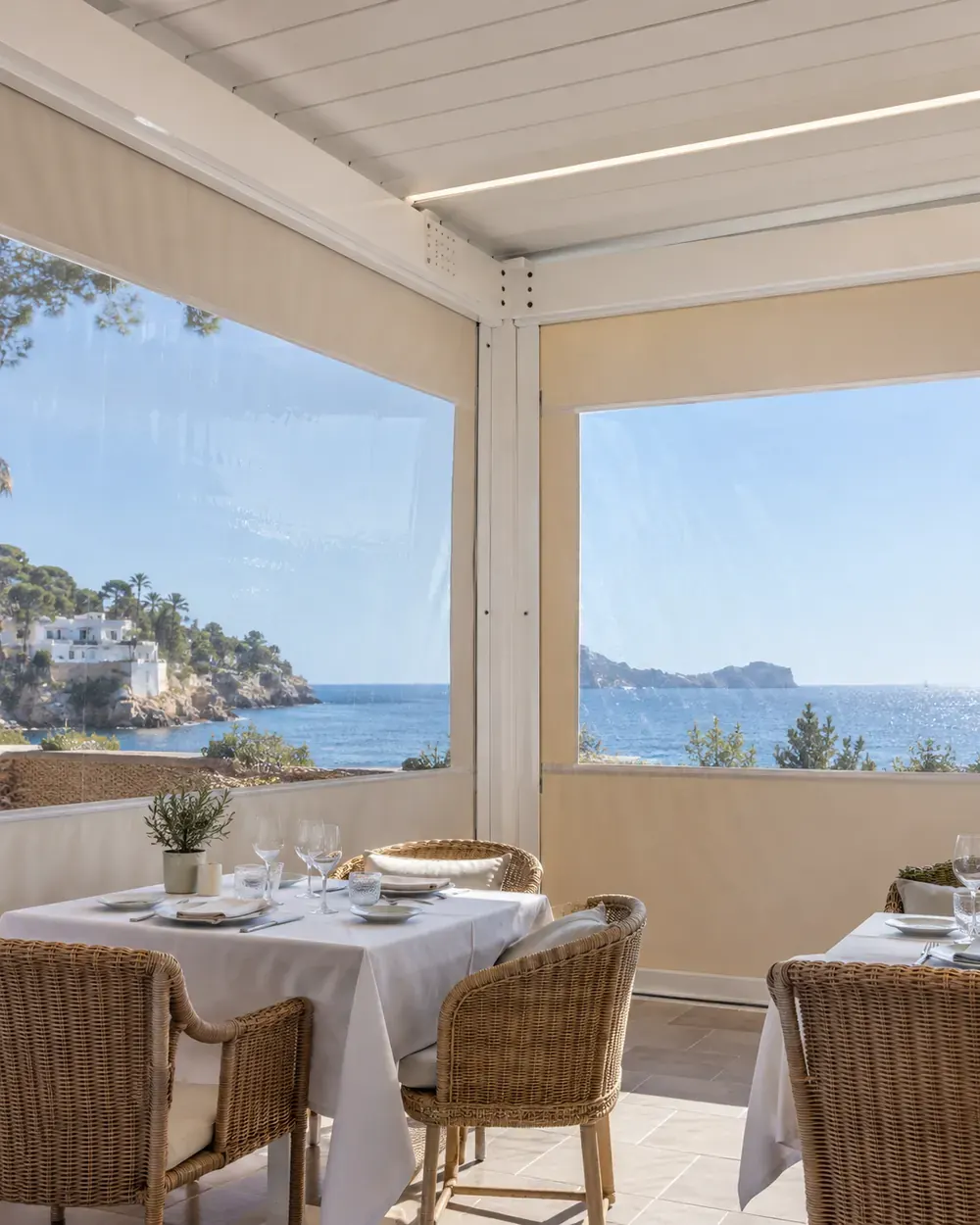
Fabric panels with clear PVC windows, larger or smaller depending on the model. You keep the wind out and can still see the sea, the street or the garden. Very popular with restaurants and on porches facing the view.
Windbreak with an awning or pergola
Under a retractable awning or a pergola, windbreaks close off the sides and turn the terrace into a sheltered space you can open up completely in summer.
It’s operated by crank handle or motor, depending on the size and model. If you’ll be raising and lowering it every day, as in a bar, we recommend motorisation with a Cherubini motor. And if what you want is a fixed glass enclosure, compare it with our terrace enclosures.
What’s included when we install your windbreak awning
We hand it over working and properly adjusted. The same technicians who measure up do the fitting, with no subcontractors.
- Free home visit, measuring and advice
- A look at where the wind gets in
- Made-to-measure Sauleda or Dickson fabric
- Clear windows if you want them
- Powder-coated aluminium side guides
- Crank handle or Cherubini motor with remote
- Stainless anchors and fixings
- Installation by our own technical team
- Tension adjustment and test run
- Guarantee and after-sales service
Built for the seafront. On the frontline, salt air attacks the fixings and profiles first. That’s why we fit powder-coated aluminium guides and stainless fixings, and show you how to clean the clear windows so they stay clear for as long as possible.
How we install your windbreak with side guides
Six steps, one point of contact and a fixed price from the start.
- Home visit and measuringFree of charge. We measure the opening and the clear height, and look at where the wind comes from on your terrace.
- Proposal and quoteWe suggest the fabric, windows and operation, and give you a written quote with a fixed price and no obligation, often in under 24 hours.
- PermitsIf your terrace is on public land or in a community of owners, we tell you which procedure is needed and prepare the paperwork.
- Made to measureWe order the fabric with its windows, the tube and the guides to the exact size and in your chosen colour.
- Fitted by our own teamWe fix the tube and guides, fit the fabric and tension it so it goes up and down straight.
- Testing and handoverWe raise and lower it with you, adjust anything that needs it and explain how to use and look after it.
Send us a photo of your terrace and tell us where the wind gets in? We’ll tell you which solution fits before we come to measure.
Send a photo on WhatsAppWindbreak awning or zip screen?
Both are vertical screens with side guides, but they don’t behave the same way. This is the difference we’re asked about most.
| Feature | Windbreak awning with side guides | Zip screen |
|---|---|---|
| Main purpose | Keeping out wind and chill on open terraces | Filtering the sun and giving privacy on large windows, porches and pergolas |
| How the fabric is held | The fabric runs down the side guides and is tensioned at the bottom | A zip welded to the fabric runs inside the guide along its full height |
| Usual fabric | Awning fabric, with or without clear PVC windows | Micro-perforated screen fabric |
| Visibility | Full visibility through the clear windows | You see out through the weave; by day, little can be seen from outside |
| Wind | Designed to block the wind on exposed terraces | Very stable thanks to the zip; wind resistance depends on the model and size |
| Operation | Crank handle or motor, depending on the model | Usually motorised |
| Typical use | Bars, restaurants and porches with views | Homes, penthouses and the sides of pergolas |
Many terraces combine the two: a windbreak at the front, where the wind hits, and a zip screen on the side that gets the afternoon sun. If the light is what bothers you most, take a look at our roller and vertical awnings too.
Windbreak awning prices in Malaga: what affects them
We don’t give generic prices: two terraces of the same width can need very different solutions. This is what drives the quote:
A fixed, written quote in under 24 hours
We come and measure for free, explain each option and give you a price that won’t change halfway through the job. No obligation.
Windbreak awnings in the Axarquia, Malaga and the Costa Tropical
We set out from Velez-Malaga to measure up free of charge. On the promenades of Torre del Mar, Fuengirola and Marbella, the levante and the poniente call the shots; in Nerja and Almuñécar we’re careful not to block the view; in Granada city, the aim is to stretch the terrace season when the weather turns cooler.
Malaga and Costa del Sol
Costa Tropical and Granada
Want to use your terrace even when the wind blows?
Tell us what you need in four quick steps and we’ll call you to arrange the visit. No obligation.
- Free home visit and measuring
- A fixed, written quote in under 24 hours
- Fitted by our own team, no subcontractors
- Guarantee and after-sales service close to you
Frequently asked questions about windbreak awnings in Malaga
How much does a windbreak awning with side guides cost, and what does it depend on?
The price of a windbreak awning with side guides varies a lot from one terrace to the next, which is why we don’t give ballpark figures: a generic price per metre would have you comparing things that aren’t the same. We’d rather come out, measure up free of charge and give you the real price of the windbreak awning you need in Malaga, whether it’s for your home or your business.
What weighs most in the quote is the surface area of each panel (width by height), the number of panels to be closed off, whether they have clear windows and how big they are, and the operation: crank handle or Cherubini motor with remote. Where the guides are fixed also counts, because anchoring to a concrete wall isn’t the same as fixing to metal posts or to the profiles of a pergola.
The fabric matters too. We work with Sauleda and Dickson, and at the visit we show you the sample book so you can choose the colour and finish to suit the use: a family porch doesn’t need the same as a bar terrace where the screens go up and down every day.
With all that, we give you a written quote with a fixed price and no obligation, often in under 24 hours. You can request it using the form or on our contact page, and if you run a business, take a look at our awnings for bars and restaurants.
What’s the difference between a windbreak awning and a zip screen?
Both come down vertically along side guides, which is why they’re often confused. The difference lies in how the fabric is held and what each one is designed for, and it’s worth being clear about it before asking for a quote.
On a windbreak awning with side guides the fabric runs down the guides and is tensioned at the bottom; its main job is to keep out the wind and chill on open terraces. It usually has awning fabric, or fabric with clear PVC windows, so you block the wind and can still see what’s outside. It’s the classic screen for seafront bars and restaurants.
On a zip screen the fabric has a welded zip along both edges that runs inside the guide for its full height. The fabric stays taut and held from top to bottom, with no gaps at the sides. It’s usually a micro-perforated screen fabric that filters the sun and gives privacy without taking away the view, and it’s almost always motorised.
If your problem is the wind and you want to see through it, a windbreak is usually the answer. If the afternoon sun bothers you more and you want a neat, very taut screen, go for the zip. On many terraces we combine the two, and at the visit we’ll tell you which goes on each side. If you’re still unsure, take a look at our roller and vertical awnings too.
Can a windbreak awning stand up to the levante and poniente winds on the coast?
A windbreak is designed precisely to block the wind, and the side guides are what stop the fabric blowing loose or banging about. But no awning is indestructible, and it’s worth knowing how it works so you use it properly and it lasts for many years.
Its real wind resistance depends on the model, the size of the panel and how it’s anchored. A very wide panel takes more pressure than two narrower ones, which is why on large terraces we usually split the screen into several modules. We also choose the anchors to suit what we’re fixing to, whether that’s a wall, a post or a pergola profile, always with stainless fixings.
On days of strong levante in Torre del Mar, Fuengirola or on the Malaga promenade, the sensible thing is to follow the manufacturer’s instructions for use. If the windbreak is lowered under an extended awning, remember that the overhead awning does need to be retracted in strong gusts. That’s where motorisation with a wind sensor comes in handy, as it retracts the awning on its own, depending on the model.
At the visit we look at where the wind gets into your terrace, how many hours a day it usually blows and what structure you have, and we suggest the number of panels and the safest anchoring. If you already have a windbreak that’s been damaged by the wind, we can also check it over through our awning repairs and fabric replacement service.
Can I put a windbreak on my bar terrace? Do I need permission?
Yes, windbreaks for bar terraces are one of the jobs we do most. They let customers stay outside when it’s windy or as evening falls, and extend the terrace season into the cooler months. The first thing to check is where the terrace is.
If the terrace is on public land, the town hall will normally have a terrace bylaw that regulates what can be put up, how high it can be, whether it must be retractable and even the colours. Every town has its own, and it isn’t the same in Velez-Malaga, Malaga city or Marbella. If the terrace is private but within a community of owners, you may need the agreement of the other owners.
At QUBRE we handle the paperwork and permits when they’re needed: we tell you which procedure applies and prepare what’s required so the installation complies from day one. There’s more information in our guide to permits for installing an awning or a pergola.
For a business we usually recommend motorised panels or ones with a sturdy crank handle, because they go up and down every day, and fabric in your business colours with clear windows so the inside can be seen from the street. See more examples on our awnings for bars and restaurants page.
What is a clear PVC windbreak awning like, and how do you look after the windows?
A clear windbreak awning combines fabric with panels of clear PVC joined to it, depending on the model. That way you block the wind without turning the terrace into a closed box: the light comes in and you can still see the sea, the street or the garden.
You can choose anything from a clear strip at the eye level of someone sitting down to larger windows. In restaurants with views we usually put the window at table height; on home porches, where some privacy matters too, a narrower strip is sometimes enough. We decide it with you at the visit.
Clear PVC needs a little care to stay clear. Clean it with water, mild soap and a soft cloth, never with scourers, solvents or products containing alcohol, which scratch it or cloud it. With the salt air on the seafront, it’s a good idea to rinse it with fresh water now and then, and avoid rolling it up wet or sandy, because the marks stay. There are more tips in how to clean and look after an awning.
Over the years and with the sun, any clear panel loses some of its clarity. When that time comes, if the tube and guides are in good shape, there’s no need to replace the whole system: we can just renew the fabric. We do this through our fabric replacement service, including on windbreaks installed by another company.
Can a windbreak be fitted under an awning or pergola I already have?
Yes, and it’s one of the most useful combinations. The awning or pergola protects you from above and the windbreak closes off the front or sides, which is where the wind really gets in. The result is a terrace you can use on many more days of the year.
Before suggesting it, we check the structure you already have. The guides need a good anchoring point at the top and bottom: that could be the wall, a post, a pergola beam or the floor. If your pergola is aluminium, we’ll normally fix it to its profiles; if it’s wooden, we check the condition of the wood and the type of fixing. With a retractable awning the approach changes, because the awning moves and retracts, so we look for independent supports.
It doesn’t matter if the pergola or awning was installed by another company: we look at it just the same and, if we find something worth correcting first, we’ll tell you. We also provide after-sales service for installations by other installers.
If you’re thinking about a new structure, a bioclimatic pergola with windbreaks or zip screens on the sides gives you an outdoor room you can use almost all year round. And if you’d rather have a fixed solution, compare it with our aluminium and glass enclosures, designed for anyone who wants to gain an extra room.
Crank handle or motor: which operation is best for a windbreak?
It depends on how often you’ll use it and the size of each panel. Both options work well and are reliable; the difference lies in day-to-day convenience and how many panels you have to operate each time.
A crank handle is simple and doesn’t need electricity. It suits home porches where the windbreak goes down in autumn and up in spring, or small panels that take little effort to operate. The drawback is that if you have several panels, you have to do them one by one, and on tall panels you’ll notice the effort.
A motor makes sense when the screen goes up and down every day, as in a bar that opens and closes its terrace, or when the panels are large or in awkward places. We fit Cherubini motors with a remote control or wall switch, and you can operate several panels at once or each one separately, depending on the set-up. You’ll need a power point nearby; at the visit we’ll tell you what’s needed.
If you start with a crank handle and want a motor later on, it can often be motorised afterwards, depending on the model. We explain it in detail on our awning motorisation page and in the article on how to choose an awning motor.
Does a windbreak help with rain and the winter chill?
With the chill, yes: it’s one of the main reasons people fit one. By closing off the front and sides, the cold night air and the damp from the sea stop blowing across the terrace, and the space stays much more pleasant. In the Axarquia and on the Costa del Sol it lets you make the most of your terrace for a good part of the winter.
With rain, it’s not quite so simple. A windbreak stops rain that blows in sideways on the wind, but it isn’t a roof. For the terrace to be properly sheltered you need a cover: an awning, a pergola with a canopy or, if you want it to stand up to heavy downpours, a bioclimatic pergola with the louvres closed.
It’s also worth knowing that wet fabric shouldn’t be left rolled up for long. If you raise it while it’s damp, lower it again as soon as the sun comes out so it can dry; that way you avoid stains, smells and mould. With the salt air on the seafront, an occasional rinse with fresh water extends its life.
If what you’re after is an enclosed space to use as an extra room, compare the windbreak with a glass terrace enclosure. At the free visit we explain the advantages of each option for your home or business and give you a fixed-price quote for whichever one you choose.