Do you need permission for an awning in Spain, or for a pergola on your terrace in Malaga or Granada? It’s one of the questions we’re asked most before people take the plunge, and the honest answer is: it depends, and quite often, yes. A retractable awning on a balcony isn’t the same as a fixed pergola anchored to the floor of a penthouse terrace, and living in a villa isn’t the same as living in a building with a community of owners.
In this guide we explain which factors decide whether your installation needs any paperwork, the difference between a “declaración responsable” (a sworn statement to the town hall) and a minor works licence, which documents are usually requested and how we handle it all at QUBRE so you don’t have to wrestle with the paperwork. The aim is for you to install with peace of mind and no nasty surprises afterwards.
Quick answer: do you need permission for an awning or a pergola?
If you’re after a short answer, this is the general guidance we give at every home visit:
- Domestic retractable awning (folding-arm, cassette, drop arm, roller): usually the simplest case, but it may need the community’s permission if it goes on the facade and, depending on the town hall, some kind of municipal procedure.
- Fixed pergola (aluminium, bioclimatic, wooden, wall-mounted): as it’s a permanent structure, the town hall is more likely to ask for planning permission.
- Terrace enclosures: they change the exterior appearance and, in many cases, the usable floor area, so it’s almost always worth checking first.
- Business awnings over the public highway: as well as the procedure for the installation itself, a permit to occupy the street usually comes into play.
The only way to know whether you need permission is to look at your particular case: the type of installation, exactly where it’s going and your town’s regulations. That’s why we always check before we install.
Why there’s no single answer on permission for an awning in Spain
Any company that tells you “you don’t need anything” without having seen your terrace is, at best, over-generalising. The rules aren’t set by the installer: they’re set by the town hall, through its planning regulations and bylaws, and by the community of owners, through the law and its own statutes.
This means the same awning may be treated differently in two neighbouring towns, or even on two streets in the same town if one of them is inside a protected historic centre. It also means that an awning that doesn’t need town hall permission may still need the neighbours’ approval.
That’s why we talk about two independent permissions: the administrative one (the town hall) and the civil one (the community of owners). Having one doesn’t replace the other.
The factors that decide whether you need permission
1. The type of installation: retractable awning or fixed pergola
A domestic retractable awning folds back against the facade, has no foundations and doesn’t create an enclosed space. So, generally speaking, it’s considered a light installation. A pergola, on the other hand, is a structure that stays up all year round, with posts, beams and fixings into the floor or the wall.
The more an installation resembles a “building” (a fixed structure, a roof, side enclosures, a large surface area), the more likely the town hall is to require some form of permission.
2. Where it’s installed: facade, terrace, penthouse or garden
An awning on a balcony overlooking the street is a very different matter from a pergola in the back garden of a villa that can’t be seen from the road. Visibility from outside and the impact on the facade carry a lot of weight in the decision, for both the town hall and the community.
Penthouses are a special case: the terrace is usually for private use, but the roof and facade of the building are common elements, so a pergola or an enclosure up there almost always means talking to the community.
3. Whether you live in a community of owners
A building’s facade is a common element even if your balcony is for your use only. The Spanish Horizontal Property Act (Ley de Propiedad Horizontal) allows each owner to alter their home as long as they don’t affect the building’s safety, structure, layout or exterior appearance, or harm another owner, and it requires them to notify whoever represents the community beforehand.
In practice, that means sticking to the awning model and colour the building already has, or asking for approval at the owners’ meeting. We explain it in detail in our guide on awnings in a community of owners and the Spanish Horizontal Property Act.
4. Your town hall’s regulations
Every municipality in Malaga and on the Costa Tropical in Granada applies its own town planning rules and bylaws. Some specifically regulate awnings and other items on facades; others deal with them under minor works in general. That’s why permission for the same awning can differ between Velez-Malaga, Malaga city, Marbella or Motril.
5. Protected areas and historic centres
If your home is in a historic centre, a listed building or a protected area, the conditions will usually be stricter: colours, materials, sizes or even whether you can install anything at all. In these cases it’s always worth asking the town hall which permission you need before choosing a model.
Awning permission: what’s usually checked for each type
These are the most common situations we come across in homes and businesses, always to be confirmed with each town hall:
- Retractable or cassette awning on a terrace: the main things checked are the community’s rules (model, colour and projection) and whether the town hall requires any procedure for items on facades.
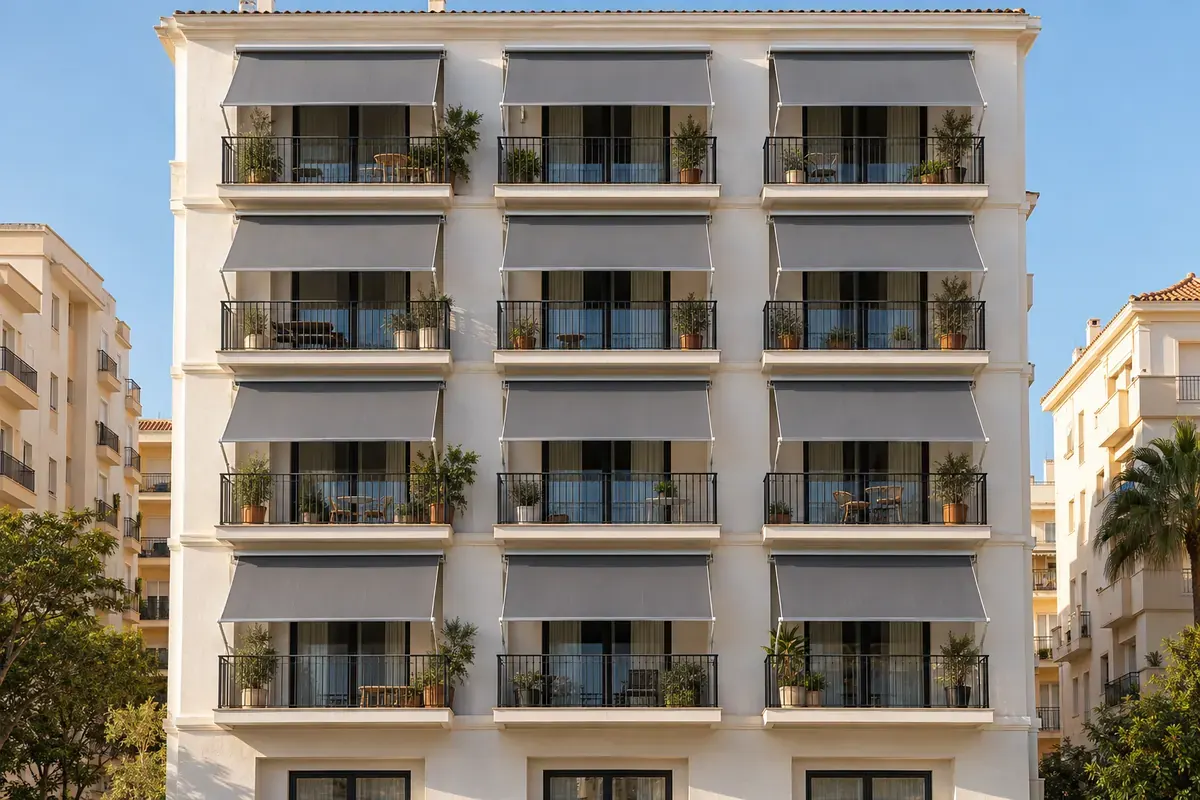
- Drop arm or roller awning on a balcony: what usually matters most is matching the rest of the building.
- Vertical awning or zip screen: if it closes off the sides of a terrace, some authorities may treat it as an enclosure, so it’s worth asking.
- Awning with support legs: as it rests on the ground, they look at where it stands and whether it stays within your property.
- Awnings for bars and businesses: if the terrace is on the public highway, you’ll normally also need the town hall’s permit to occupy that space, plus whatever conditions it sets for it.
Minor works licence for pergolas: when do you need planning permission for a pergola in Spain?
Pergolas are where a minor works licence or, depending on the town, a “declaración responsable” crops up most often. The main factors are:
- The area it covers and whether it creates a new covered space.
- Whether it has foundations or is anchored to the floor slab and the facade.
- The type of roof: a folding canopy isn’t the same as adjustable louvres like those on a bioclimatic pergola.
- Whether the sides are closed in with glass, a zip screen or windbreaks, because that makes it closer to an enclosure.
A wall-mounted pergola at a villa with no community is usually simpler to get through the paperwork than the same pergola on a penthouse. And a retractable roof pergola, with a canopy that folds away, is assessed differently from a rigid roof. The same goes for terrace and porch enclosures: because of their effect on the facade, it’s always worth checking first.
Quick-reference table: installation, what’s checked and possible permission
This table sums up what we usually find. It doesn’t replace checking with your town hall or your community’s statutes: every case is confirmed before we install.
| Installation | What’s usually checked | Possible procedure |
|---|---|---|
| Retractable awning on a balcony or terrace | The building’s model and colour, projection over the street | Community approval; town hall procedure depending on the municipality |
| Vertical awning or side zip screen | Whether it works as an enclosure | Check first; depending on the case, a “declaración responsable” |
| Wall-mounted or aluminium pergola | Surface area, fixings, visibility | “Declaración responsable” or minor works licence |
| Bioclimatic pergola | Louvred roof, structure, side enclosures | “Declaración responsable” or minor works licence |
| Terrace or porch enclosure | Facade, surface area, use of the space | Community and town hall procedure: always check |
| Business awning on the public highway | Occupation of public space | Town hall occupation permit as well as the installation |
“Declaración responsable” or minor works licence: the differences
These are the two terms you’ll hear most when you ask about permission for an awning or a pergola. They don’t mean the same thing:
“Declaración responsable” (sworn statement)
With a “declaración responsable”, the owner informs the town hall that they’re going to carry out the work and declares that it complies with the regulations, providing whatever documents are requested. It’s a quicker procedure because you don’t wait for prior authorisation, but responsibility for compliance lies with whoever signs it, and the town hall can check afterwards.
Minor works licence
A minor works licence is an authorisation the town hall grants before work starts, after reviewing the application. It usually applies to work of a certain scale that doesn’t amount to major building work. Which of the two applies is decided by each town’s regulations, not by the installer.
What if no town hall procedure is needed?
That can happen with light installations in certain towns. Even so, it’s worth confirming, and if you live in a community, you still have to follow its rules. A properly checked “not needed” is worth far more than an assumed one.
Not sure what your terrace needs? We come to your home, measure up for free and tell you what’s required before giving you a written, no-obligation quote with a fixed price in under 24 hours. Get a free quote or call us on +34 694 57 17 33.
Documents usually requested to apply for permission
Every town hall has its own form and requirements, but some documents come up again and again in this kind of application:
- Application or official form for the “declaración responsable” or the minor works licence, with the owner’s details.
- Description of the work: what’s being installed, materials, sizes and location.
- The installation quote, which is usually used as the basis for municipal fees and taxes.
- Sketch or plan showing the dimensions and where it goes on the property.
- Photos of the facade or terrace as it is now.
- The community’s approval, when the installation affects common elements.
- Additional technical documents in cases where the town hall requires them because of the size of the structure.
Our written, fixed-price quote already includes the sizes, materials and description, which makes preparing the permit application much easier.
Malaga and Granada: why awning licences and permission vary from town to town
We work right across the Axarquia, Malaga city, the Costa del Sol and the Costa Tropical in Granada, and we see it every day: each town hall has its own way of doing things.
- Axarquia: in Velez-Malaga, Torre del Mar, Nerja, Torrox, Rincon de la Victoria and Algarrobo, traditional old towns sit alongside modern urbanisations, and the approach can vary from one area to another.
- Malaga city and the Costa del Sol: in Malaga city, Torremolinos, Benalmadena, Fuengirola, Marbella and Estepona there are lots of buildings with communities of owners and urbanisations with their own rules on appearance.
- Costa Tropical and Granada: in Motril, Salobreña, Almuñécar and the Granada area there are also specially protected neighbourhoods where checking first is essential.
On top of that, many urbanisations on the coast have their own internal rules on awnings and pergolas, which apply in addition to town hall permission.
How we handle permission for your installation at QUBRE
Rather than assuming your case doesn’t need anything, we always follow the same process before we install:
- Free home visit and measuring: we look at the terrace, the facade and the surroundings, and advise you on the system that suits you best.
- Reviewing your case: we look at the type of installation, whether there’s a community of owners and what your town hall usually requires for that kind of work.
- A written quote with a fixed price in under 24 hours, with the technical description you’ll later use for the application.
- Handling the paperwork and permits when they’re needed: we prepare whatever’s required so the procedure doesn’t eat into your time.
- Installation by our own technical team, with powder-coated aluminium and stainless fixings built for the coast, and a guarantee on the structure and installation.
This preliminary step may seem like a delay compared with “just installing it”, but it avoids the things that cause the most grief: complaints from the community, notices from the town hall or having to take down something you’ve already paid for.
Common mistakes when applying for permission, and a checklist before you install
- Thinking “it’s my terrace, so I can do what I like”. The facade and the roof are still common elements.
- Choosing the colour and model before checking the rules. If the community has a set model, the one you like may not be the one you’re allowed to fit.
- Confusing the neighbours’ approval with the town hall procedure. They’re two different permissions and you normally need both.
- Adding side enclosures without checking. Closing in a pergola with glass or vertical awnings can completely change how it’s treated.
- Relying on what your neighbour did. They may have installed it without authorisation, or when the rules were different.
- Leaving the permission until after you’ve installed. Putting things right afterwards is usually more expensive and slower than doing it properly from the start.
Permission checklist before installing your awning or pergola
- Do you live in a community of owners? Check the statutes and whether there’s an approved awning model and colour.
- Can the installation be seen from the street or does it affect the facade? Talk to the president or the property administrator.
- Is it a fixed structure, with a roof or enclosures? Find out what permission your town hall requires.
- Is your home in a historic centre or a protected building? Ask before choosing a model.
- Is it a business with a terrace on the street? Check the permit to occupy the public highway.
- Ask for a written quote with sizes and materials: you’ll need it for the application.
We take care of the paperwork. Free home visit and measuring, a no-obligation quote with a fixed price in under 24 hours, and handling of the paperwork when it’s needed. Get a free quote or call us on +34 694 57 17 33.
FAQs about permission for awnings and pergolas in Spain
Do all awnings need permission?
Not necessarily. A domestic retractable awning usually involves a simpler procedure than a fixed structure, but it may need the community’s approval and, depending on the town hall, some kind of municipal procedure. It’s worth confirming case by case.
Do I need planning permission (a minor works licence) for a pergola in Spain?
It depends on the town, the area it covers, how it’s anchored and whether the sides are closed in. In many cases the town hall asks for a minor works licence or a “declaración responsable”, which is why we check before installing.
What’s the difference between a “declaración responsable” and a minor works licence?
With a “declaración responsable” you notify the town hall of the work and declare that you comply with the regulations, without waiting for prior authorisation. A minor works licence is granted by the town hall before work starts, after it has reviewed the application. Which one applies is set by each town’s regulations.
What if my terrace is private, part of my own home?
Even if it’s for your private use, if the installation affects the facade or common elements of the building, the community’s rules and the town’s regulations still apply.
What happens if I install without permission and it’s requested later?
You could face a fine and, in some cases, be required to remove the installation. That’s why it’s worth settling this question before you install, not afterwards.
Which documents are usually needed to apply for permission?
Normally the town hall’s application form, a description of the installation with sizes and materials, the quote, a sketch, photos and, if it affects common elements, the community’s approval.
Does QUBRE handle the permission for me?
Yes. We review your case at the home visit, which is free, and when it’s needed we handle the paperwork and permits so you don’t have to deal with them.
Conclusion: check your case before you install
Permission for an awning or a pergola depends on the type of structure, whether you live in a community of owners and your town’s regulations. There’s no one answer that fits everyone, but there is a safe way to go about it: check before you install.
At QUBRE we review it at the free home visit, give you a written quote and, if needed, handle the paperwork for you in Malaga, across the province and on the Costa Tropical in Granada. Get a free quote and we’ll confirm what your installation needs.