Can you put up awnings in a community of owners without asking anyone’s permission? It’s a question we hear all the time, and the answer is almost always no. Even if the balcony or terrace is for your use only, the building’s facade isn’t quite as “yours” as it seems: it’s a common element, and any visible change affects every owner.
In this guide we explain what the Spanish Horizontal Property Act (Ley de Propiedad Horizontal) says about awnings and pergolas, how to propose a uniform model to the owners’ meeting, which options suit balconies, penthouses and communal areas, and what we do at QUBRE so the installation doesn’t end in a row with the neighbours. It’s all explained in practical terms, from our experience of installing on buildings in Malaga and Granada.
Awnings in a community of owners: why the facade isn’t entirely private
In a building under the horizontal property system (propiedad horizontal) there are two kinds of elements: private ones, which are your home and everything inside it, and common ones, which belong to all the owners. The facade, the roof, the structure and the shared areas all fall into this second group.
That’s why, even if your terrace is for your private use, an awning or pergola that can be seen from the street changes the appearance of a common element. It’s the reason awnings in a community of owners are subject to rules that simply don’t exist for a detached house.
Understanding this from the outset saves you a lot of trouble: it isn’t about the neighbours “letting you” put up an awning, but about everyone having a say in how the building they share looks.
What the Spanish Horizontal Property Act says about awnings
The Spanish Horizontal Property Act (Ley de Propiedad Horizontal) is the national law that governs life in buildings divided into flats and commercial premises. It doesn’t mention awnings specifically, but its rules on common elements and on works inside homes apply in full to this kind of installation.
Knowing the Horizontal Property Act well lets you put your case for an awning with solid arguments and avoid misunderstandings with the community of owners. These are the key points to be clear on before installing awnings in a community of owners:
What the law allows and what it restricts
Article 7 of the Horizontal Property Act allows each owner to alter their home as long as they don’t affect the building’s safety, its general structure, its layout or its exterior appearance, or harm the rights of another owner. It also requires owners to notify whoever represents the community before carrying out any works.
An awning changes the exterior appearance of the facade. So in practice, installing one means respecting whatever the community of owners has agreed or getting its approval.
Notice that the Horizontal Property Act doesn’t ban awnings: what it asks is that the outside of the building isn’t changed without the knowledge and agreement of the other owners. Done properly, awnings in a community of owners are perfectly compatible with the law and, what’s more, they improve the facade when everyone follows the same approach.
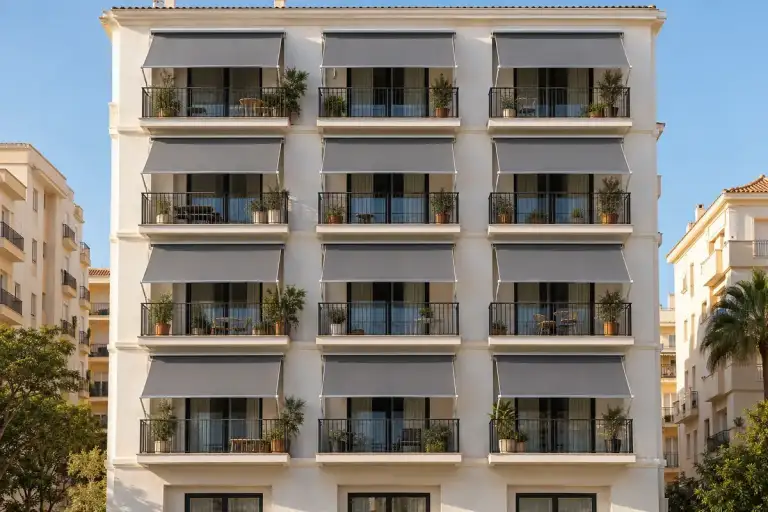
A uniform look: same model, same colour
If your building already has an awning model and colour, you’ll usually have to stick to them. Changing the fabric colour, the type of arm or the system on your own may be treated as an unauthorised alteration to the facade, even if your awning is better quality than the rest.
Statutes, internal rules and owners’ meeting agreements
Many communities have statutes or internal rules that cover awnings: colour, type, fitting height or projection. Others have decided it at a particular meeting and it’s recorded in the minutes book. Before installing, ask the president or the property administrator to confirm what has been approved. The majority needed to approve a change depends on the case and on the statutes: check with the property administrator.
Town hall permission is a separate matter
Approval from the community of owners doesn’t replace the procedure with the town hall, or the other way round. They are two independent permissions: a civil one (the community of owners) and an administrative one (the town hall). We explain it in detail in do I need permission to install an awning or pergola?
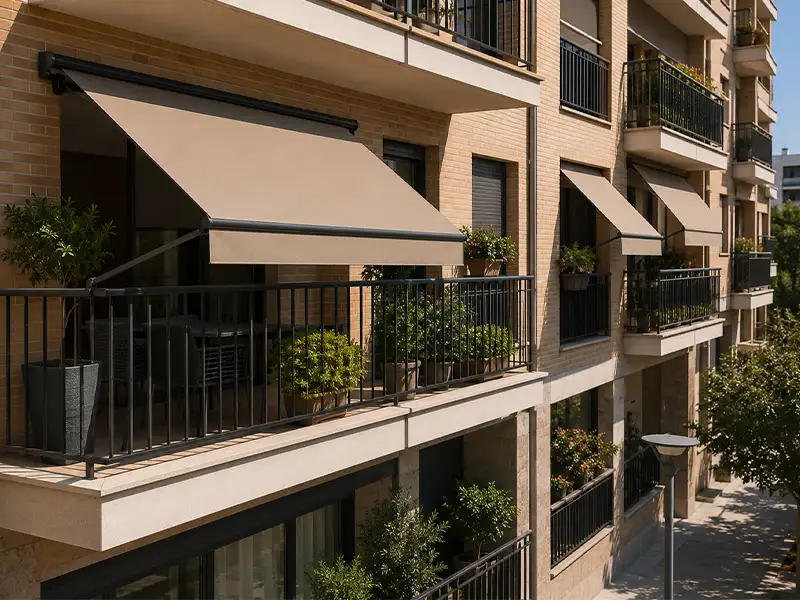
How to propose a uniform awning model to the owners’ meeting
When the building has no approved model, or the existing one has been discontinued, the smartest move is to propose one for everyone. That way each neighbour can install their awning whenever they like without going back to the meeting. This is the process we recommend:
- Speak to the president or the property administrator and ask for the item to be put on the agenda for the next owners’ meeting.
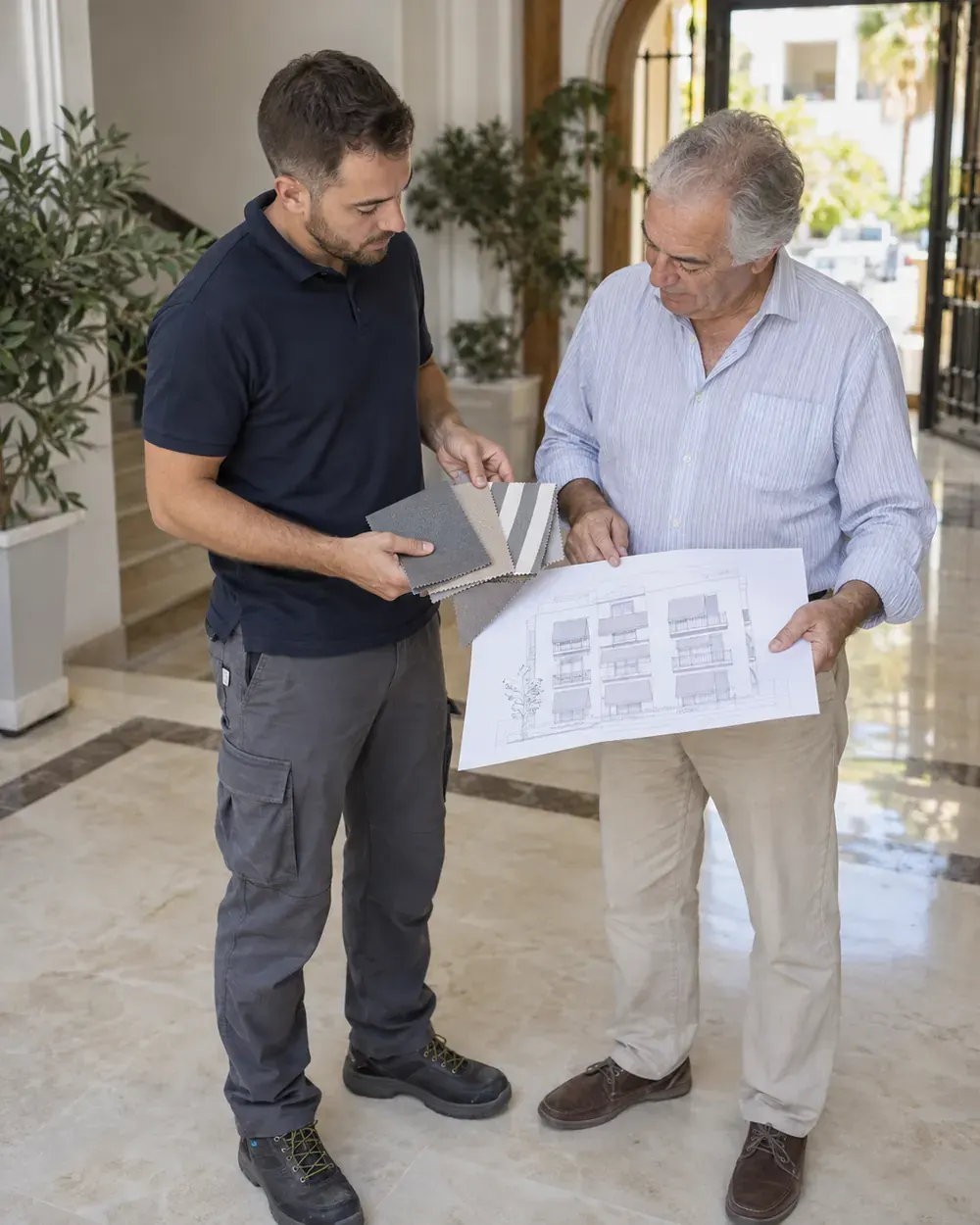
- Ask for a technical proposal: the type of awning for each opening on the facade, the fabric colour, the aluminium finish and how it will be anchored. At QUBRE the home visit and measuring are free.
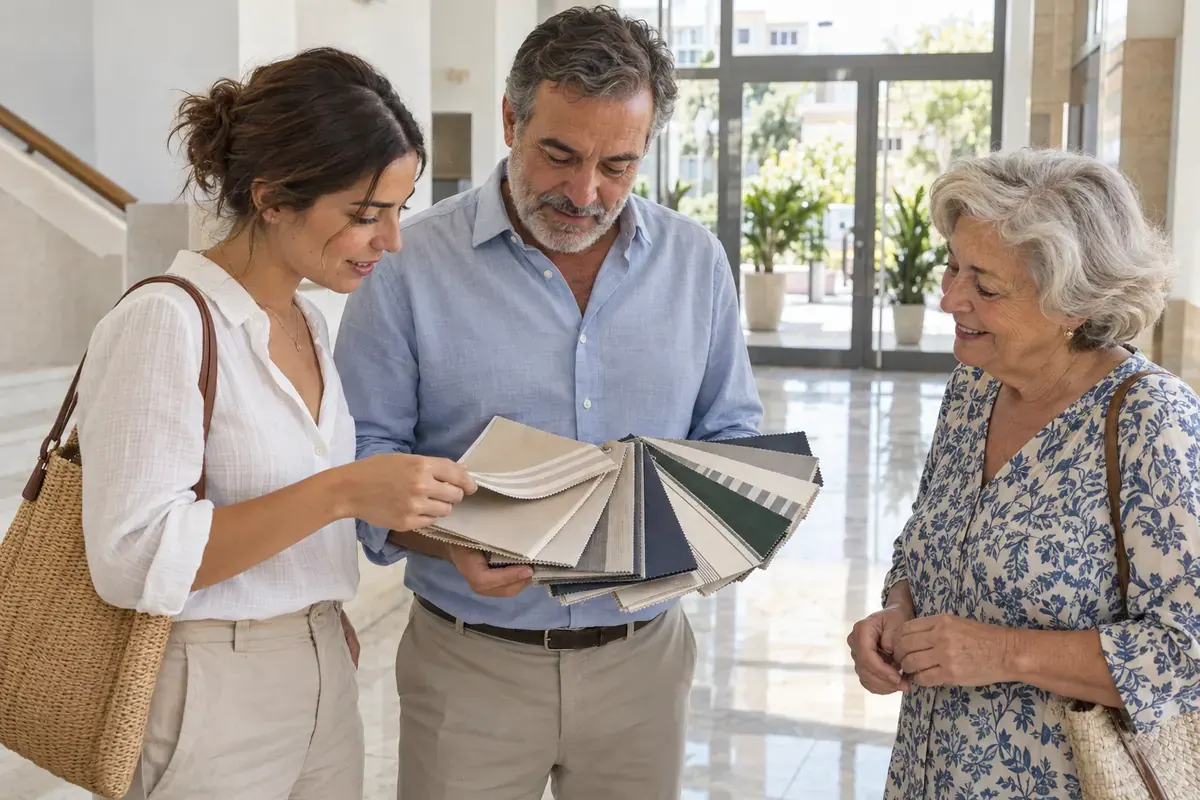
- Bring fabric samples so the neighbours can choose the colour by seeing the real material. We work with Sauleda and Dickson fabrics, which come in wide colour ranges.
- Draw up a spec sheet for the approved model: system, fabric colour, frame colour and fitting height. Make sure it’s recorded in the minutes.
- Leave the option of motorisation open so anyone who wants it can have it without spoiling the look.
- Each neighbour installs when they like, always with the approved model, and lets the community know about the installation.
This approach makes awnings in a community of owners straightforward: a shared decision, taken once, that prevents arguments for years.
What paperwork to take to the community of owners’ meeting
The clearer the proposal, the easier it is for the community of owners to approve it without putting it off to another meeting. We recommend taking:
- A description of the system for each type of opening: balcony, window, terrace or penthouse.
- Physical samples of the fabric and the frame colour, because colours are misleading on paper or on screen.
- Photos or mock-ups of how the facade would look with the proposed model.
- An approximate quote per home, in writing, so each owner knows what they’re committing to if they decide to install.
- The planned anchoring method, to reassure anyone worried about damage to the shared facade.
With this information, the meeting can vote on facts rather than assumptions, and the agreement is clearly defined for the future.
Which type of awning suits each part of the building
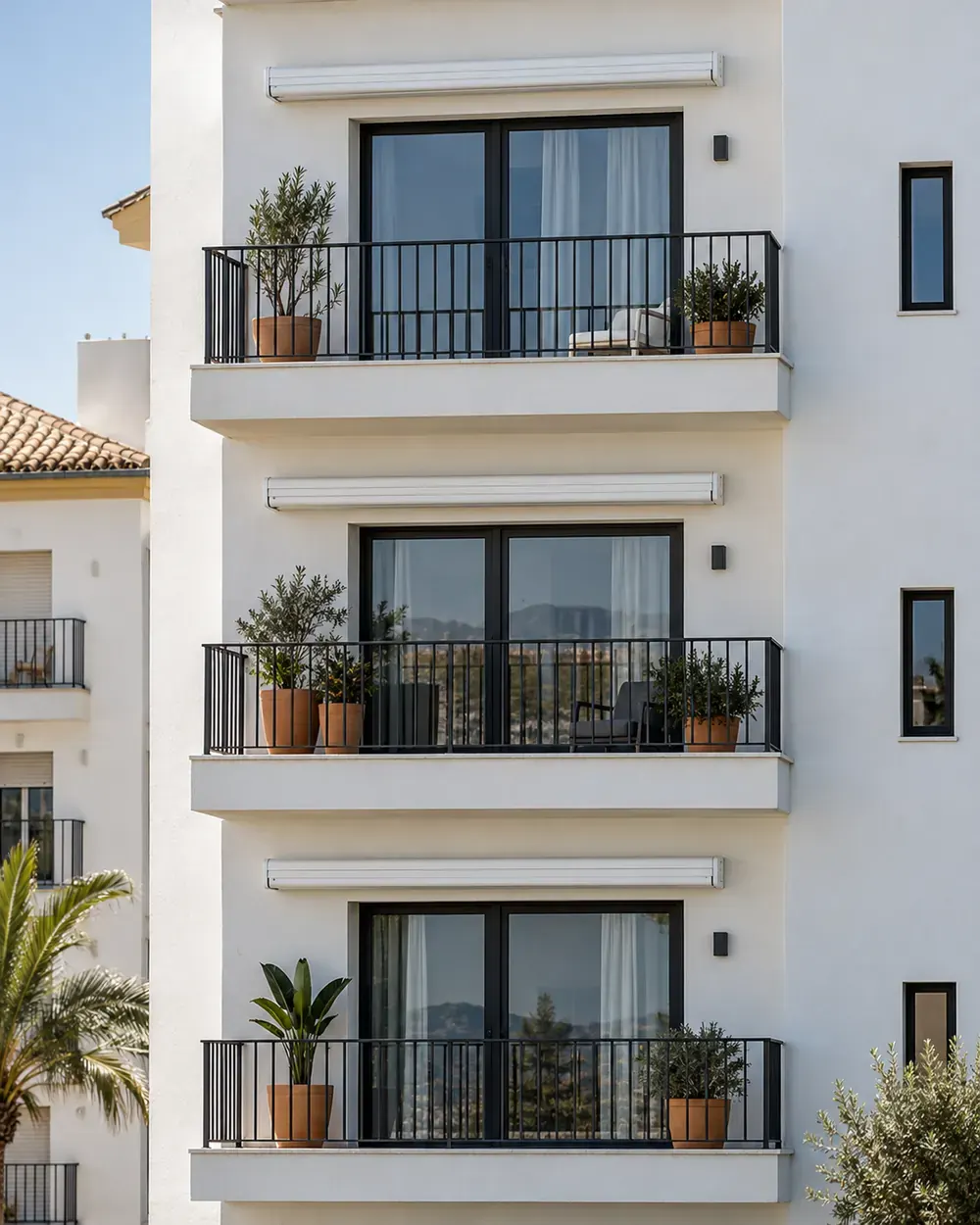
Choosing the right system for each opening on the facade is key to a result that’s both uniform and practical. This is the general guidance we give when we’re asked about awnings in a community of owners:
| Part of the building | Usual system | Why it works |
|---|---|---|
| Narrow balconies | Drop arm awning | It rests on the railing and gives shade without taking up the balcony |
| Windows | Roller or vertical awning | It blocks the sun without sticking out much from the facade |
| Large terraces | Retractable awning or cassette awning | Generous projection with no posts; the cassette protects the fabric when retracted |
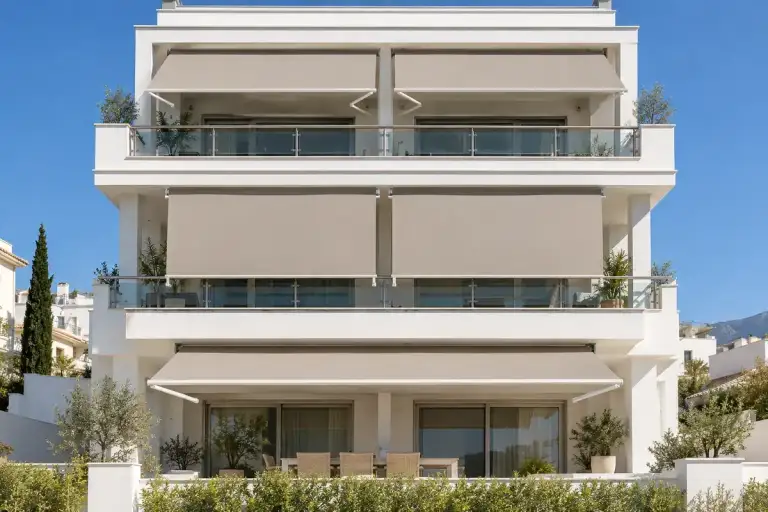
| Penthouses | A pergola or a large-projection retractable awning | They cover large areas; they need particular care with the community |
| Communal areas | Aluminium pergola with a canopy or louvres | Shade for the pool, sun terrace or entrances |
Motors and sensors for awnings in a community of owners
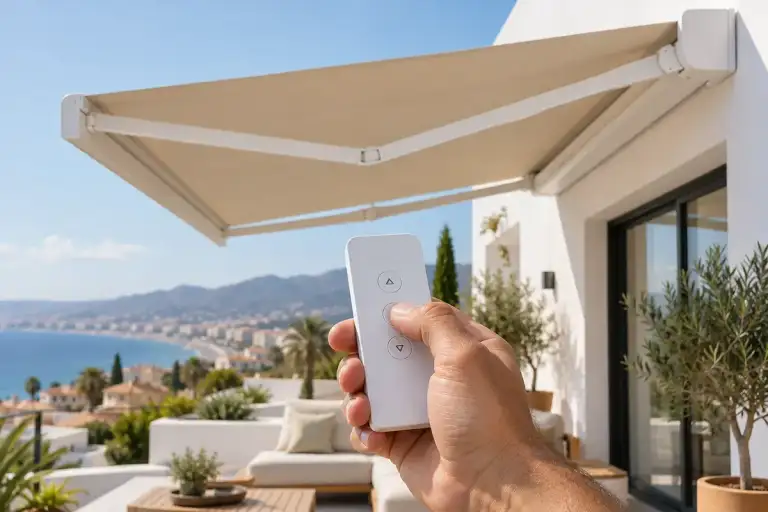
Motorisation doesn’t change the look as long as the model, fabric and frame are the approved ones, so it’s usually an option each neighbour can add freely. On buildings on the coast, a wind sensor is especially useful: it retracts the awning when the wind gets up, even if the owner isn’t at home, and reduces the risk of breakages that could affect the facade or the neighbours below. We work with Cherubini motors, which can be operated with a wall switch, a remote control or automation.
What matters is that, for each type of opening, all the neighbours use the same system and the same colour. You’ll find more options on our page on awnings for communities of owners in Malaga.
Does your community want matching awnings? We prepare a technical proposal for the owners’ meeting, with fabric samples, a free home visit and measuring, and a written, no-obligation quote with a fixed price in under 24 hours. Get a free quote or call us on +34 694 57 17 33.
Pergolas, enclosures and communal areas in a community of owners
Pergolas on penthouses and terraces
Pergolas are the most delicate issue within a community of owners. Even if the penthouse terrace is for your private use, the pergola is anchored to the facade or the floor slab, it can be seen from outside and it creates a fixed structure. That’s why it’s always wise to get the community of owners’ approval, on top of whatever procedure the town hall requires.
A bioclimatic pergola with aluminium louvres or an aluminium pergola with a canopy are discreet solutions that usually blend in well on modern buildings, but every case is assessed on its own merits.
Terrace enclosures
Aluminium and glass terrace enclosures change the facade even more than an awning does. In buildings with a community, the sensible thing is to raise it at the owners’ meeting before asking for detailed quotes, and for the community of owners to set a common profile type and finish if several neighbours want to enclose their terraces.
Communal areas: pools, sun terraces and entrances
Beyond awnings for each home, many communities of owners ask us for shade for the pool area, the sun terrace or the building entrance. In this case it’s the community itself that commissions the installation, normally after approving it at a meeting. Aluminium pergolas with a canopy are a very popular choice because they stand up well in coastal areas and need little maintenance.
Safety when installing awnings in a community of owners
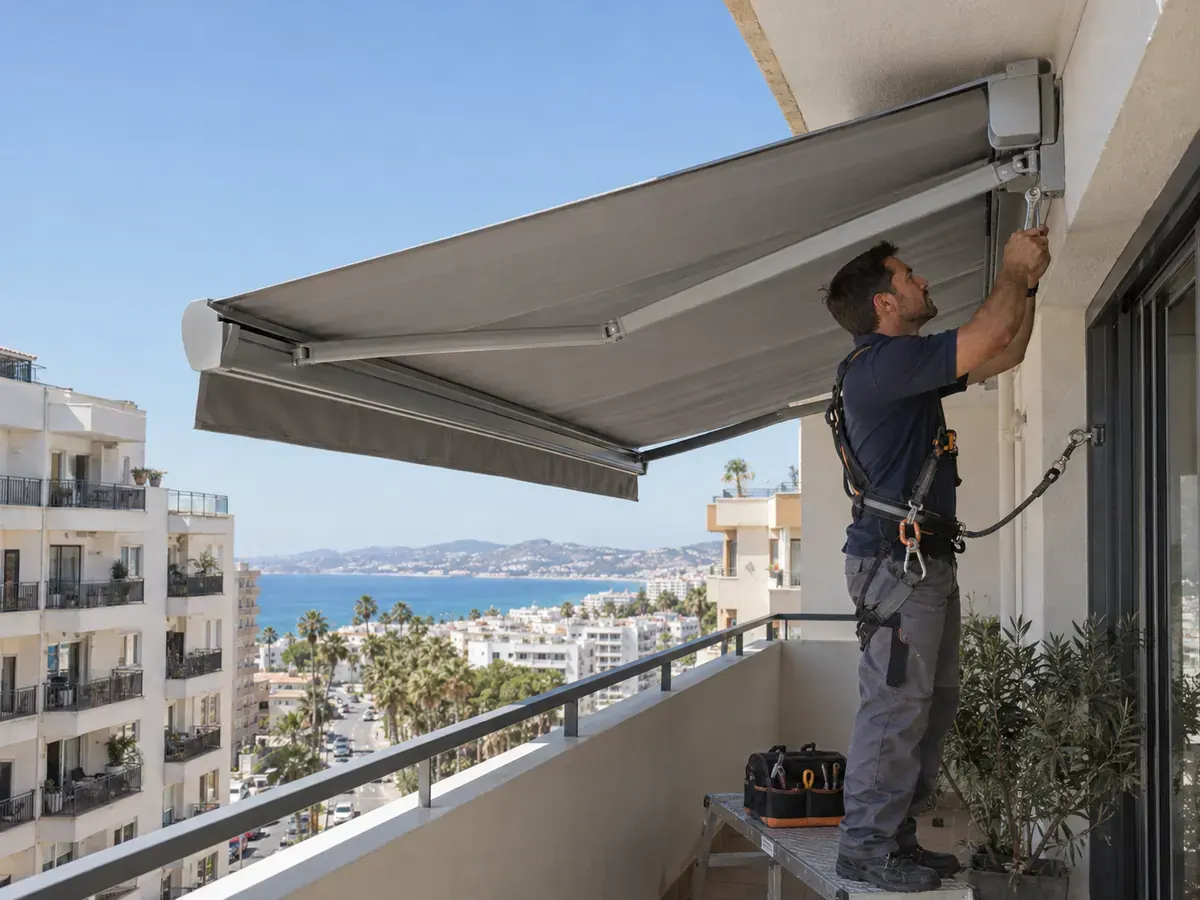
Installing awnings in a community of owners means working at height, above the street and anchoring to a shared facade, and that has to be done properly. A poorly executed fixing doesn’t just put the awning at risk: it can damage a common element or fall onto the street below. These are the points we look after on every job:
- Safe working at height: our technicians use the right safety equipment for each balcony or facade.
- Fixings suited to the surface: anchoring into concrete, brick or the edge of a floor slab are very different things, so we check the surface before drilling.
- Materials built for the coast: powder-coated aluminium and stainless fixings, so humidity and salt don’t rust the fittings.
- A wind sensor on motorised awnings, so they retract on their own if the wind picks up. Find out more about awning motorisation.
- Our own technical team and a guarantee on the structure and installation.
Renewing or repairing a community’s awnings
Over the years, the fabric on awnings in a community of owners fades unevenly: some homes replace it and others don’t, and the facade ends up looking like a patchwork. Renewing them all at once, with the same fabric, gives the building back its uniform look.
In these cases there’s no need to replace the whole awnings. If the frames are in good condition, all it takes is a fabric replacement and repairs to any arms or mechanisms that need them. We also look after installations fitted by other installers, so it doesn’t matter who put up the original awnings.
How to organise the renewal of awnings in a community of owners
A renewal works best when the community of owners coordinates it. The usual approach is to choose the new fabric colour at the owners’ meeting, ask for a single proposal for the whole building and let each neighbour sign up, so the facade looks consistent again in no time. If an owner would rather wait, at least they’ll know which model to fit when they renew theirs.
It’s also a good moment to check the fixings on all the awnings, replace rusty screws with stainless ones and motorise any awnings people want to modernise. Doing it all in one go simplifies the logistics and keeps disruption in the building to a minimum.
To keep the fabric in good condition between renewals, take a look at our guide on how to clean an awning.
Common mistakes with awnings in a community of owners
- Installing without telling anyone. Even if your awning matches everyone else’s, the Horizontal Property Act requires you to notify whoever represents the community about the works.
- Choosing the colour to suit your own taste. If there’s an approved colour, that’s the one to use, even if the sample book has prettier options.
- Assuming a private terrace means anything goes. The facade is still a common element.
- Confusing the community’s agreement with town hall permission. You normally need both.
- Relying on what another neighbour did. Their awning may not be authorised, or it may have been installed under earlier rules.
- Not putting anything in writing. If the meeting approves a model, make sure it’s recorded in the minutes with all its details.
Avoiding these mistakes is far easier than sorting out a dispute with the community of owners afterwards, which in the worst case can end with you being required to remove the installation.
Install your awning with no problems with your community of owners. We check the building’s rules, prepare the paperwork for the owners’ meeting and handle the permit when one is needed. Free home visit and no-obligation quote. Get a free quote or call us on +34 694 57 17 33.
FAQs about awnings in a community of owners
Can I install any awning I like if my terrace is private?
Not necessarily. If it can be seen from outside or affects the look of the building, it’s still subject to the community’s rules, even though the terrace is for your use only.
What does the Spanish Horizontal Property Act say about awnings?
It doesn’t mention them specifically, but it states that each owner may alter their home as long as they don’t affect the building’s safety, structure, layout or exterior appearance or harm another owner, and that they must notify whoever represents the community about the works.
What happens if I install an awning without telling the community?
The community can require you to remove the awning and, if the dispute isn’t resolved, take the matter to court. It’s better to check before you install.
Do I need every neighbour to agree unanimously?
It depends on the case and on each community’s statutes. Many already have an approved model that lets you install without a new vote; for changes, it’s best to check with the property administrator.
Can I fit an awning in a different colour if mine has been discontinued?
The best approach is to propose a new common model to the owners’ meeting, with fabric samples, so all the neighbours adopt it when they renew their awnings.
Do I need permission from the town hall as well as from the community?
They’re separate procedures. The community’s approval doesn’t replace whatever town hall procedure applies, which depends on the type of installation and each municipality’s rules.
Can QUBRE prepare the proposal for the owners’ meeting?
Yes. We measure up for free, propose the right system for each opening on the facade, bring fabric samples and give you a written, no-obligation quote with a fixed price.
Conclusion: a shared decision avoids disputes
Installing awnings in a community of owners means checking the building’s rules, respecting the look of the facade and also completing the town hall procedure. The simplest way to go about it is for the community of owners to approve a common model and for each neighbour to install it whenever they like.
At QUBRE we help you with the proposal for the owners’ meeting, installation by our own team and after-sales service in Malaga, across the province and on the Costa Tropical in Granada, from Torremolinos and Fuengirola to the Axarquia. Get a free quote and we’ll look at it together.