Home › Pergolas › Wooden pergolas
Wooden pergolas · Malaga, Axarquia and Costa TropicalWooden pergolas in Malaga with the warmth of natural timber
Treated outdoor timber beams, shade with a real country-house feel and a corner of the garden you won’t want to leave. We design and install made-to-measure wooden pergolas in Malaga with our own team, and we’re upfront about the care they need.
- Our own team, no subcontractors
- Home visit and measuring free
- Fixed-price quote in under 24 hours
- Powder-coated aluminium and stainless fixings
- Guarantee and after-sales service
In short
QUBRE's wooden pergolas in Malaga are made to measure with beams of wood treated for outdoor use, for gardens, porches and country houses. QUBRE fits them with our own team, explains the upkeep the wood needs and gives a written fixed-price quote after measuring for free.
Updated · QUBRE technical team, Velez-Malaga
Wooden pergolas in Malaga: made to measure, not from a kit
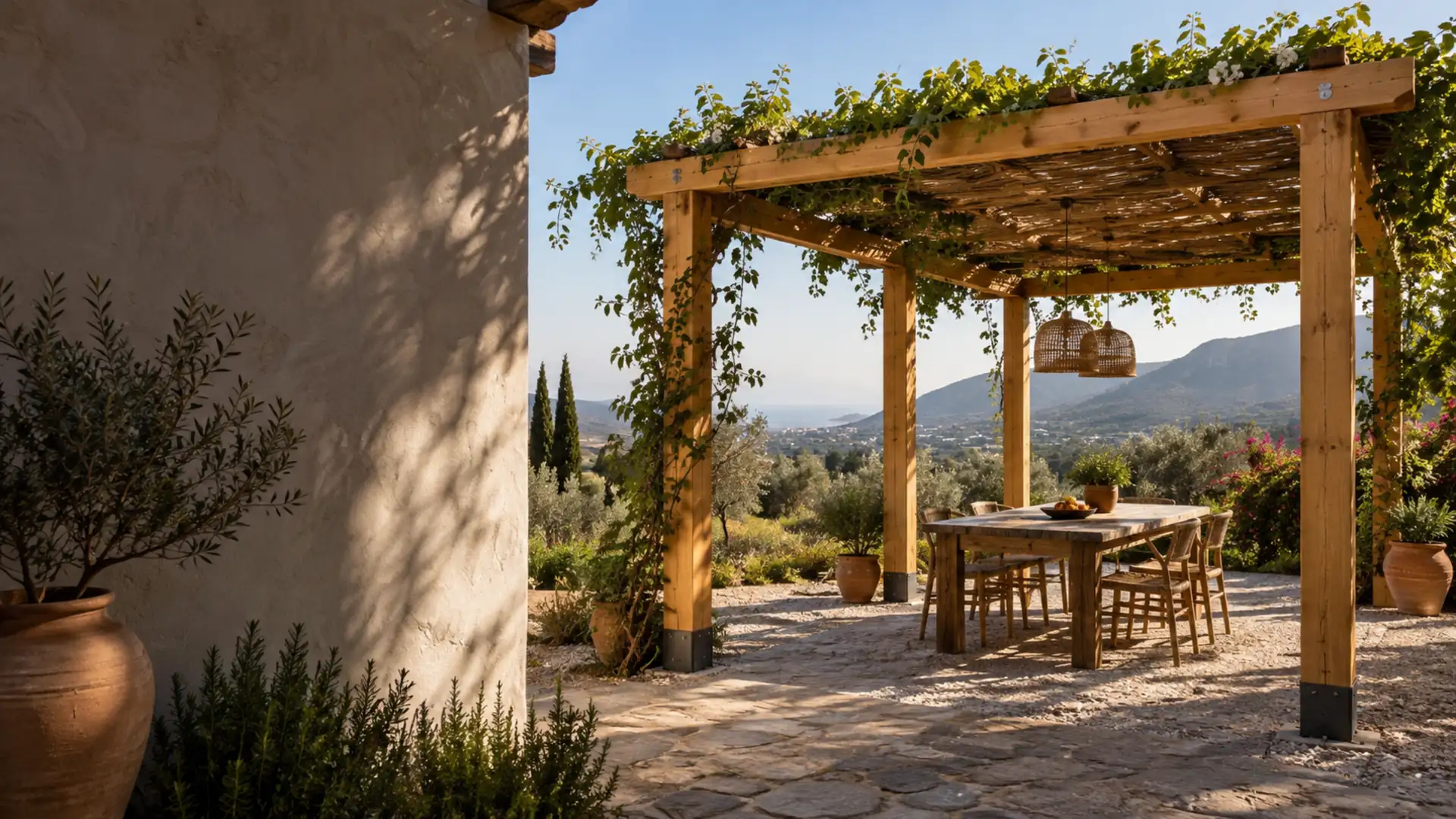
Wooden pergolas in Malaga still have something no other material quite manages: the feel, the warm colour and the way they blend into a garden, sit beside a barbecue or frame the front of a country house in the Axarquia. A well-built wooden pergola doesn’t look like an add-on; it looks as if it’s always been there.
Online you’ll find plenty of DIY kits. We do something different: a made-to-measure wooden pergola, designed for your space, with the beam and post sizes its dimensions call for, anchored to the ground or the facade as needed, and installed by our own technical team. You notice the difference the first time a levante storm blows through, and again as the years go by.
We use timber treated for outdoor use, prepared to stand up to sun, damp and insects. Even so, wood is a living material and it needs looking after. We tell you straight so you know exactly what you’re choosing, and if you’d rather forget about maintenance, we also offer wood-effect aluminium.
Where do our wooden pergolas look their best?
- Villa garden
- Country house or cortijo
- Barbecue area
- Beside the pool
- Front porch
- Vegetable garden or patio
Three ways to enjoy a wooden pergola
The structure is the same; what changes is where you put it and what roof you give it. At the visit we’ll see which one suits your home.
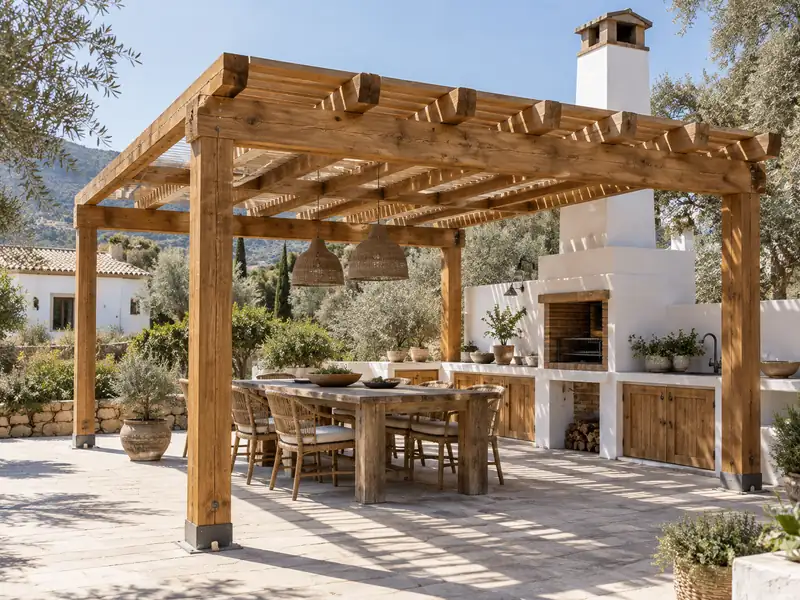
Freestanding wooden pergola
Four or more posts in the middle of the garden to create an outdoor dining area, a barbecue spot or a reading corner separate from the house. Anchoring the posts to the ground is the key.
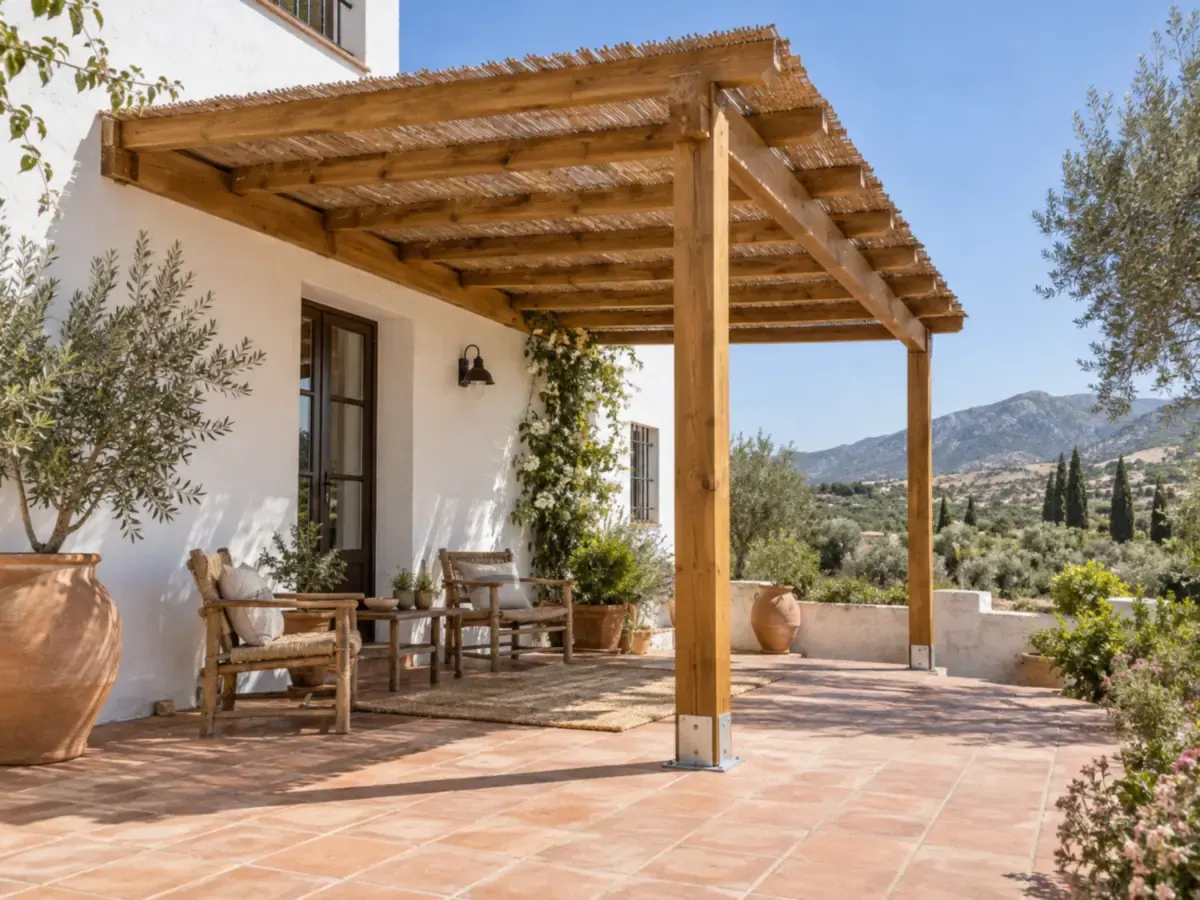
Wall-mounted wooden pergola
Fixed to the facade on one side and resting on posts on the other. It extends the house outwards and suits rustic homes beautifully. We explain the anchoring on our wall-mounted pergolas page.
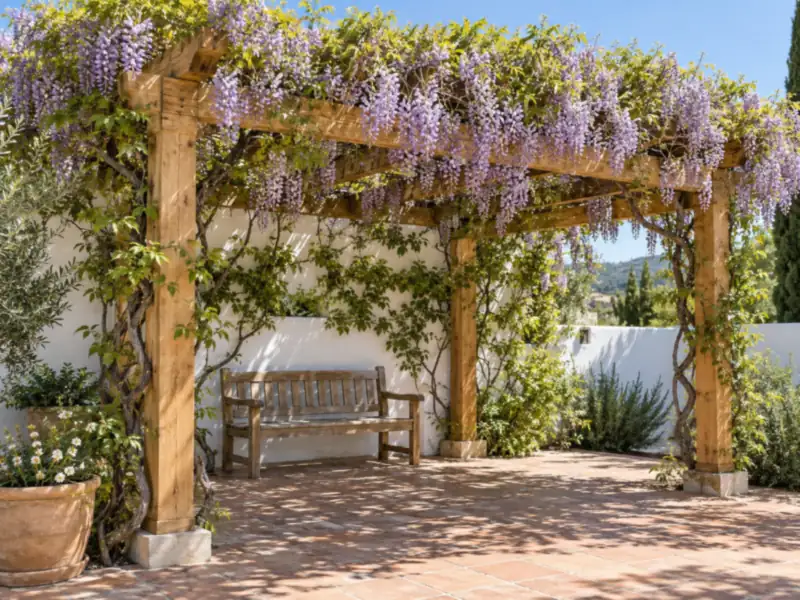
With climbers, reed screening or fabric
You can leave the roof open for a climbing plant to grow over it, cover it with a natural material or add a sliding canopy for shade whenever you want it. More about the canopy on our retractable roof pergola page.
If you love the look of wood but your pergola will be on the seafront or in full sun all day, consider wood-effect aluminium too: the same warm tone with no sanding or varnishing. You’ll find every option on our pergolas in Malaga page.
Picture your wooden pergola in your garden
Choose wall-mounted or freestanding, try a fixed-slat roof or a sliding canopy and adjust the size. If you change the colour, you’ll also see how it looks in aluminium. Ask for a quote with your design and we’ll fine-tune it at the visit.
1. Model
2. Type of roof
3. Frame colour Anthracite
Canopy colour Ecru
5. Side screens
6. Approximate size
Your design
This is a guide only. We finalise the sizes, model and finishes with you at the free technical visit.
What’s included with your made-to-measure wooden pergola
We hand it over fully installed and ready to enjoy, with written care instructions. The same technicians who measure up are the ones who install it.
- Free home visit, measuring and advice
- Made-to-measure design for your garden or porch
- Timber treated for outdoor use
- Beam and post sizes to suit the dimensions
- Anchoring to the ground or facade as required
- Stainless fittings and fixings
- Installation by our own technical team
- Sauleda or Dickson sliding canopy if you choose one
- Paperwork and permits handled if needed
- Maintenance guidance, guarantee and after-sales
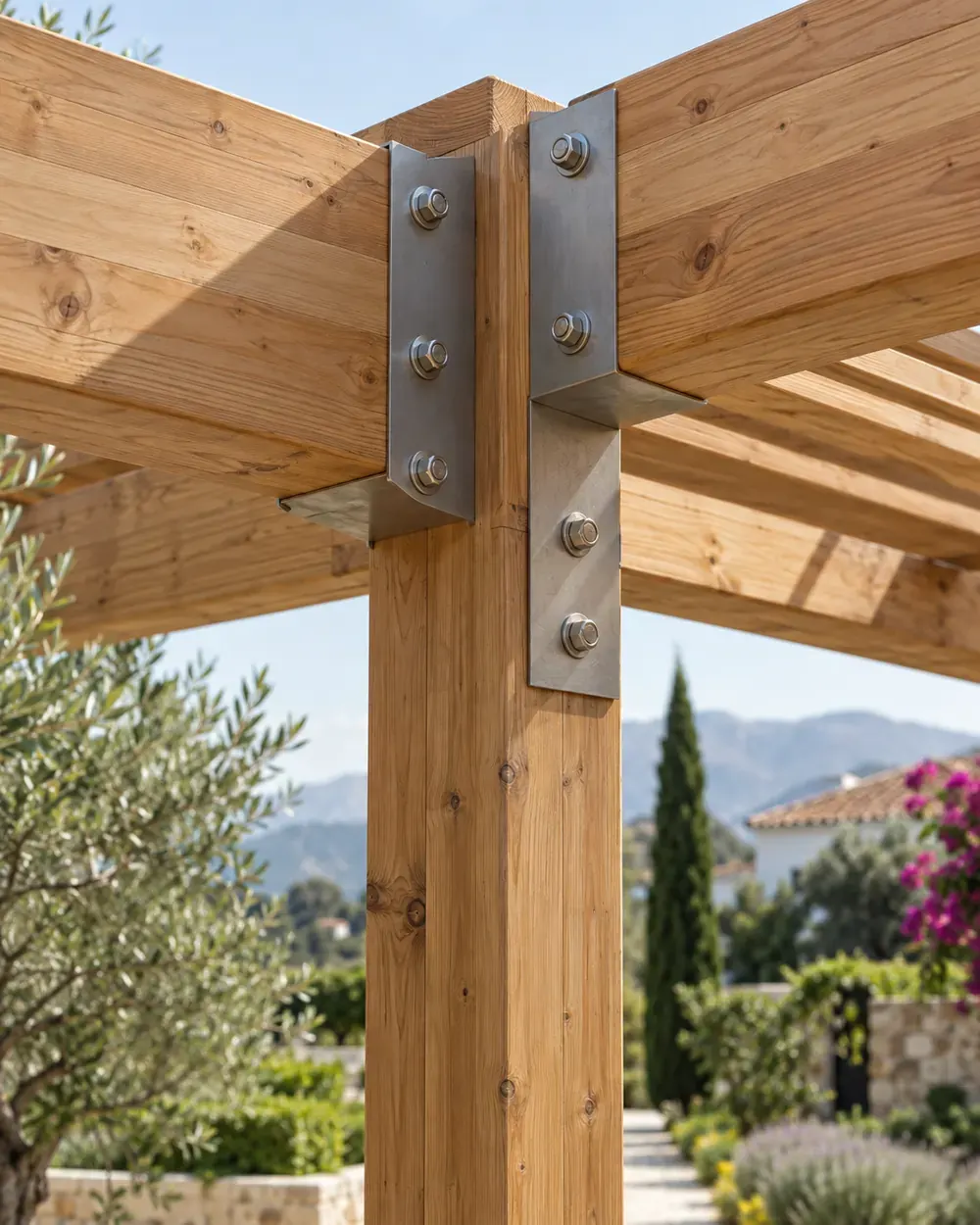
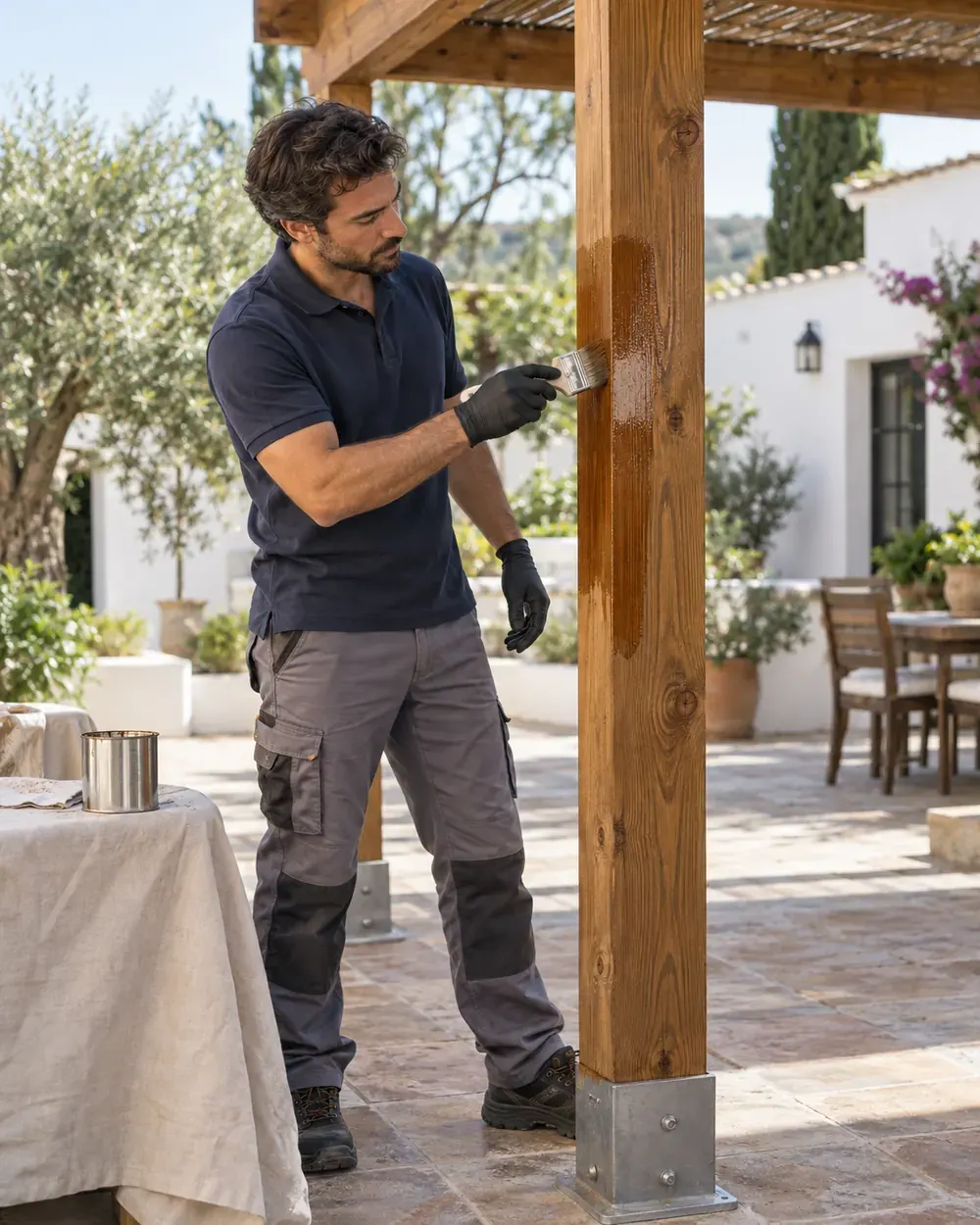
Wood, yes, but well protected. The biggest enemy of a wooden pergola is water sitting at the base of the posts. That’s why we lift the timber off the ground with metal post bases, use stainless fixings and tell you how often to renew the protective finish. Materials come with a 2-year warranty, depending on the manufacturer and product, and we also guarantee the structure and the installation.
How we build your wooden pergola
Six steps, one point of contact and a fixed price from the start.
- Visit and measuringWe come at no cost, measure up and look at the ground, the facade and the sun and wind the area gets.
- Design and timberTogether we decide the size, beam sections, type of roof and wood finish.
- Fixed-price quoteIn writing and with no obligation, often in under 24 hours. What you sign is what you pay.
- PermitsIf your town hall or community of owners requires any paperwork, we’ll tell you and prepare it.
- Installation by our own teamWe anchor the posts with their fittings, put up the structure and fit the roof.
- Handover and careWe check everything with you and leave you written instructions on how and when to maintain the wood.
Already have an idea or a reference photo? Send it to us along with a photo of your garden and we’ll tell you how to adapt it to your space.
Send a photo on WhatsAppWooden pergola or wood-effect aluminium?
It’s the question we’re asked most. Both give a warm look; the difference is in day-to-day life.
| Look | Treated timber | Wood-effect aluminium |
|---|---|---|
| Look | Natural, with real grain and feel | Recreates the tone and grain in the coating |
| Maintenance | Renew the protective finish regularly | Clean with soap and water |
| Salt air and humidity | Holds up if well treated, but needs more care on the seafront | Powder-coated aluminium with stainless fixings |
| Sun | Turns grey over the years if not protected | Keeps its colour, depending on the coating |
| Weight | Heavier; thicker sections | Lightweight and stable |
| Best for | Cortijos, gardens and rustic houses | Any home, including on the coast |
| Repairs | Can be sanded, re-treated and parts replaced | Profiles replaced if damaged |
If you live inland in the Axarquia or have a sheltered garden, wood can be perfect. On the seafront we usually recommend wood-effect aluminium. And if you want a roof that closes when it rains, take a look at the bioclimatic pergola.
Wooden pergola prices: what affects the cost
A made-to-measure wooden pergola can’t be compared with a DIY kit: each one is designed and built for a specific spot. This is what drives the quote:
Fixed-price written quote in under 24 hours
We measure up for free, explain every option and give you a price that won’t change halfway through the job. No obligation.
Wooden pergolas in the Axarquia, Malaga and the Costa Tropical
From Velez-Malaga we come out to measure at no cost across the whole province and the Costa Tropical in Granada. The cortijos and country houses inland in the Axarquia and the gardens of residential developments are wood’s natural home; on the seafront we’ll tell you honestly when wood-effect aluminium makes more sense.
Malaga and Costa del Sol
Costa Tropical and Granada
Can you picture your garden with a wooden pergola?
Tell us what you need in four quick steps and we’ll call you to arrange the visit. No obligation.
- Free home visit and measuring
- A fixed, written quote in under 24 hours
- Fitted by our own team, no subcontractors
- Guarantee and after-sales service close to you
Frequently asked questions about wooden pergolas in Malaga
What’s the difference between a wooden pergola kit and a made-to-measure pergola?
A wooden pergola kit is a standard product: fixed sizes, timber sections designed for general use and fittings meant for any kind of ground. For a small, sheltered corner it may do the job. But as soon as the space has awkward measurements, the pergola is large or it catches the wind, the limitations start to show.
A made-to-measure wooden pergola starts from your space. We measure up, decide whether it will be fixed to the facade or freestanding, check the ground the posts will stand on and where the wind comes from, and use all that to choose the beam and post sections, the spacing between them and the type of anchoring. The result fits your garden or porch to the centimetre and is sized for the loads it will have to bear.
Installation is different too. A kit is something you put up yourself or pay someone else to assemble; our pergolas are installed by our own technical team, who stand behind the structure and the installation. If anything isn’t right, you know who to call, and our after-sales service is there for you.
If you’re weighing up wood against other materials, our pergolas in Malaga page covers every type. And so we can look at your project, book a free visit using the form: we’ll give you a fixed-price quote with no obligation.
How much maintenance does a wooden pergola need on the coast?
More than an aluminium one, and it’s only fair you know that before you decide. Wood is a living material: the sun dries it out and turns it grey, damp makes it swell and salt air speeds up the wear. Looking after the timber isn’t complicated, but it does need doing fairly regularly if you want the pergola to look good for many years.
The basics are to clean the structure of dust, leaves and salt deposits with water and a soft brush, and to renew the protective finish when you notice the wood losing colour or no longer repelling water. How often depends on exposure: a pergola on the seafront in full sun will need it sooner than one in a shady garden inland. We leave you written instructions to suit the wood and treatment on your pergola.
It’s worth checking the base of the posts once a year, as that’s where water lingers longest, along with the fittings and screws. That’s why we raise the posts off the ground on metal bases and use stainless fixings, so water doesn’t collect and nothing rusts.
If you don’t want to spend that time on it, the alternative is wood-effect aluminium. And if your pergola has a fabric canopy, our blog explains how to clean and look after the fabric.
What does it mean when timber is treated for outdoor use?
Untreated wood left out in the open soon cracks, rots in the damp and attracts insects. Timber treated for outdoor use has been given a treatment that protects it against those three enemies: water, fungi and wood-boring insects. It’s the bare minimum for a pergola that will spend years outdoors on the Malaga coast.
There are different types of treatment depending on the wood. Some penetrate deep into the timber, such as pressure treatment (autoclave), while others form a protective layer on the surface, such as wood stains and oils. The usual approach is to combine a deep treatment with a surface finish that also adds colour and protects against UV. Which combination your pergola has depends on the wood and the model, and we set it out in the quote.
The deep treatment lasts a long time, but the surface finish gradually wears away with sun and rain, which is why it needs renewing from time to time. That’s the maintenance we explain at handover.
If you’re worried about how it will last on the seafront, compare it with our aluminium pergolas, which don’t need this kind of care. And if you’d like to talk it through for your own home, book a free visit using the form.
Wooden pergola or wood-effect aluminium: which is right for me?
Choosing between a wooden pergola and a wood-effect aluminium one is one of the most common dilemmas, and the answer depends on three things: where the pergola will go, how much time you want to spend on it and what matters more to you, authenticity or practicality.
Wood has a feel and character that can’t be fully imitated. It looks wonderful at cortijos, country houses and lush gardens, and it can be repaired by sanding and re-treating. In return, the protective finish needs renewing every so often and, on the seafront, it suffers more from salt air and sun.
Wood-effect aluminium recreates the tone and grain in a coating on aluminium profiles. It doesn’t rot or crack and only needs cleaning with soap and water. It’s lighter, so it puts less load on the facade if it’s wall-mounted. We explain it on our aluminium pergolas page.
Our practical advice: inland in the Axarquia or in sheltered gardens, wood can be perfect. On the seafront, on penthouses in full sun or if you don’t want any maintenance, wood-effect aluminium is usually the more sensible choice. At the visit we show you both options so you can decide with the samples in your hand. Book it using the form.
Can a wooden pergola stand up to the terral and the levante?
Yes, as long as it’s properly sized and properly anchored. Wood is strong and slightly flexible, so it absorbs gusts well, but like any pergola its stability depends above all on two things: the sections of the beams and posts and how it’s anchored to the ground or the facade.
The levante (easterly) and poniente (westerly) winds bring strong gusts to the coast, so on open terraces or in exposed gardens the structure needs sizing with a margin to spare. The terral, the hot, dry wind that comes down from inland in summer, blows less hard but dries the wood out badly, which is why the protective finish wears faster where it’s common. We take both into account in the design and in the maintenance instructions.
The roof makes a big difference. An open pergola or one covered in climbers offers little resistance to the wind. If it has a sliding canopy, it’s best to retract it in strong gusts, just like an awning; if we motorise it with a Cherubini motor and a wind sensor, it retracts on its own. We explain how on our awning motorisation page.
If your area is particularly windy and you want to close off one side, a windbreak awning with side guides shelters the seating area without taking away the light. At the visit we assess how much wind your garden gets and size everything accordingly.
Can I put a canopy or a waterproof roof on a wooden pergola?
Yes, and it’s a great way to get more out of it. An open wooden pergola gives lovely shade once a climber covers it, but that takes time to grow and it won’t keep the rain off. If you want shade from day one or to use the area in autumn, you have several roof options.
The most versatile is a sliding canopy: Sauleda or Dickson fabric that slides along guides over the structure. You draw it out when the sun’s fierce and pull it back when you want open sky, by hand or with a motor. It protects from light rain, depending on the fabric and the pitch, although it’s best to retract it in a downpour. We explain it on our retractable roof pergola page.
You can also fit fixed slats or natural materials such as reed screening, which give airy shade but let the water through. If what you’re after is a roof that closes completely in the rain, the most effective solution is a bioclimatic pergola, although in that case the structure is aluminium.
The important thing is to decide before it’s built, because the roof changes the weight, the pitch and the way water drains off. At the visit we show you what suits the pergola you have in mind and give you a fixed-price quote with everything included.
Do I need planning permission for a wooden pergola in my garden?
It depends on the town hall, the size of the pergola and whether it’s fixed or removable. A wooden pergola anchored to the ground is a fixed structure, and in many municipalities in Malaga and Granada it’s processed as minor works, through a minor works licence or a “declaración responsable” (a sworn statement to the town hall). For a country house on rural land, specific rules may also apply.
Every municipality, from Velez-Malaga to Torrox, Nerja or Motril, has its own bylaws, and what’s fine in one town isn’t necessarily fine in the next. On residential developments there may also be internal rules on materials, heights or distances from boundaries, and if the pergola is fixed to the facade of a building, the community of owners has a say. We explain it in awnings and pergolas in communities of owners.
Installing without permission when it’s required can lead to a fine and even having to take the pergola down. It isn’t worth the risk, especially with a made-to-measure structure that can’t simply be moved somewhere else.
That’s why, before we install, we check which procedure applies in your case and, if the project needs it, we handle the paperwork and permits for you. You’ll find a summary of the most common cases in our article do I need permission to install an awning or a pergola in Malaga or Granada?
Do you repair or restore old wooden pergolas?
Yes. Our after-sales service looks after both the pergolas we’ve installed and those fitted by other installers, and wooden ones benefit from it more than most. Over the years it’s normal for the wood to turn grey, for surface cracks to appear or for the base of a post to have deteriorated in the damp.
The first step is to come and assess the condition of the structure. If the wood has only lost its finish, it can be cleaned, sanded and re-protected to bring back much of its original look. If any parts are damaged, especially the posts or joints, they can be replaced. We also check the fittings and screws, which on the coast are often the first thing to fail.
Sometimes the conclusion is that restoring it isn’t worth it, because the structure is badly damaged or was undersized from the start. In that case we’ll tell you honestly and suggest alternatives, such as a new pergola in wood or wood-effect aluminium that makes use of the same space.
If your pergola has a torn or sun-worn canopy, we can replace that too: we explain how on our awning repairs and new fabric page. To have us take a look, send us a few photos using the form.