Home › Awnings › Roller and vertical awnings
Roller and vertical awnings · Malaga, Axarquia and Costa TropicalVertical awnings in Malaga against low sun and prying eyes
When the sun comes in from the side, a horizontal awning can’t reach it. We make and fit vertical awnings in Malaga to measure: roller awnings for balconies and windows, and guided vertical awnings for porches and windy terraces. With Sauleda and Dickson fabrics, a Cherubini motor if you want one, and our own team.
- Our own team, no subcontractors
- Home visit and measuring free
- Fixed-price quote in under 24 hours
- Powder-coated aluminium and stainless fixings
- Guarantee and after-sales service
In short
Vertical awnings in Malaga block the sun when it comes in from the side: roller awnings for balconies and windows, and side-channel vertical awnings for porches and windy terraces. QUBRE makes them to measure with Sauleda or Dickson fabric and an optional Cherubini motor, measures for free and gives a written fixed price in under 24 hours.
Updated · QUBRE technical team, Velez-Malaga
Vertical awnings in Malaga: shade from the side, privacy and less wind
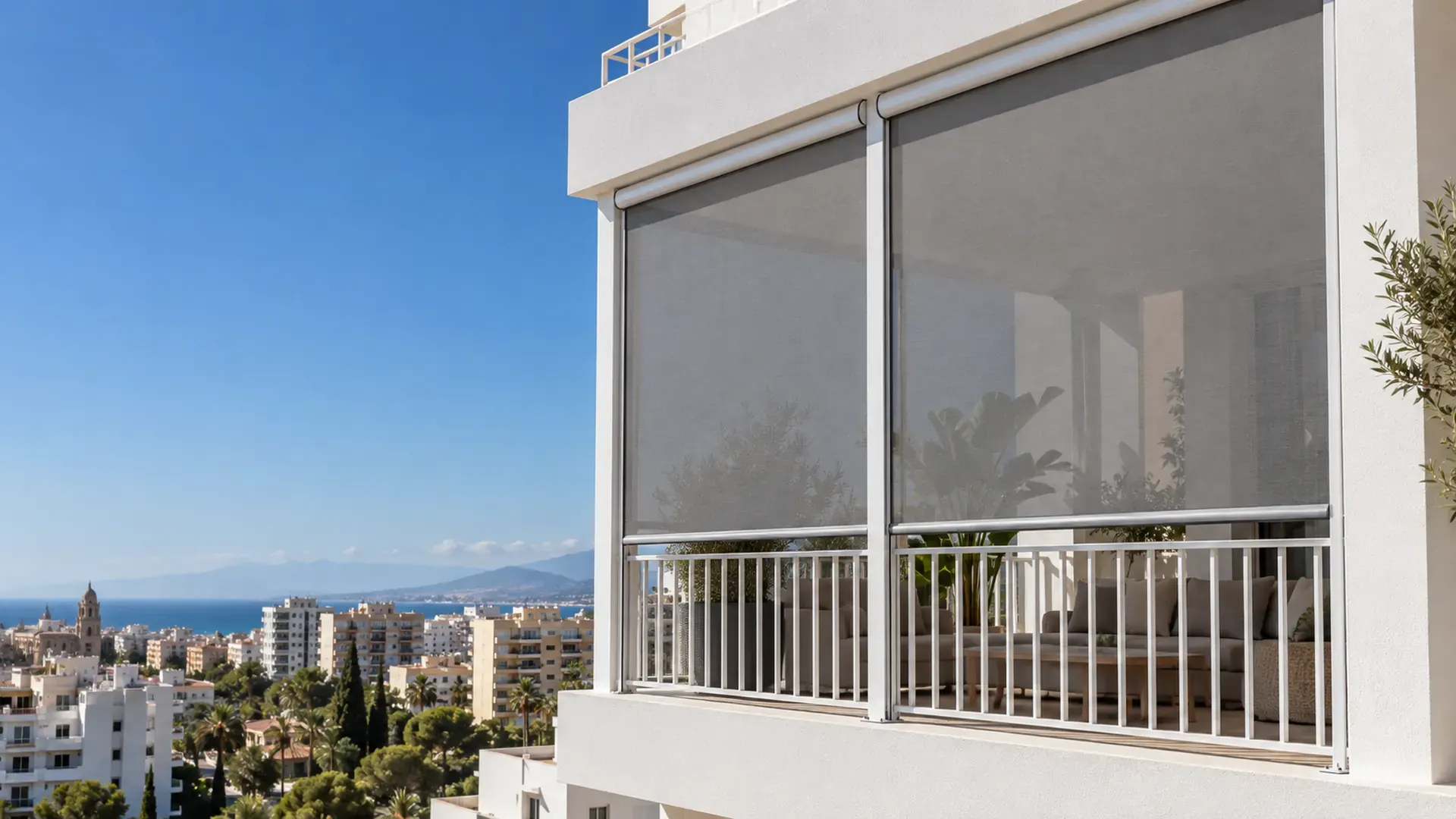
Vertical awnings in Malaga solve what a terrace awning can’t: the afternoon sun that comes in almost flat, the neighbour opposite looking straight in and the breeze that blows in from the side. The fabric drops vertically from a roller tube, like an outdoor curtain, and sits right in front of the problem.
Within this family, the roller awning is the simplest: the fabric hangs free with a weight bar and, depending on the model, hinged arms that push it out over the railing. It’s the classic choice for balconies and windows. The vertical awning with side guides holds the fabric at the sides with cables, aluminium profiles or a zip, and it’s the one that stands up to the wind on porches and open terraces.
Both are made to measure, operated by crank handle or by Cherubini motor, and can be made in opaque acrylic fabric or micro-perforated fabric so you don’t lose the view. We’ll help you choose based on which way you face and the wind in your area.
Where do we fit them?
- Flat balconies
- West-facing terraces
- Villa porches
- Large windows
- Beach bars
- Play areas
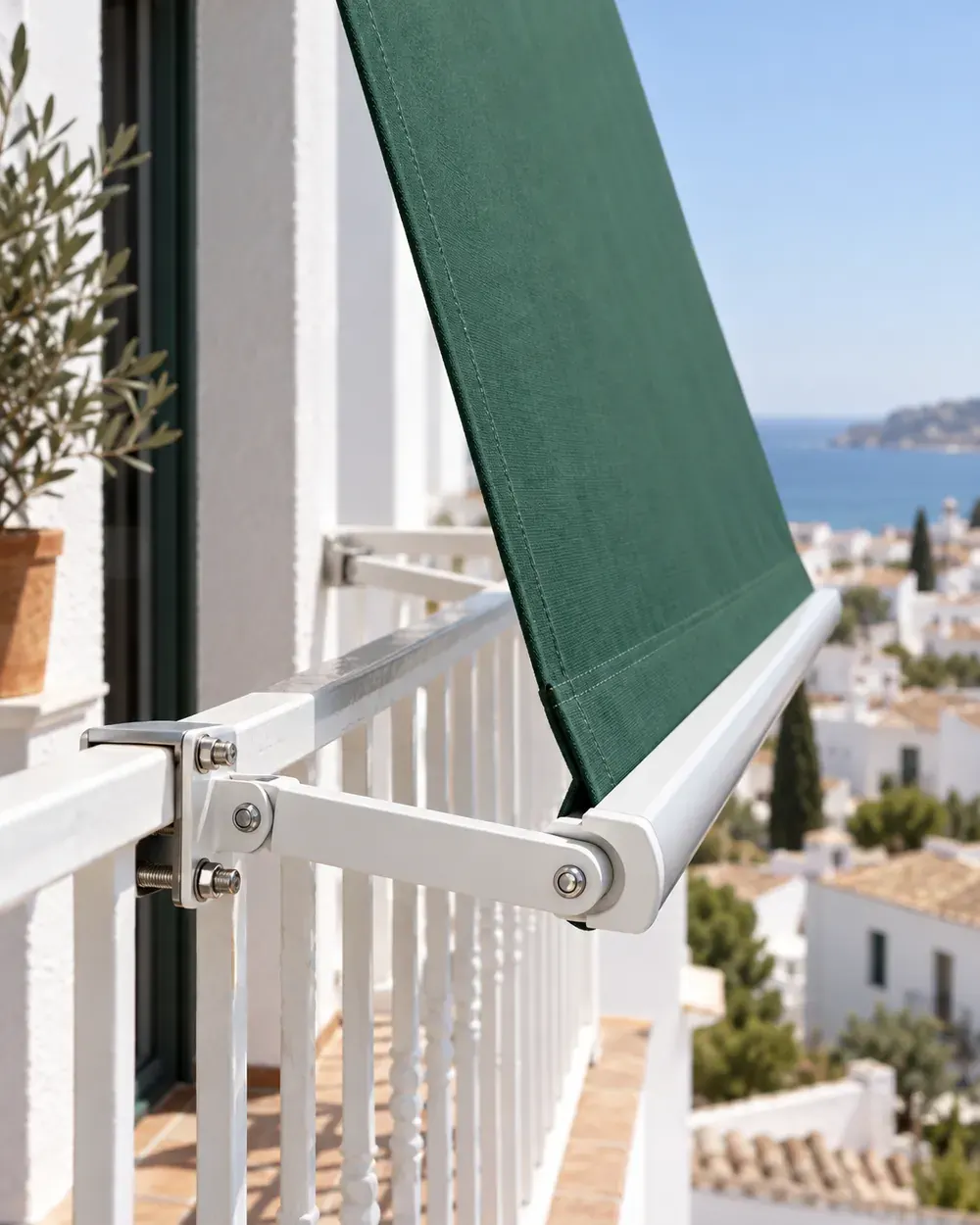
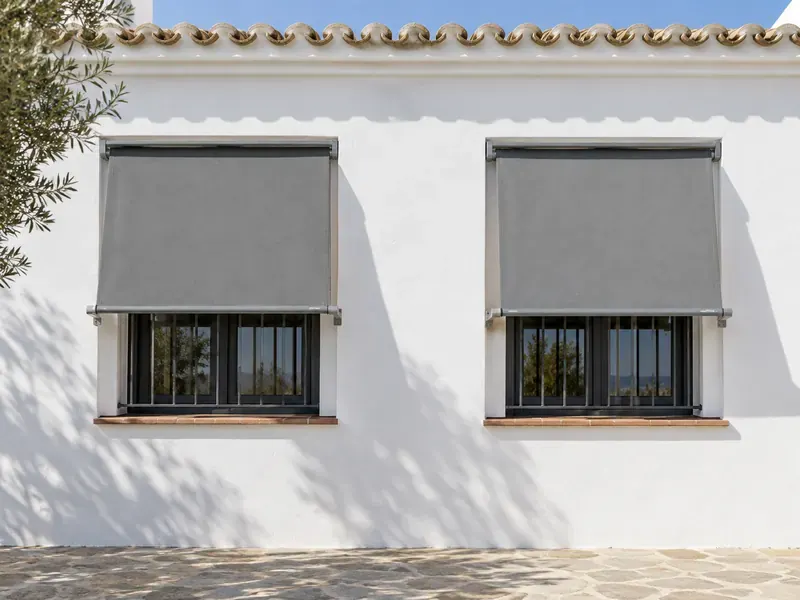
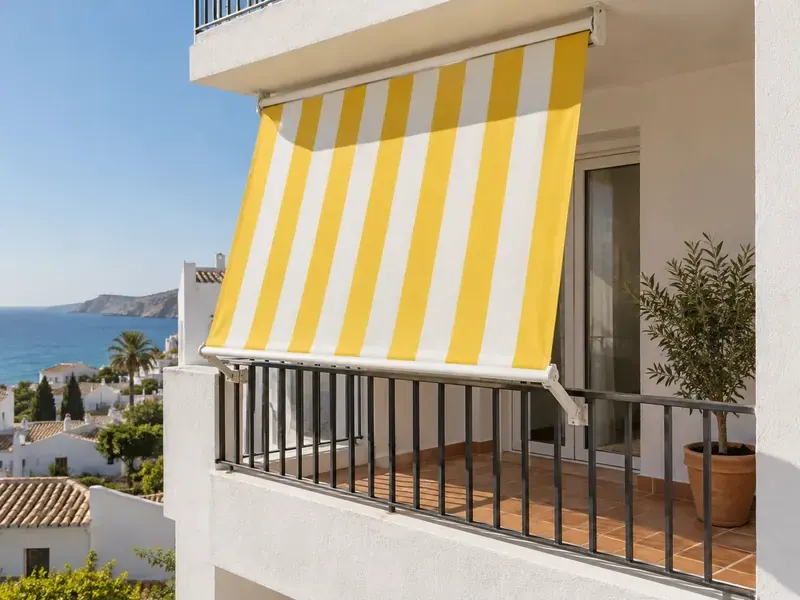
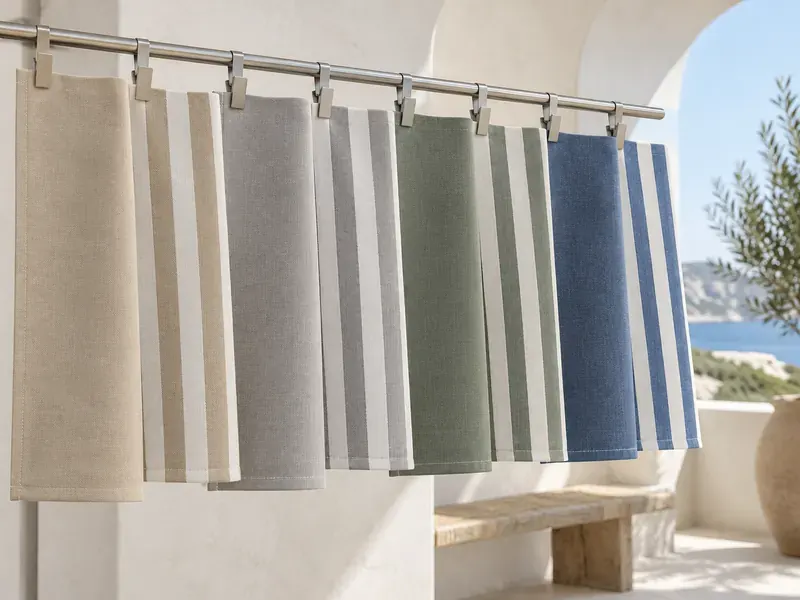
Roller awning, roller with arms or vertical with side guides
Three ways to drop a fabric vertically. The choice depends on how exposed the opening is to the wind and whether you want the fabric to project outwards.
Free-hanging roller awning
The fabric drops straight down with a weight bar. Simple, discreet and effective on windows and balconies sheltered from the wind, or under a porch.
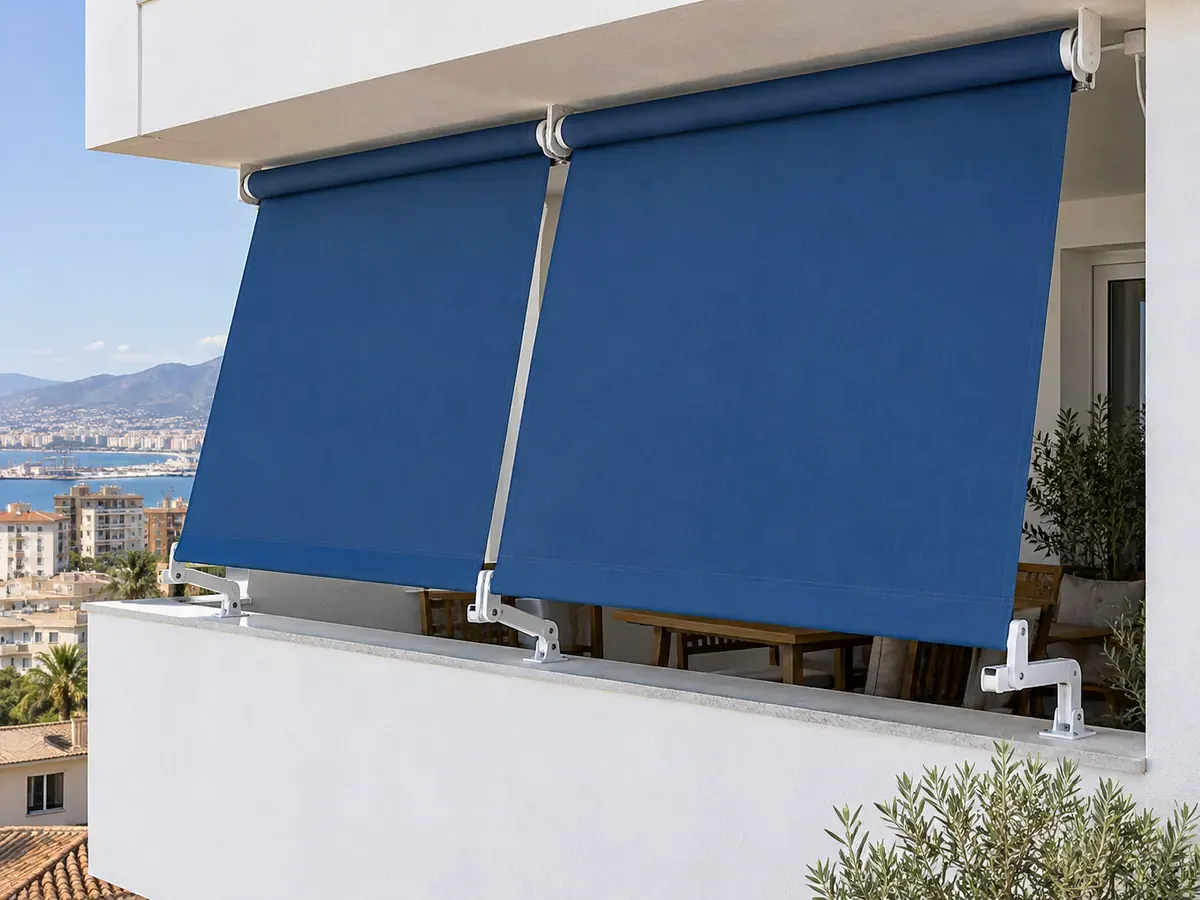
Balcony roller awning with arms
Hinged arms at the bottom push the fabric out over the railing. More airflow, more light and a firmer hold than a free-hanging roller.
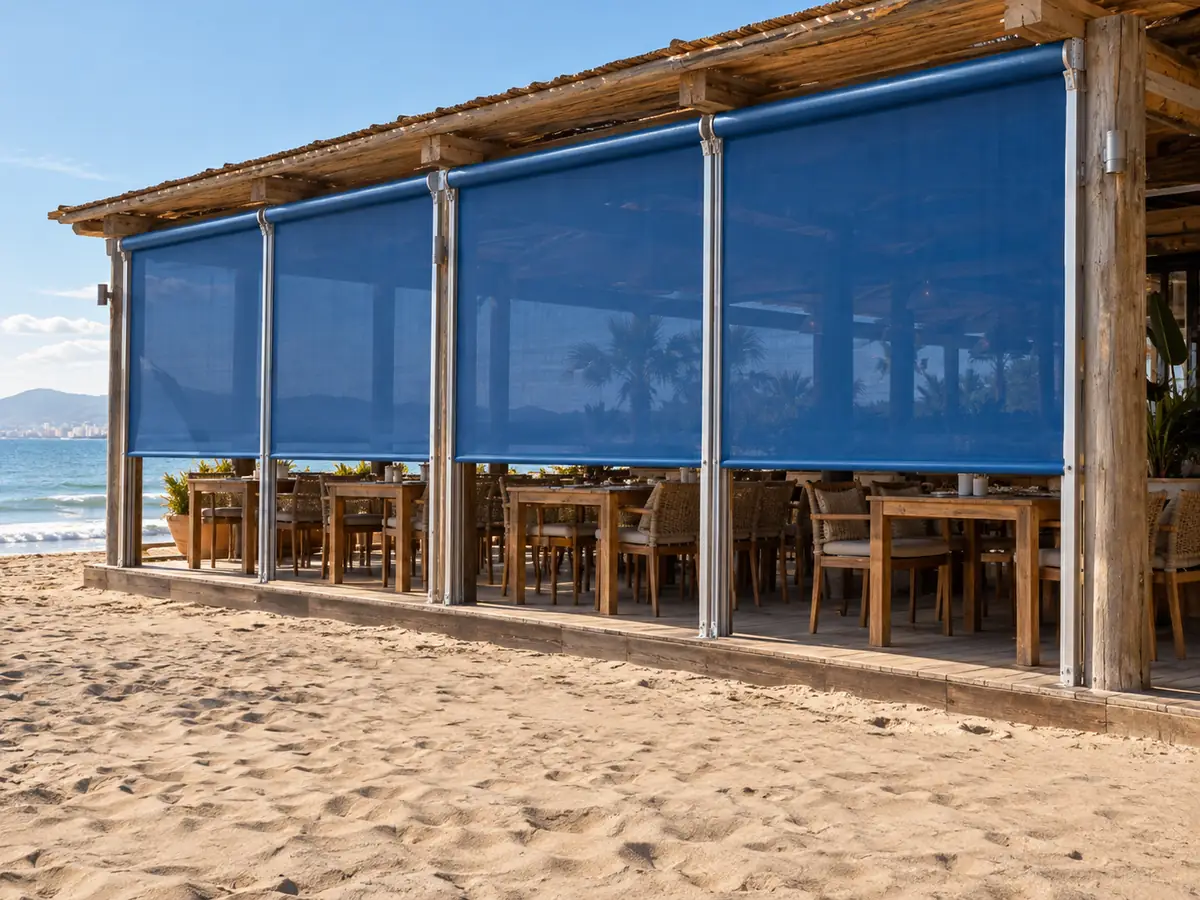
Vertical awning with side guides
The fabric runs along side cables or profiles and won’t blow loose in the wind. For maximum stability, the zip screen has a zip running inside the guide.
If you want to close off one side of the terrace completely against the levante, take a look at the windbreak awning with side guides. And for windows where you’d rather the fabric dropped at an angle and let the air through, the system you want is the drop arm awning.
Design your vertical awning in 30 seconds
Choose the fabric and frame colour, lower and raise the fabric to see how it blocks the sun and add a Cherubini motor. When you’re happy with it, ask for a quote with your design and we’ll fine-tune it at the visit.
1. Type of awning
2. Sauleda or Dickson fabric Beige stripes
3. Frame colour White
5. Approximate size
Your design
For guidance only. Colours are approximate: at the visit we’ll show you the real fabric sample book and confirm sizes and finishes.
What’s included with your roller or vertical awning
We hand it over installed, aligned and working. If there are several awnings, they all sit at the same height with the same drop.
- Free home visit, measuring and advice
- A look at which way you face and the wind
- Awning made to measure for the opening
- Acrylic or micro-perforated fabric
- Arms, cables or guides depending on the system
- Powder-coated aluminium frame
- Stainless fixings
- Crank handle or Cherubini motor with remote
- Installation by our own technical team
- Guarantee and after-sales service
The weight bar has to sit flush. On vertical awnings with side guides we measure any slope in the floor or low wall so the bar rests along its full length. If there’s a gap at one end, the wind gets in there and the fabric works harder.
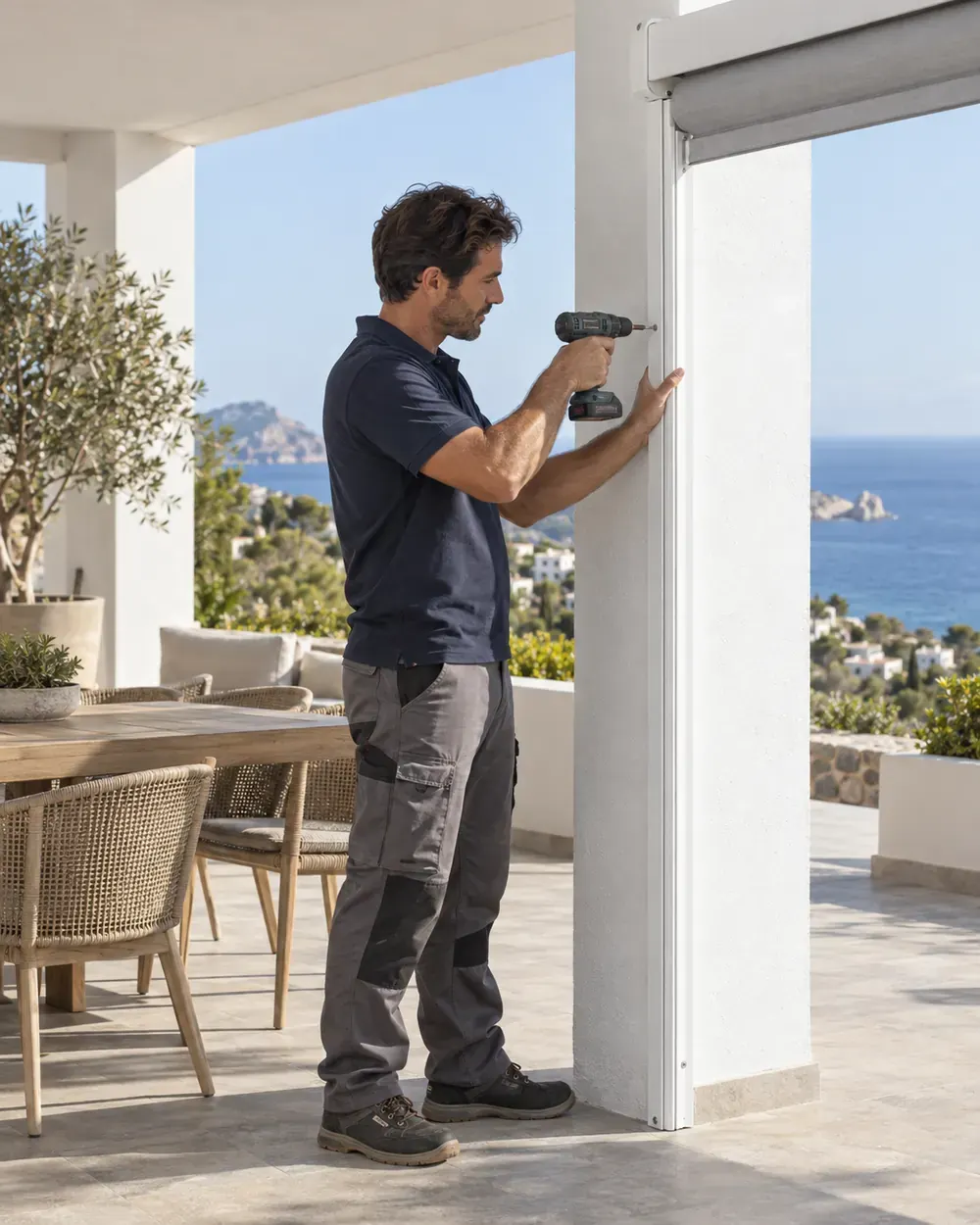
How we install your vertical awning
Six clear steps and a price that doesn’t change along the way.
- Home visit and measuringWe measure the opening, the height and any slope, and look at where the sun and wind come from.
- System and fabricWe choose a free-hanging roller, one with arms or one with side guides, and show you acrylic and micro-perforated fabrics.
- Fixed-price quoteIn writing, with no obligation and a fixed price, often in under 24 hours.
- Made to measureWe order each awning to its exact size, with your chosen fabric and frame colour.
- Fitted by our own teamWe anchor the tube, arms or guides with stainless fixings and line up the drop.
- Testing and handoverWe lower and raise it with you, programme the remote if it has one, and you get our guarantee and after-sales service.
Send us a photo of your balcony or porch? We’ll tell you which vertical awning fits before we come to measure.
Send a photo on WhatsAppThe difference between a roller awning and a guided vertical awning
Both drop vertically, but they don’t behave the same in the wind or suit the same places.
| Feature | Roller awning | Vertical with side guides |
|---|---|---|
| How the fabric is held | Free-hanging with a weight bar, or with hinged arms | Cables, side profiles or a zip |
| Wind | Moves in the breeze; retract it if it’s windy | Much more stable, depending on the system |
| Where it fits | Balconies, windows and sheltered openings | Porches, open terraces and pergolas |
| Projection | With arms, the fabric projects over the railing | Drops straight down, close to the opening |
| Opening size | Small and medium | Medium and large |
| Look | Light and classic | Clean, with side profiles |
| Operation | Crank handle or Cherubini motor | Crank handle or Cherubini motor |
If the wind is strong and the opening is large, the next step up is the zip screen. You’ll find every system on our made-to-measure awnings in Malaga page.
Vertical awnings in Malaga: what affects the price
We don’t give “from” prices, because a roller awning for a window and a guided vertical awning for a porch are very different products. This is what drives the quote:
A fixed, written quote in under 24 hours
We come and measure for free, explain each option and give you a price that won’t change halfway through the job. No obligation.
Vertical awnings in Malaga, the Axarquia and the Costa Tropical
From Velez-Malaga we install roller and vertical awnings right across the Axarquia, Malaga city, the Costa del Sol and the Costa Tropical. On west-facing facades they block the afternoon sun; on the seafront and in areas hit by the levante, we choose side guides and stainless fixings so the fabric stays firm.
Malaga and Costa del Sol
Costa Tropical and Granada
Shall we fit your vertical awning?
Tell us what you need in four quick steps and we’ll call you to arrange the visit. No obligation.
- Free home visit and measuring
- A fixed, written quote in under 24 hours
- Fitted by our own team, no subcontractors
- Guarantee and after-sales service close to you
Frequently asked questions about vertical awnings in Malaga
What’s the difference between a roller awning and a vertical awning?
Both drop the fabric vertically, which is why the names are often used interchangeably. The difference lies in how the fabric is held at the bottom and the sides. The roller awning is the simplest: the fabric unrolls from a tube and hangs free, with a weight bar at the bottom. Depending on the model, it can have hinged arms that push the lower part outwards, over the balcony railing.
When we talk about a vertical awning in the broader sense, we usually mean the whole family of awnings that drop vertically, including those with guided fabric: tension cables, aluminium side guides or the zip system of the zip screen. The guides stop the fabric moving in the wind and let you close off larger openings, such as porches and terraces.
In practice, a roller awning is ideal for balconies, windows and sheltered terraces where you want shade and privacy without any fuss. A guided vertical awning is for larger or more exposed spaces, where the wind is part of everyday life.
If what you need is to close off one side of the terrace completely to stop the levante or the poniente (the easterly and westerly winds), have a look at the windbreak awning with side guides too. At the free visit we’ll show you which one suits your space.
Which vertical awning copes best with the wind on the coast?
The one with the fabric held at the sides. A roller awning with free-hanging fabric moves in the slightest breeze: it’s fine on a sheltered balcony, but on an exposed terrace it bangs about, makes a noise and takes a beating. As soon as wind is a regular thing, you want a guided system.
There are three levels. Tension cables keep the weight bar in place and limit the swaying, and they’re a discreet solution. Aluminium side guides hold the edges of the bar or the fabric and give a much firmer hold; this is the vertical awning with side guides we fit most often on porches. And the zip screen has a zip welded to the edge of the fabric that runs inside the guide, so the fabric won’t come out even when the wind pushes against it.
If you’re looking for vertical awnings in Malaga, where the levante and the poniente blow in during the afternoon, we recommend side guides on any open terrace, and a zip screen when the wind is strong or the opening is large. The exact wind resistance depends on the model and size and is set by the manufacturer; at the visit we’ll tell you which system makes sense for your terrace.
Even so, any fabric awning should be retracted in a storm. With a Cherubini motor and a wind sensor, depending on the model, it goes up on its own. You’ll find more information on our awning motorisation page.
Will a balcony roller blind block my sea view?
It depends on the fabric you choose and how you use it. With an opaque acrylic fabric, a balcony roller awning gives you shade and privacy, but fully lowered you can’t see out. That’s why many customers use it at half height or push it out with hinged arms: it blocks the sun in front of you and you can still see over the top or round the sides.
If you don’t want to give up the view, the answer is a micro-perforated technical fabric or screen fabric. These fabrics have an open weave that blocks much of the sun and heat, but you can see outside from indoors, especially when it’s brighter outside than in. During the day it’s hard to see in from the street, so you keep a degree of privacy. The exact properties depend on each fabric and manufacturer.
On a sea-view balcony in Nerja, Torrox or Rincon de la Victoria, it’s usually the best combination: cool shade at lunchtime with the sea right in front of you. At the visit we show you real samples so you can see what the view looks like through each one.
If you want shade but with the window clear and the view open underneath, compare it with the drop arm awning, which comes down at an angle. And if your balcony is a generous size, a small retractable awning might suit you.
When is a vertical awning better than a horizontal one?
When the sun is low. A horizontal awning, like a retractable one, is perfect at midday with the sun high in the sky: it casts its shade directly below. But late in the afternoon, on a west-facing terrace, the sun comes in almost flat and slips in under the fabric. That’s where a vertical awning does its job, because it sits in front of the sun like a screen.
It’s also better when you want privacy. On terraces overlooking the street, a neighbour or a communal area, a vertical awning blocks the view from outside without any building work. And when the problem is wind from the side, a vertical awning with side guides stops the air at the side of the terrace, which a horizontal awning simply can’t do.
The most common approach on the coast is to combine the two: a horizontal awning for midday shade and a vertical one on the side or the front for the afternoon sun, the wind or the neighbour’s view. It works really well on penthouses and villa porches, and under pergolas too, where the afternoon sun comes in from the side.
If you’re unsure, there’s an explanation of how to keep the heat out in which awning keeps the heat out best, and every system on our made-to-measure awnings in Malaga page.
Can vertical awnings be fitted to a pergola or a porch?
Yes, and it’s one of the best ways to make the most of a porch or a pergola. Vertical awnings can be fixed between the posts, under the front beam or on the side, turning an open space into a room you can close off when the wind blows, when the afternoon sun comes in or when you want more privacy.
On porches and pergolas we usually use guided systems, because the opening tends to be large and exposed. A vertical awning with side guides or a zip screen keeps the fabric taut even in the wind, and looks neat between the posts. To close it in completely and use the porch in winter, take a look at our aluminium and glass enclosures too.
Before installing, we always check that the structure has somewhere solid to anchor to, especially if the pergola is wooden or made from a lightweight profile. We also measure the clear height and any slope in the floor, so the weight bar rests properly along its full length and there are no gaps.
If you have a pergola, whether we fitted it or another installer did, we can add vertical awnings to it. If you don’t have one yet, on our pergolas in Malaga page you’ll see options already designed with side screens in mind.
Which fabric should I choose for a roller awning: acrylic or micro-perforated?
It depends on what you want to achieve. Acrylic fabric is the classic awning fabric: opaque and available in plains and stripes. It gives dense shade and plenty of privacy, and it’s the best choice if you don’t want anything to be seen from outside or if the roller awning has to match other awnings on the facade. We work with the Sauleda and Dickson collections.
Micro-perforated or screen fabric has an open weave. It blocks a good part of the sun’s radiation, lets the air through and lets you see outside from indoors. It’s the one to go for when you don’t want to lose the view or the natural light, for example in a living room that opens onto the terrace or on a balcony with views. Its exact properties vary depending on the fabric and the manufacturer.
There are a few more things to bear in mind. A dark colour in a screen fabric gives a better view out; a light one reflects more heat. On a free-hanging roller, acrylic fabric is a little heavier and moves less in the breeze. And if your community requires a particular colour, we’ll find it in the sample book. You’ll find care tips in how to clean an awning.
At the visit we show you real samples and make a recommendation based on which way you face. If the fabric on your current roller awning is worn, we can replace it without changing the whole awning: we explain how in awning repairs and fabric replacement.
Can I motorise my roller awnings and operate them all at once?
Yes. Roller and vertical awnings can be motorised with a Cherubini motor inside the roller tube, and operated by remote control or a wall switch. The real advantage comes when you have several: with a multi-channel remote you can raise or lower each one separately or all of them at once.
It’s very handy on facades with several balconies, on porches with vertical awnings on three sides or on bar and restaurant terraces with lots of awnings. Instead of going round the house turning crank handles, one button lowers all the shading on the sunny side, and another raises it when the sun has gone.
Depending on the model, you can add automation: a sun sensor that lowers the awnings when the heat builds up, even when you’re out, and a wind sensor that raises them when gusts hit. On the coast that’s real peace of mind, because a free-hanging roller left down in the levante takes a real battering and can end up with torn fabric.
If you already have roller awnings with a crank handle, in many cases we can motorise them without replacing the awning, as long as the tube and fabric are in good condition. We need a power point nearby, and we’ll point that out at the visit. You’ll find all the details on our awning motorisation page and in the article on the roller awning.
Are there vertical awnings for bars and beach bars?
Yes, and they’re among the most useful for hospitality businesses on the coast. On a bar terrace on the promenade, the afternoon sun comes in from the side just when it’s busiest, and the wind can change from one minute to the next. A vertical awning at the front or sides keeps the terrace full: it shades the tables, cuts the wind and, with guided fabric, copes better with the breeze.
For businesses we recommend guided, motorised systems. The guides stop the fabric hitting customers or waiting staff, and the motor means a single member of staff can lower and raise all the shading in seconds. And if you want to keep customers warm in winter too, it can be combined with a windbreak awning with side guides with a clear window.
Before installing on public land you need to check each town’s terrace bylaw, which may regulate the type of awning, side screens and colours. We’ll advise you at the visit and, if needed, handle the paperwork so you don’t run into problems with the council inspectors.
You’ll find more ideas for your business on our awnings for bars and restaurants page. And if your vertical awning is already worn, we’ll repair it even if we didn’t install it.