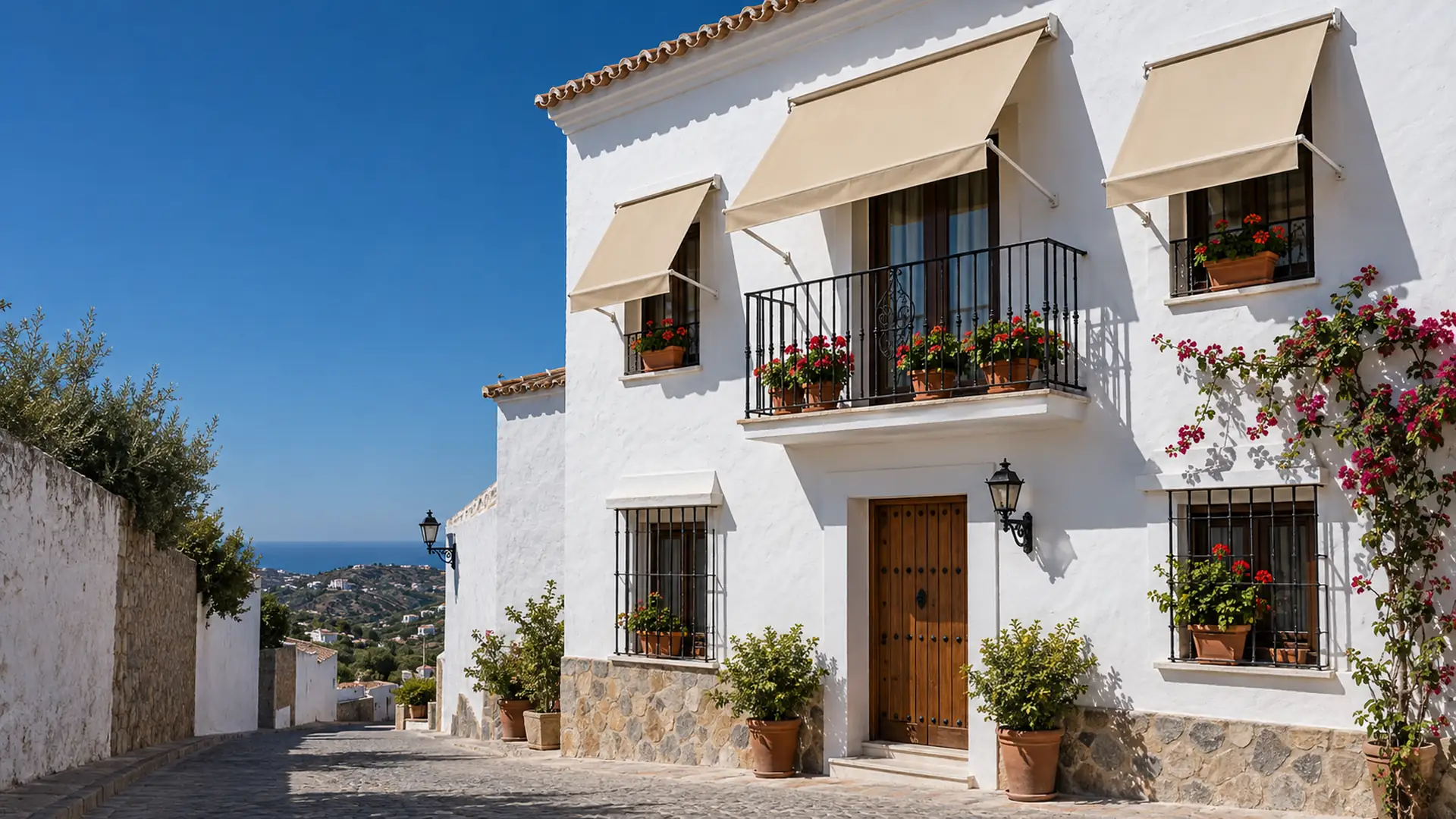
Home › Awnings › Drop arm awnings
Drop arm awnings · Malaga, Axarquia and Costa TropicalDrop arm awnings in Malaga for windows and balconies
Stop the sun before it reaches the glass. We install drop arm awnings in Malaga made to measure for each window or balcony: the fabric angles down, gives shade and still lets the air and the view through. With or without a cassette, manual or with a Cherubini motor, and fitted by our own team.
- Our own team, no subcontractors
- Home visit and measuring free
- Fixed-price quote in under 24 hours
- Powder-coated aluminium and stainless fixings
- Guarantee and after-sales service
In short
A drop arm awning in Malaga shades windows and balconies: the fabric comes down at an angle on two arms, blocking the sun while letting air and the view through. QUBRE makes it to measure, with or without a cassette, manual or with a Cherubini motor, with Sauleda or Dickson fabric and fitted by our own team.
Updated · QUBRE technical team, Velez-Malaga
What is a drop arm awning and when is it the right choice?
A drop arm awning in Malaga is the classic way to shade windows and balconies. It’s fixed above the opening and has two straight arms, one on each side, that pivot out from the facade. When you lower it, the arms swing out and the fabric angles outwards, like a visor that blocks the direct sun.
Its big advantage is that it doesn’t close off the window. Soft light comes in under the fabric and the air keeps moving, so the room stays cool without being plunged into darkness, and you can still see the street or the sea. That’s why it’s the awning for south and west-facing bedrooms and living rooms, where the only alternative is keeping the shutters down all summer.
It suits almost any facade: a window awning on a house in the centre of Velez-Malaga, a balcony awning on a flat in Torre del Mar or a row of matching awnings on a building on the Costa del Sol. It can have a cassette, a crank handle or a motor.
Where do we install them?
- Bedroom windows
- Flat balconies
- West-facing facades
- Community facades
- Shop windows and premises
- Patio doors
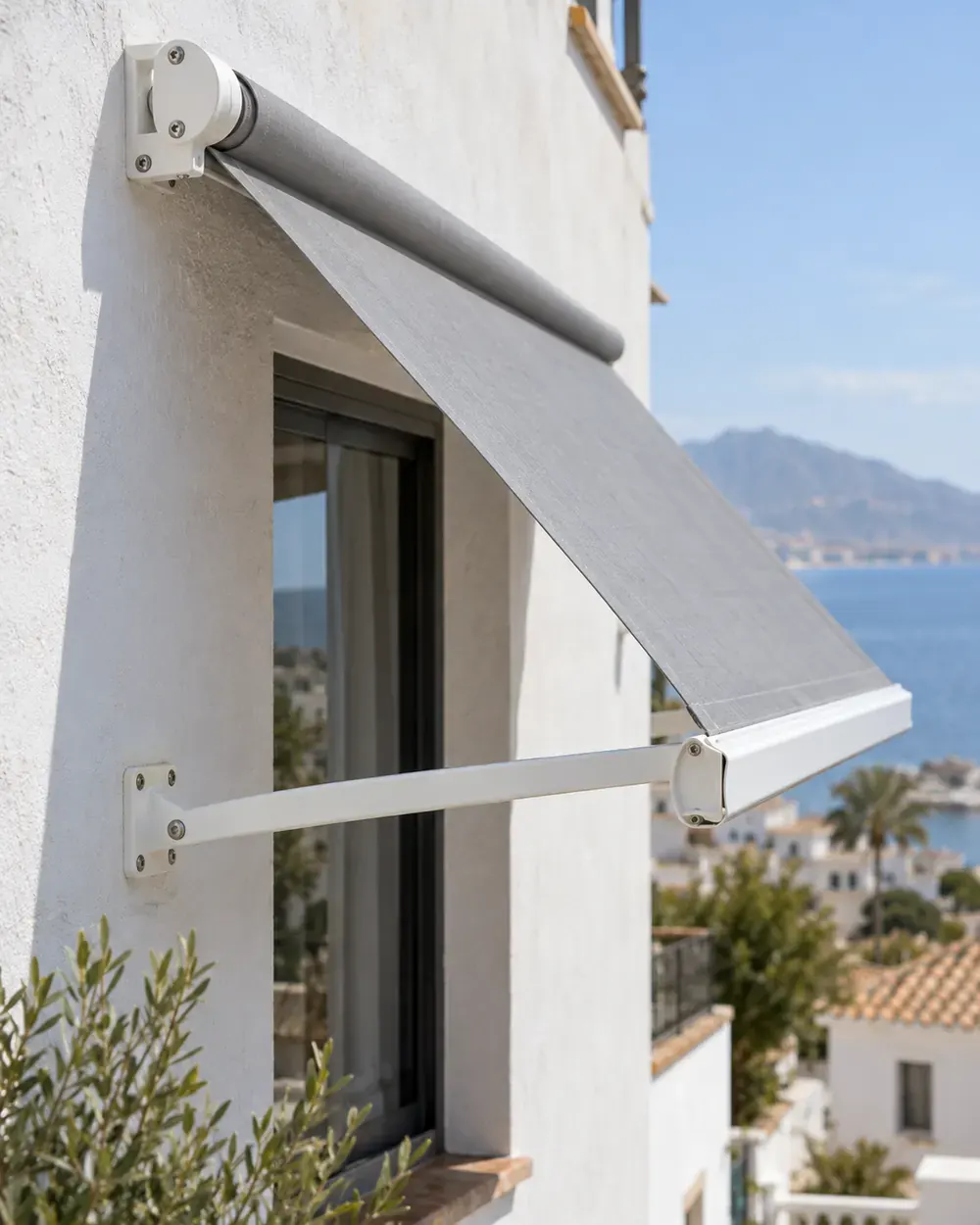
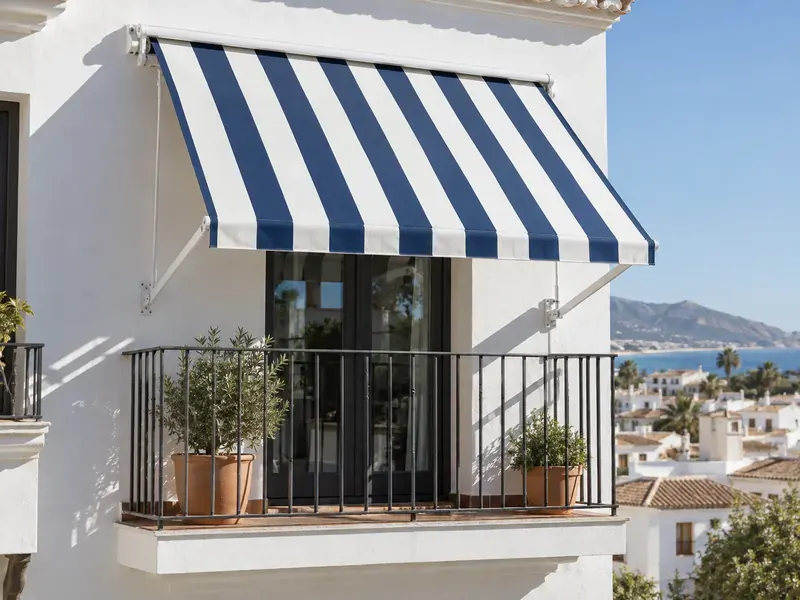
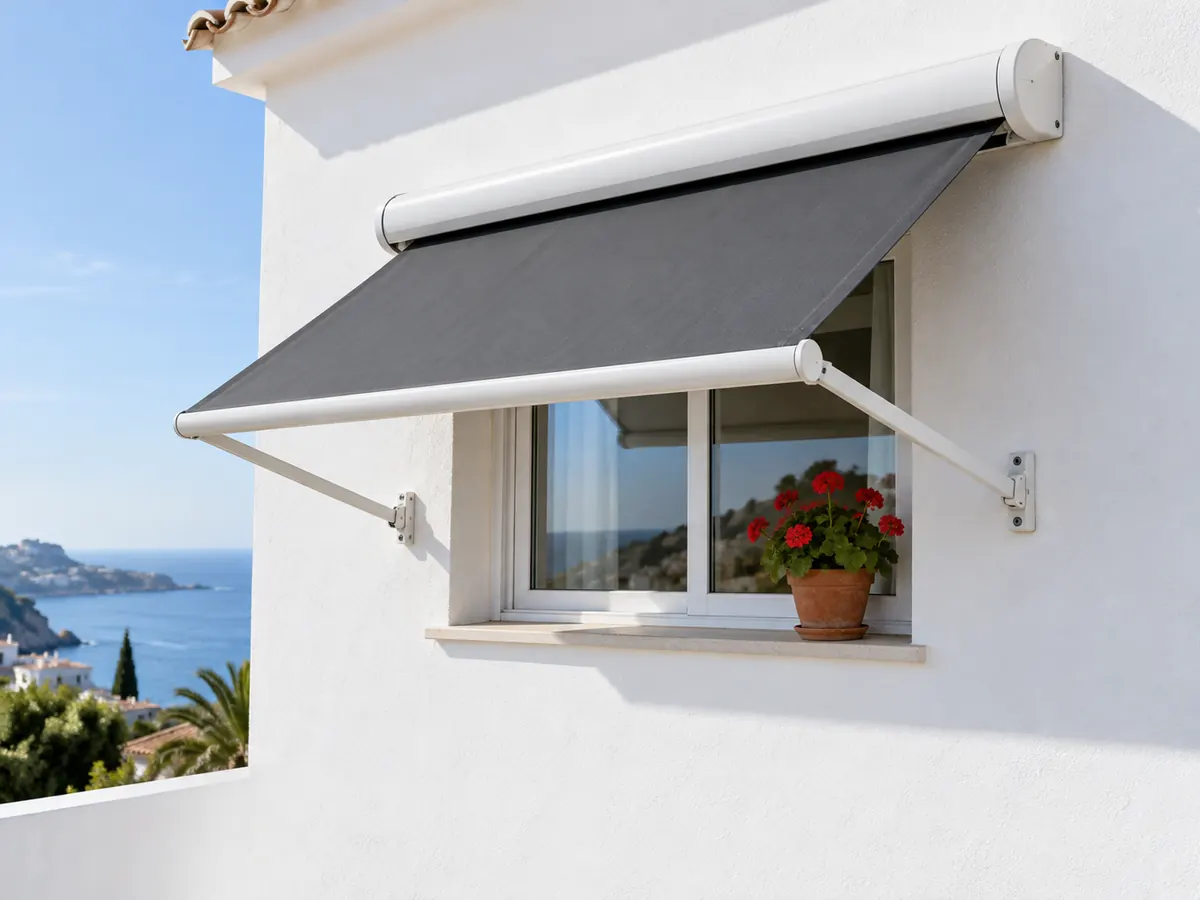
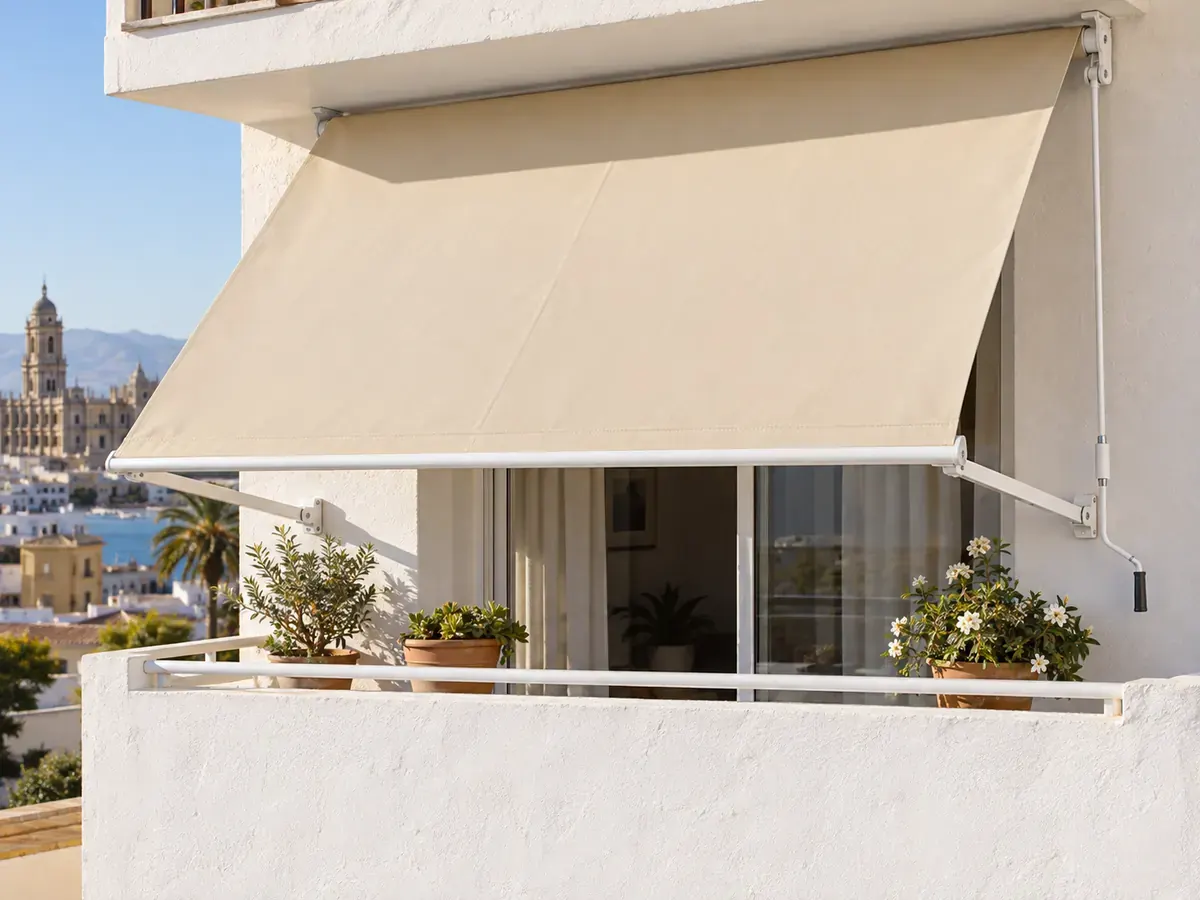
Classic, cassette or motorised drop arm awnings
Three versions of the same idea: angled shade over the opening. We help you choose based on the facade, how exposed it is and how you want to operate it.
Classic drop arm
A tube with the rolled-up fabric and two arms that pivot from the facade. Simple, effective and operated with a crank handle. Ideal under eaves or a balcony above that shelters it.
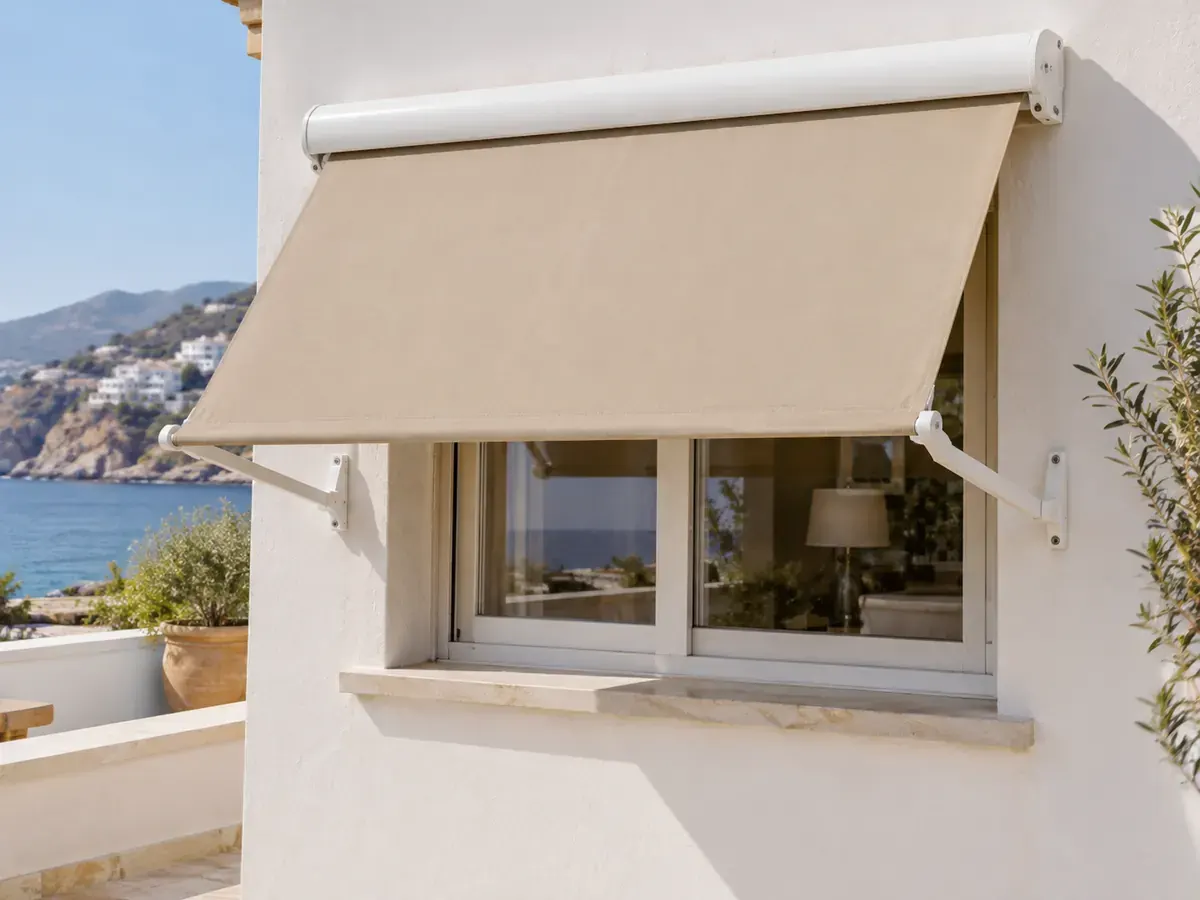
Drop arm awning with a cassette
The fabric retracts into an aluminium case. More protection from rain, sun and salt air, and a neater facade. The same principle as the cassette awning.
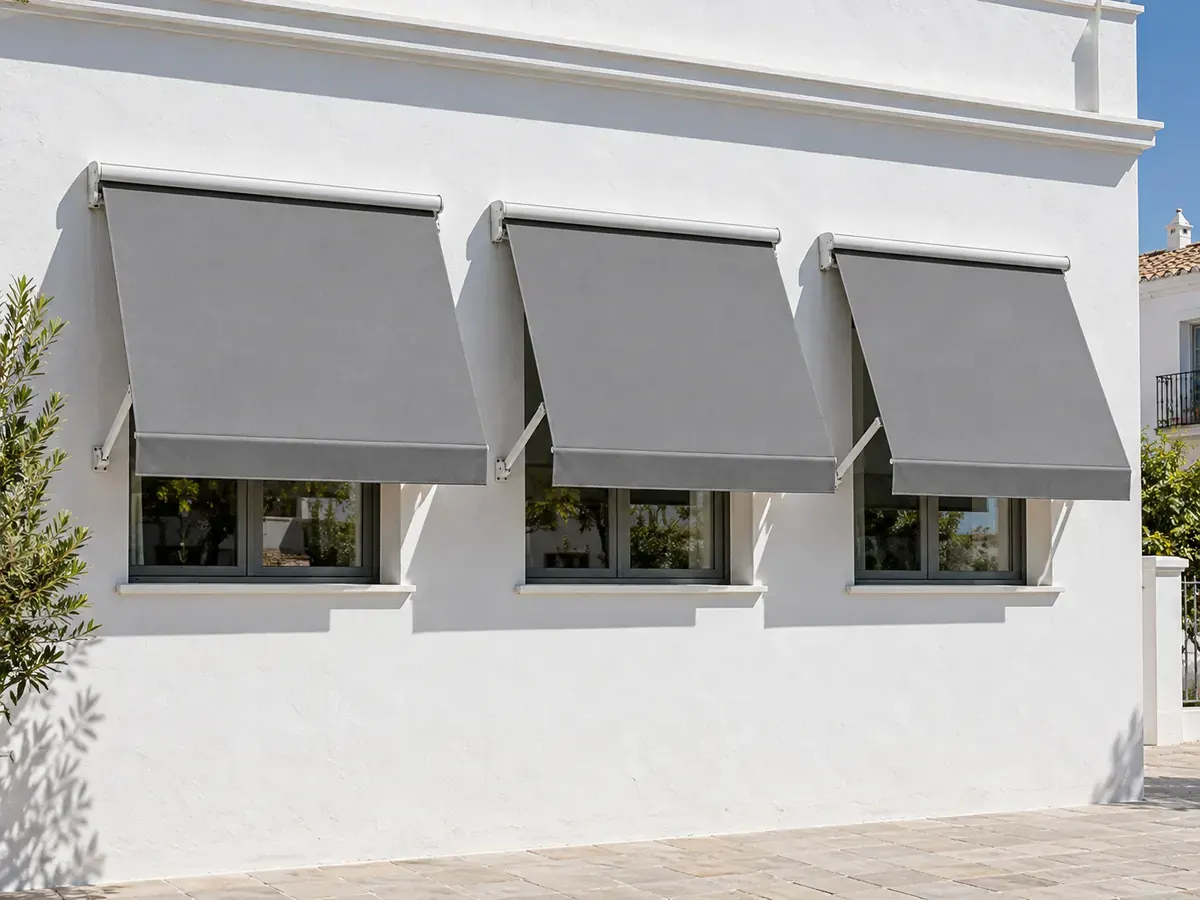
Motorised drop arm awning
A Cherubini motor in the tube and a remote control. With a multi-channel remote you can operate every awning in the house. See motorisation.
If you’re after shade to sit under on a terrace, the right system is the retractable awning. And if the sun comes in very low or you want privacy, take a look at roller and vertical awnings.
Design your drop arm awning in 30 seconds
Choose a Sauleda or Dickson fabric and the frame colour, lower and raise it to see how it shades the window, and add a Cherubini motor. Then ask for a quote with your design.
1. Type of awning
2. Sauleda or Dickson fabric Beige stripes
3. Frame colour White
5. Approximate size
Your design
A rough simulation with approximate colours: at the visit we show you the real fabric sample book and finalise sizes and finishes.
What’s included with your drop arm awning
We leave it fitted, lined up and working. The person who measures your window is the person who installs your awning.
- Free home visit, measuring and advice
- A look at which way the window faces
- Awning made to measure for the opening
- Your choice of Sauleda or Dickson fabric
- Powder-coated aluminium arms and brackets
- Stainless fixings
- Crank handle or Cherubini motor with remote
- Cassette, if you choose one
- Installation by our own technical team
- Guarantee and after-sales service
Several windows, one facade. If you’re fitting awnings on several windows, we measure and install them together so they line up, at the same height and with the same fabric. Your facade will look better for it, and your community will thank you too.
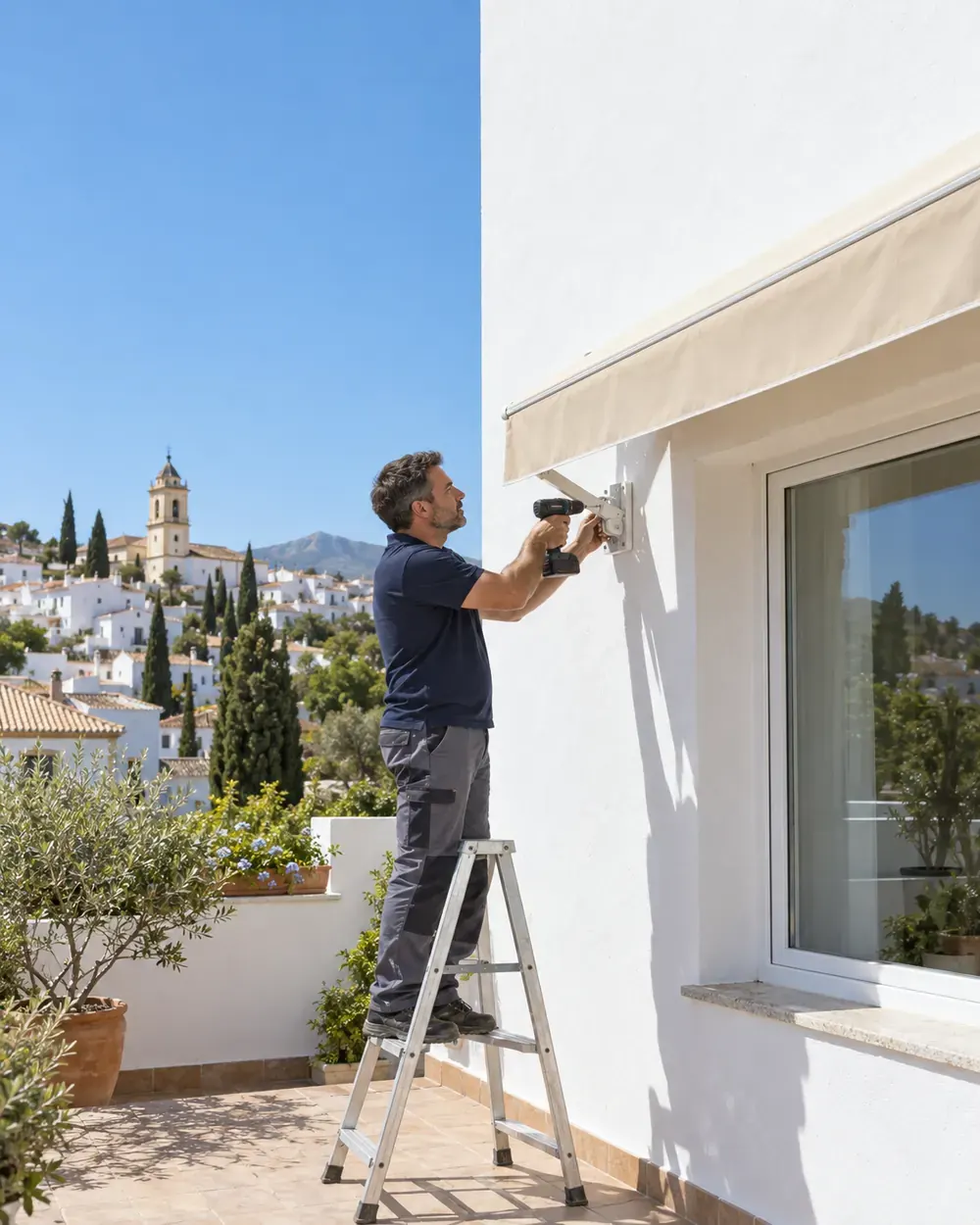
How we install your drop arm awning
A short, clear process, with a fixed price from the start.
- Home visit and measuringWe measure the opening and the height down to the railing or sill, and look at which way it faces.
- Arm lengthWe choose the arm so the fabric drops at the angle that best blocks the sun on your window.
- Fixed-price quoteIn writing, with no obligation and a fixed price, often in under 24 hours.
- Made to measureWe order the awning with your measurements, the fabric you’ve chosen and, if you want them, a cassette and motor.
- Installation by our own teamWe fix the brackets with stainless fixings, adjust the arms and line up the fabric.
- Testing and handoverWe lower and raise it with you, programme the remote if it has one, and it’s covered by our guarantee.
Can you send us a photo of the window or balcony? We’ll tell you whether a drop arm awning suits it before we come to measure.
Send a photo on WhatsAppDrop arm awning or roller awning?
Both protect windows and balconies, but they position the fabric differently. That changes the light, the airflow and the view.
| Feature | Drop arm awning | Roller or vertical awning |
|---|---|---|
| How the fabric comes down | Angled outwards, like a visor | Vertically, close to the opening or with hinged arms |
| Light and ventilation | Soft light comes in and air flows underneath | Filters more light; ventilation depends on the fabric |
| View | You can still see out | More privacy; the view depends on the fabric |
| Low afternoon sun | Can sneak in underneath late in the day | Blocks it better |
| Wind | Arms rest against the facade or railing | Moves about if free-hanging; with guides it copes much better |
| Where it fits | Windows and balconies with a view | Balconies, porches and west-facing facades |
| Operation | Crank handle or Cherubini motor | Crank handle or Cherubini motor |
We explain roller awnings and guided vertical awnings on our roller and vertical awnings page. Every system is in made-to-measure awnings in Malaga.
Drop arm awnings in Malaga: what affects the price
We don’t give "from" prices, because every awning is made to measure for a specific window or balcony. This is what moves the quote:
A fixed-price quote, in writing, in under 24 hours
We’ll measure up for free, explain every option and give you a price that won’t change halfway through the job. No obligation.
Drop arm awnings in Malaga, the Axarquia and the Costa Tropical
We install drop arm awnings from Velez-Malaga right across the Axarquia, Malaga city, the Costa del Sol and the Costa Tropical. On inland homes they keep out the afternoon sun and the hot terral wind; on seafront flats we choose a cassette and stainless fixings so the salt air doesn’t take its toll.
Malaga and Costa del Sol
Costa Tropical and Granada
Shall we bring some shade to your window?
Tell us what you need in four quick steps and we’ll call you to arrange the visit. No obligation.
- Free home visit and measuring
- A fixed, written quote in under 24 hours
- Fitted by our own team, no subcontractors
- Guarantee and after-sales service close to you
Frequently asked questions about drop arm awnings in Malaga
What is a drop arm awning and how is it different from a retractable awning?
A drop arm awning is fixed above a window or balcony and has two straight arms, one on each side, that pivot from a fixed point on the facade. When you lower it, the arms swing outwards and the fabric sits at an angle, like a visor. There’s no elbow joint: each arm is a single straight piece that pivots and drops, hence the name.
A retractable awning works differently. Its arms have an elbow that straightens out horizontally, and the fabric extends almost flat over the terrace, creating a large area of shade to put a table under. A drop arm awning, on the other hand, is designed to protect the window opening or the front of the balcony, not to cover a whole terrace.
That angled shape has a clear advantage: the fabric blocks the direct sun but leaves a gap underneath where soft light comes in and air flows. The room isn’t left dark or stuffy, and you can still see the street or the sea. And because the arms rest against the facade itself or the railing, a drop arm awning copes well with moderate wind.
If you’re not sure which suits you, have a look at the overview of systems in made-to-measure awnings in Malaga or book a free visit and we’ll explain it on your own facade.
Which drop arm awning is best for a balcony with a railing?
On a balcony, a drop arm balcony awning is usually fitted so that when it’s lowered, the arms rest on the railing or sit just outside it. That way the fabric covers the front of the balcony and the midday sun doesn’t pour straight into the living room, while you can still step out, lean over and air the house.
There are three measurements to bear in mind: the width of the balcony, the height from the fixing point down to the railing, and how far the railing sticks out from the facade. With those figures we choose the arm length so the fabric drops at the right angle: not so vertical that it blocks your view, and not so horizontal that it lets the afternoon sun through.
If the balcony is very deep or the sun comes in very low, a roller awning with hinged arms, which drops more vertically, might suit you better, or a small retractable awning if what you want is shade on the balcony itself so you can sit out. We’ll explain it with examples at the visit.
In a flat within a community, remember to check whether there’s an approved model or fabric colour for the facade. If there is, we’ll find the same fabric in the Sauleda and Dickson collections so your awning matches your neighbours’.
Does a drop arm awning work on a window that gets the afternoon sun?
Yes, and it’s one of its most common uses. A drop arm window awning stops the sun before it reaches the glass, which is exactly what heats the room up. An interior blind or a curtain cuts the light, but by then the heat is already inside; an exterior awning stops it outside. That’s why the difference is so noticeable in west-facing bedrooms and living rooms.
With afternoon sun there’s one catch: it comes in low and at an angle. If the window faces due west, late in the day the sun can sneak in under the fabric. In those cases we play with the arm length and the drop angle so the awning covers more of the opening, or combine it with a vertical awning if the window is very tall.
The fabric colour matters too. A mid or light tone reflects more sun and gives a pleasanter light indoors; a dark tone cuts more glare but holds a little more heat in the fabric. We’ll show you in the sample book and recommend one based on which way your window faces.
If you’d like to know more about keeping the heat out of your home, there’s a detailed explanation in which awning keeps the heat out best.
Is a drop arm awning with a cassette worth it?
A drop arm awning with a cassette keeps the rolled-up fabric inside a small aluminium case above the window. When you raise it, the fabric is stored away and protected; when you lower it, it comes out of the cassette and the arms project it outwards. From outside you see a clean profile instead of a tube with the fabric on show.
It’s especially worth it in three cases. First, on facades that get direct rain and sun all day, because the fabric lasts longer when it’s stored away protected. Second, near the sea, where salt air and humidity stain the fabric sooner. And third, when you want a smarter-looking facade, for example on a renovated house or in a community that asks for a uniform look.
If your window is under a balcony or eaves that already shelter the retracted awning, a drop arm awning without a cassette works just as well and is simpler. At the visit we look at your facade and tell you honestly whether a cassette adds anything in your case.
The same principle applies to terraces: if you’re interested in full protection for a folding arm awning, you’ll find all the information on our cassette awning page. And if you’d like to compare at your leisure, book your free visit using the form.
Can a drop arm awning be motorised?
Yes. A motorised drop arm awning has a tubular motor inside the tube the fabric rolls onto, and it’s operated with a remote control or a switch next to the window. We work with Cherubini motors, which are built into the awning itself, so from the outside it looks no different.
Motorisation makes particular sense when you have awnings on several windows, because with a multi-channel remote you can lower or raise them all at once, or each one separately. It also helps when the window is hard to reach, for example over a staircase or behind furniture, and the crank handle is awkward.
On the coast there’s another advantage: depending on the model, you can add a wind sensor that raises the awning by itself in gusts, or a sun sensor that lowers it when the heat builds up. So even if you’re out all day, the house stays cool and the awning stays protected.
We also motorise drop arm awnings you already have with a crank handle, as long as the frame and tube are in good condition. We need a power point near the window, and we’ll point that out at the visit so it doesn’t come as a surprise. There’s more information in awning motorisation and awning motors.
How much wind can a drop arm awning take?
Because of its shape, a drop arm awning copes with wind better than a retractable terrace awning. The fabric is angled and the arms rest on the facade or the railing, so the wind has less surface to push against. Even so, it’s still a fabric awning, and the golden rule is the same: in strong wind, retract it.
The exact wind resistance depends on the model, the size and how it’s installed, and is set by each manufacturer. What we can control is doing a good installation: brackets properly anchored with stainless fixings, arms of the right length and well-tensioned fabric that doesn’t flap. A badly adjusted awning suffers far more in the same wind.
In places like Torre del Mar, Torremolinos or Fuengirola, where the levante or poniente (the easterly and westerly winds) blow in hard, we recommend a motor with a wind sensor, depending on the model. If you prefer a crank handle, get into the habit of raising the awning when you go out on windy days, even if everything is calm in the morning.
If your balcony or window is very exposed and you want sturdier vertical protection, take a look at the zip screen or the windbreak awning with side guides, where the fabric is held at the sides and doesn’t move in the wind.
How do you clean and maintain a drop arm awning?
It’s one of the easiest awnings to look after, because it’s small and within reach from the window or balcony. With a little care two or three times a year, the fabric and arms last much longer, even on the coast, where salt air and sand settle on everything.
For the fabric: lower it, brush it dry to remove the dust and, if it’s dirty, wash it with fresh water, mild soap and a soft sponge. Rinse it well and let it dry extended before raising it. Don’t use bleach, solvents or pressure washers, because they damage the fabric’s finish. You’ll find the steps in how to clean an awning.
For the frame: wipe the arms and brackets with a damp cloth to remove the salt, and check that the arms pivot easily and the fabric comes down straight, without one side getting ahead of the other. If you notice play, loose screws or the fabric twisting, let us know before it gets worse: it’s almost always a quick adjustment.
When the fabric is faded or torn, there’s no need to replace the whole awning. We carry out awning repairs and fabric replacement, including on awnings installed by another company, and check the arms and brackets while we’re at it.
What measurements do I need to get a quote for a drop arm awning?
To give you a first idea of the price of a drop arm awning in Malaga, we need the width of the opening (window or balcony) and the height from where the awning would go down to the sill or railing. With that and a photo of the facade, we can tell you whether a drop arm awning is a good option and what arm length suits it. You can send it to us on WhatsApp or using the form.
The awning is usually made a little wider than the opening so the shade covers the sides properly, especially when the sun comes in at an angle. How much wider depends on which way it faces and what’s around it, such as another window, a downpipe or an air-conditioning unit.
We always take the final measurements ourselves at the visit, which is free. We measure precisely, check what the wall is made of, where there’s room for the brackets and whether there’s power nearby in case you want a motor. That way the quote we give you is fixed and doesn’t change on installation day.
If you have several windows on the same facade, it’s best to measure them all at once so the awnings line up and have the same fabric. And if you live in a community, we’ll help you comply with whatever has been agreed. More information on our awnings for communities of owners page.