Home › Awnings › Monobloc awning
Monobloc awnings · Malaga, Axarquia and Costa TropicalMonobloc awnings in Malaga shade for large terraces
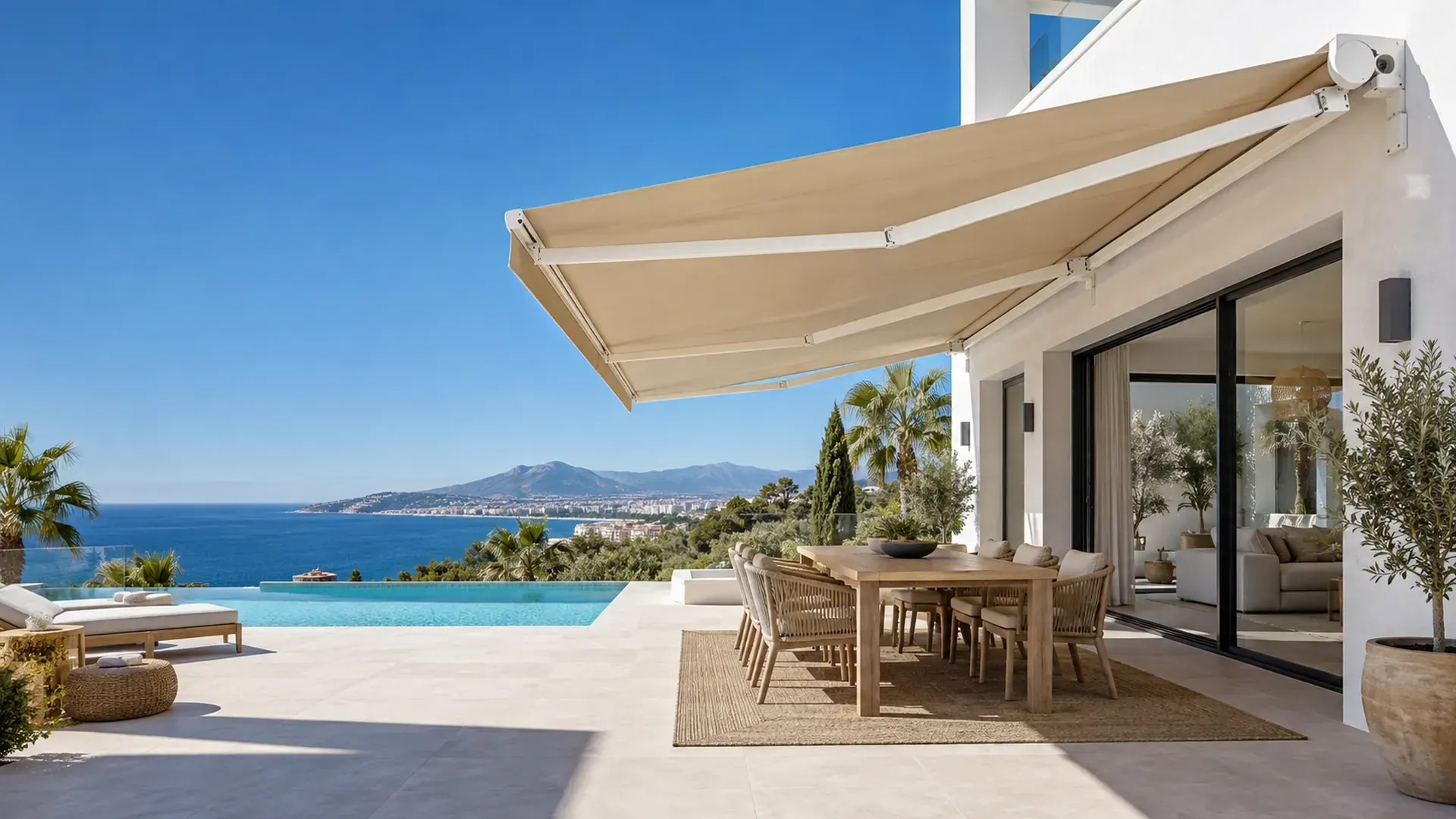
A retractable awning mounted on a square aluminium bar that makes it more rigid and easier to anchor. It’s the one to choose when the terrace is wide, the facade only allows a few fixing points or you need a lot of shade in one go. We make monobloc awnings in Malaga to measure and install them with our own team.
- Our own team, no subcontractors
- Home visit and measuring free
- Fixed-price quote in under 24 hours
- Powder-coated aluminium and stainless fixings
- Guarantee and after-sales service
In short
A monobloc awning in Malaga is a folding-arm awning mounted on a square aluminium bar, stiffer and with fewer fixing points on the facade. It is the choice for wide terraces, penthouses and businesses. QUBRE makes it to measure, with a Cherubini motor and a wind sensor depending on the model, and fits it with our own team.
Updated · QUBRE technical team, Velez-Malaga
What is a monobloc awning and why is it used for large sizes?
A monobloc awning is a folding-arm awning in which every component (the roller tube, the arm brackets and the mechanism) is mounted on a square aluminium bar running the full width. That bar is what gets fixed to the wall or ceiling. If you’re looking for a monobloc awning in Malaga for a wide terrace, this is the key point: the whole thing works as a single piece.
The bar makes it rigid and spreads the load from the arms along the facade. That’s why it needs fewer fixing points than a standard retractable awning, where each arm has its own bracket. It’s very handy on facades with little usable space for fixings, on slab edges or where obstacles have to be worked around.
It’s the system we usually suggest for long terraces, penthouses, villas and businesses that need plenty of shade. Depending on the model, it takes long-projection arms, several arms on the same awning and a motor with a wind sensor. If you want the fabric protected when it’s retracted, compare it with the cassette awning.
Where do we fit them?
- Long home terraces
- Penthouses with a long facade
- Villa porches
- Pool areas
- Bar or restaurant terraces
- West-facing facades
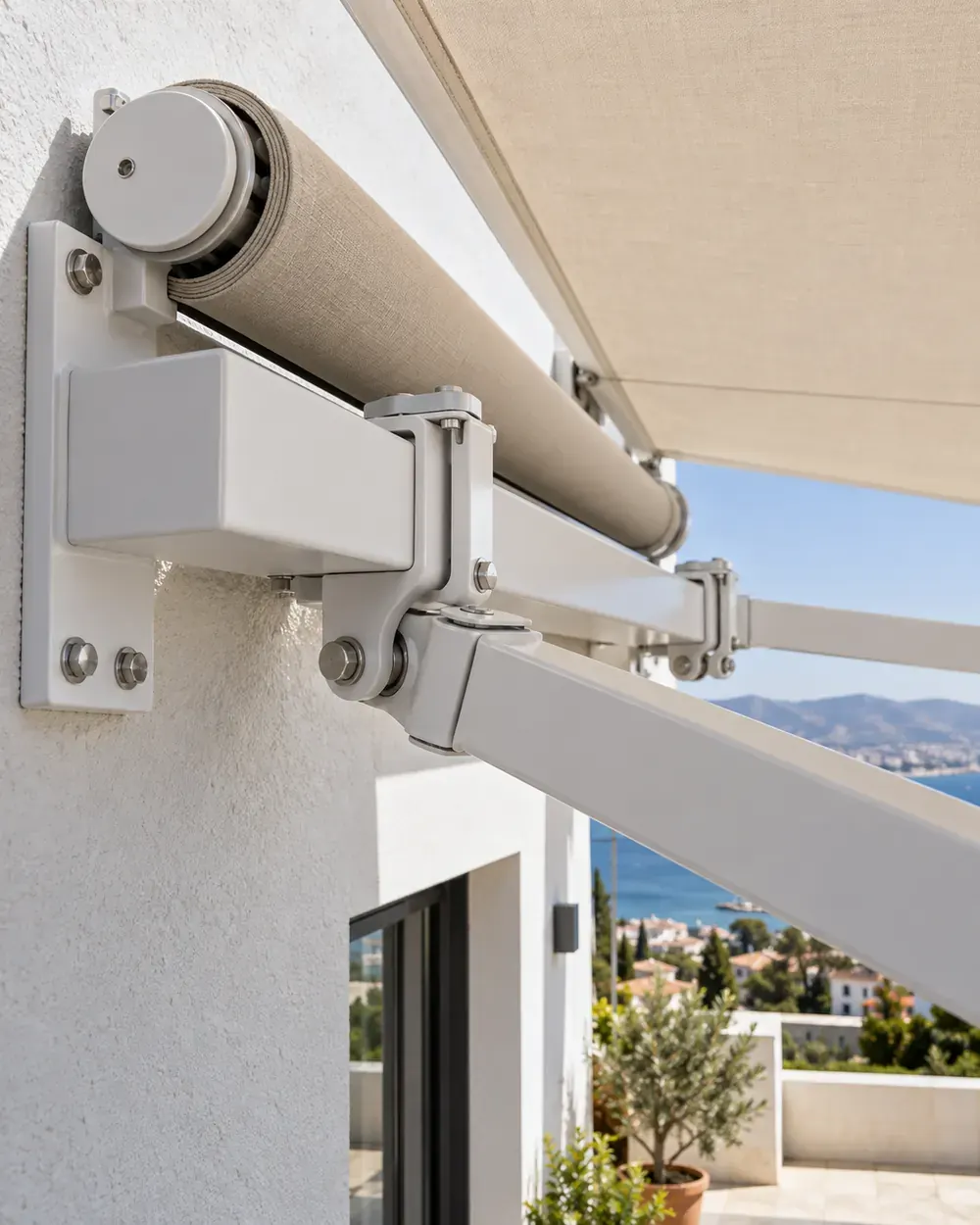
Monobloc awnings in Malaga for every type of facade
The square bar lets it be mounted in several ways. At the visit we choose the one that makes the most of your terrace.
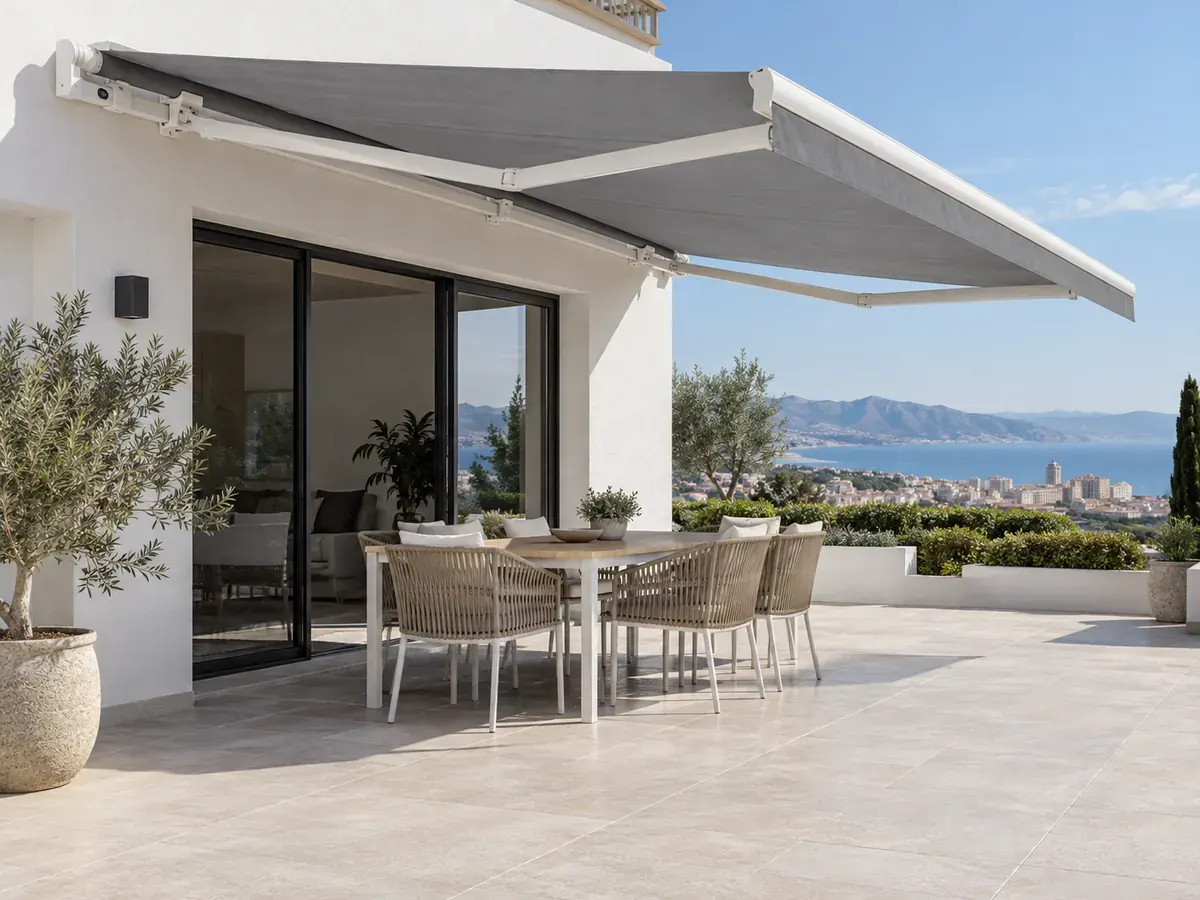
Monobloc for large sizes
When the terrace is very long, a single awning with several arms on the same bar covers the whole width without breaks. If the width calls for it, several awnings can be joined on the same bar, depending on the model.
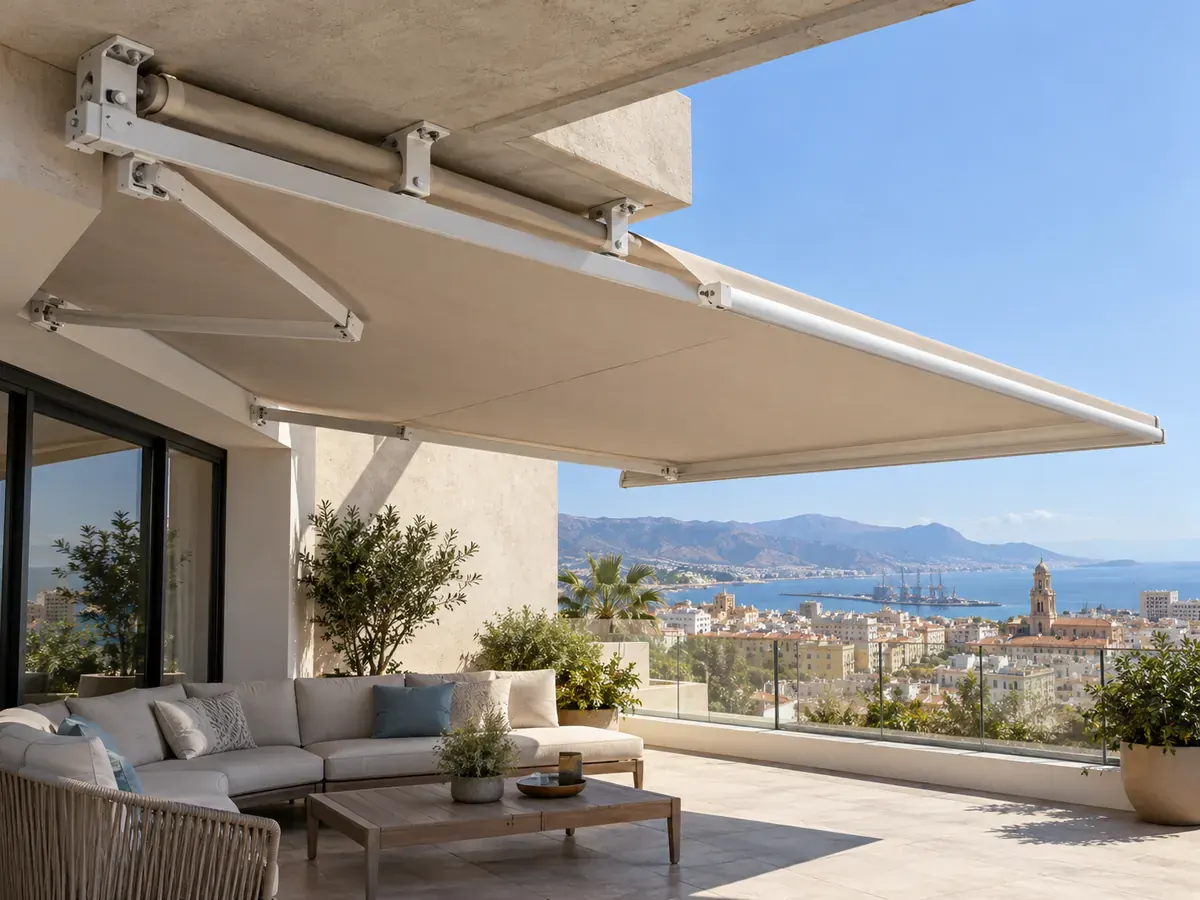
Ceiling or face-fixed monobloc
The bar is fixed to the wall or to the ceiling of the overhang. Very useful on penthouses with little free wall or on slab edges, where a standard awning can’t find anywhere to anchor each arm.
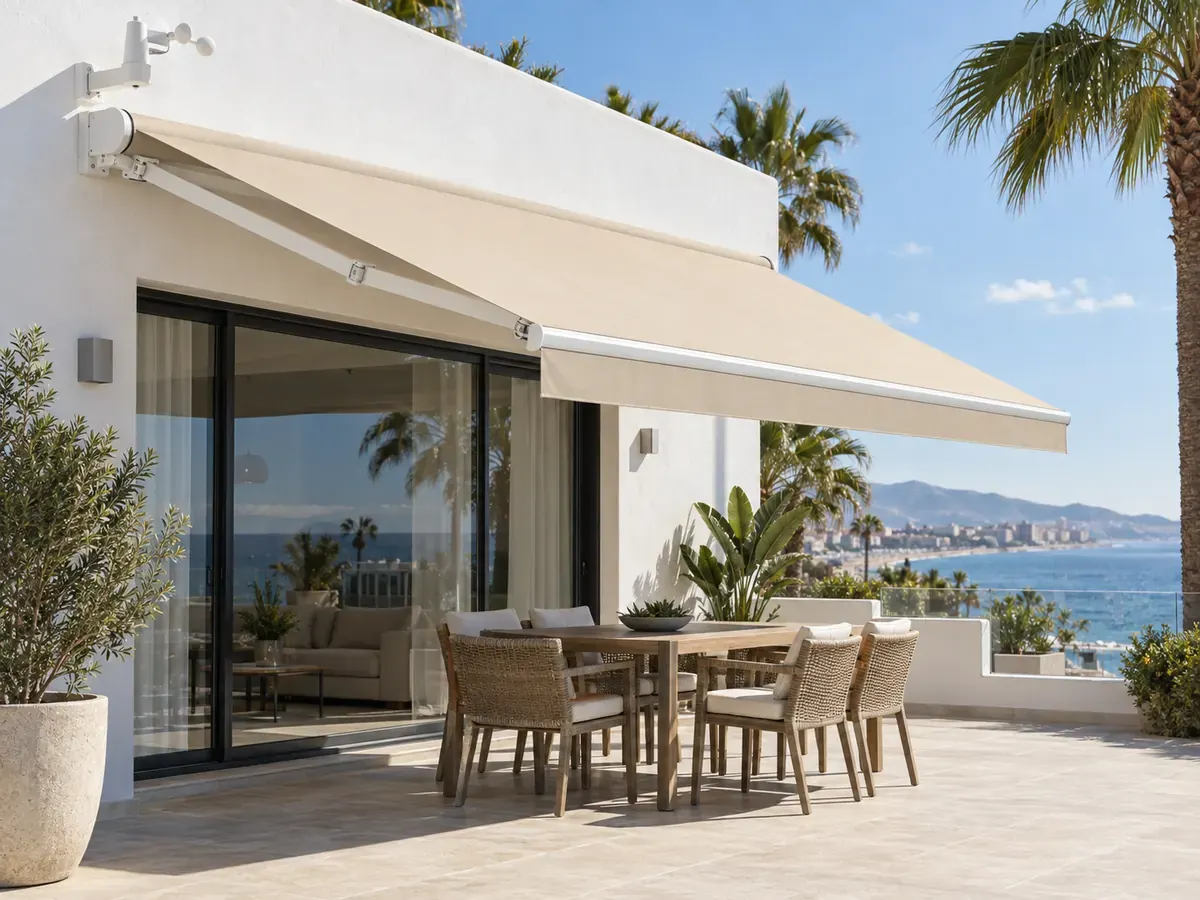
Motorised monobloc
A large awning is much easier with a motor. We fit Cherubini motors with a remote and, if you like, a wind sensor so it retracts on its own when the wind gets up.
Depending on the model, a monobloc can have a hood or canopy that protects the retracted fabric from rain and sun. If what you want is a case that encloses it completely, the right system is the cassette awning. And if you need support at the front, take a look at the awning with support legs.
Design your folding-arm awning in a minute
The designer shows a folding-arm awning: choose the fabric, the frame colour and the size, and add the Cherubini motor. We’ll decide on the monobloc bar and the number of arms with you at the visit.
1. Type of awning
2. Sauleda or Dickson fabric Beige stripes
3. Frame colour White
5. Approximate size
Your design
For guidance only. Colours are approximate: at the visit we’ll show you the real fabric sample book and confirm sizes and finishes.
What’s included when we install your monobloc awning
We hand it over installed, levelled and tested. No middlemen: the technicians who measure up are the ones who install it.
- Free home visit, measuring and advice
- A look at the facade and the fixings
- Made-to-measure monobloc awning on a square bar
- Folding arms to suit the projection
- Your choice of Sauleda or Dickson fabric
- Powder-coated aluminium frame
- Stainless anchors and fixings
- Crank handle or Cherubini motor with remote
- Installation by our own technical team
- Guarantee and after-sales service
A large awning, properly anchored. The wider an awning is, the more the anchoring matters. We check the type of facade or slab and choose the right fixings, always stainless, because on the coast that’s where salt air strikes first.
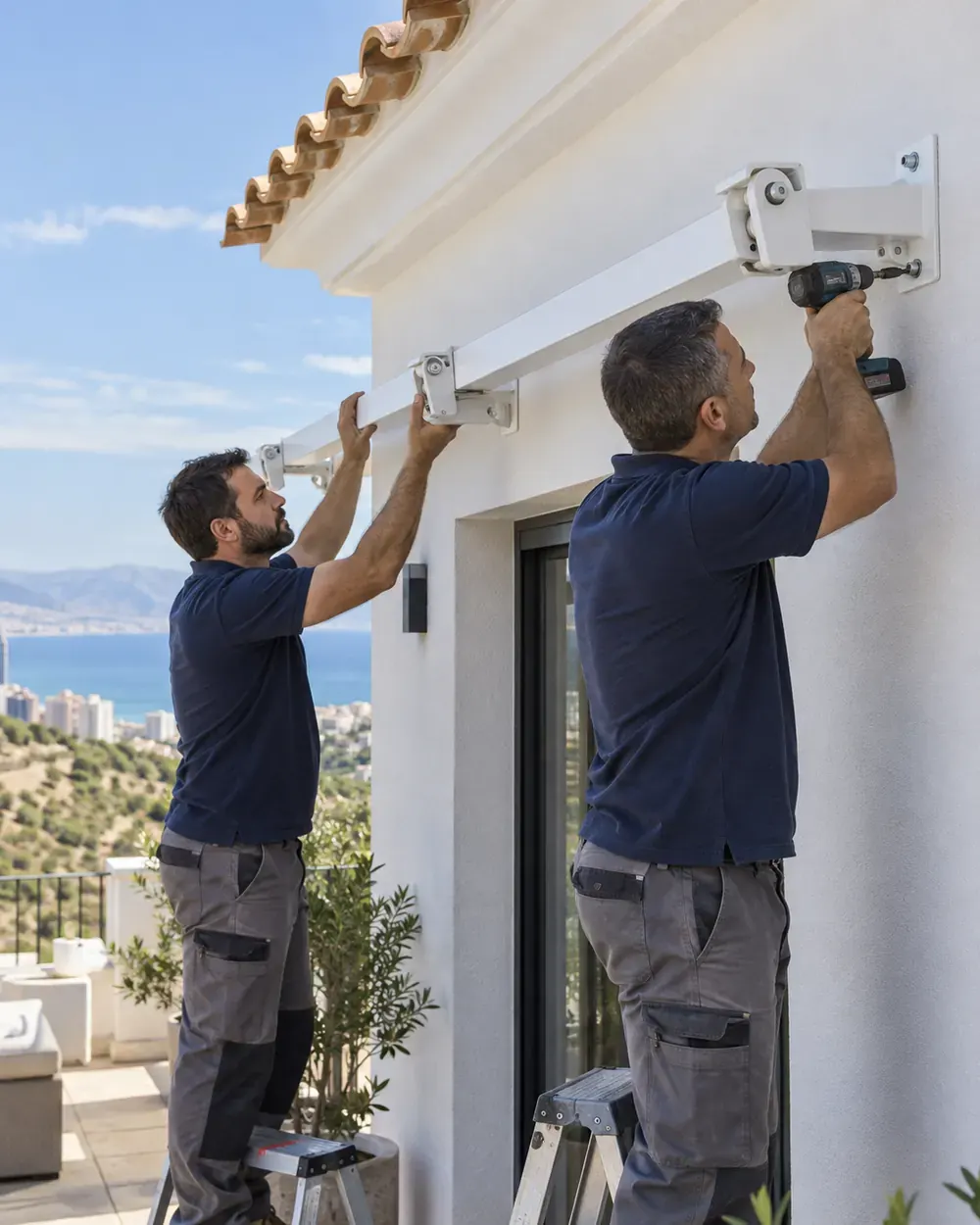
How we install your monobloc awning
Six steps, a single point of contact and a price that doesn’t change along the way.
- Home visit and measuringFree of charge. We measure the width and projection, check the facade or ceiling and look at where the sun and wind come from.
- Proposal and quoteWe suggest the number of arms, the fabric and the operation, with a written quote, fixed price and no obligation, often in under 24 hours.
- PermitsIf your community of owners or town hall asks for any paperwork, we tell you what it is and prepare the documents.
- Made to measureWe order the awning with the exact width, arm projection, fabric and colour you’ve chosen.
- Fitted by our own teamWe fix the bar, mount the awning, level the arms and install the motor and sensors.
- Testing and handoverWe extend and retract it with you, adjust the pitch and explain how to use and look after it.
Send us a photo of your facade and the rough size of your terrace? We’ll tell you whether a monobloc fits before we come to measure.
Send a photo on WhatsAppMonobloc or cassette awning?
It’s the most common question when the terrace is large. Both are folding-arm awnings, but they’re mounted and protected in different ways.
| Feature | Monobloc awning | Cassette awning |
|---|---|---|
| How it’s mounted | Everything sits on a square bar fixed to the wall or ceiling | Everything sits inside a case fixed to the wall or ceiling |
| Retracted fabric | Left on view; depending on the model, with a hood or canopy | Enclosed inside the cassette, protected from sun, rain and salt air |
| Large sizes | Its strong point: long widths and generous projections, depending on the model | Large models exist, but the case limits the sizes more |
| Fixings | A few fixing points spread along the bar | The cassette’s own brackets |
| Look | More technical; the bar and arms are visible | Cleaner: retracted, it looks like a box built into the facade |
| Maintenance | Clean the fabric and check the arms | The fabric gets less dirty as it’s stored away |
| Where it fits | Long terraces, penthouses, villas and businesses | Homes wanting a clean finish and protected fabric |
On the seafront, where salt air takes its toll on retracted fabric, the cassette awning has the edge; on very wide terraces or ones with few fixing points, the monobloc wins. If you’re unsure, we’ll show you both options at the visit. You’ll find every alternative on our awnings in Malaga page.
Monobloc awning prices in Malaga: what affects them
We don’t give generic prices: a monobloc is made to measure for each facade. This is what makes it cost more or less:
A fixed, written quote in under 24 hours
We come and measure for free, explain each option and give you a price that won’t change halfway through the job. No obligation.
Monobloc awnings in the Axarquia, Malaga and the Costa Tropical
We set out from Velez-Malaga to measure up free of charge. We install them on penthouses in Malaga city and Benalmadena, at villas in Nerja, Torrox and Rincon de la Victoria, and on business terraces in Marbella, Estepona and Motril, always with materials built to withstand salt air.
Malaga and Costa del Sol
Costa Tropical and Granada
Got a large terrace that’s crying out for shade?
Tell us what you need in four quick steps and we’ll call you to arrange the visit. No obligation.
- Free home visit and measuring
- A fixed, written quote in under 24 hours
- Fitted by our own team, no subcontractors
- Guarantee and after-sales service close to you
Frequently asked questions about monobloc awnings in Malaga
What exactly is a monobloc awning and what makes it different?
A monobloc awning is a folding-arm awning in which the roller tube, the arm brackets and the mechanism are mounted on a square aluminium bar. That bar runs the full width of the awning and is what gets anchored to the wall or ceiling. Hence the name: the whole thing works as a single block.
On a standard retractable awning, each arm has its own bracket screwed to the facade. On a monobloc, the arms are attached to the bar, and the bar is fixed with fewer fixing points spread along the facade. That makes it rigid and easier to install on facades with little usable space, on slab edges or on the ceilings of overhangs.
Its big advantage is size. Being more rigid, it can take long widths and generous projections, depending on the model, and several arms can be fitted on the same awning to keep the fabric taut. That’s why it’s the usual system for long terraces, penthouses and businesses.
What it doesn’t have is a case that encloses the fabric when it’s retracted. Some models have a hood; if you want the fabric fully protected, the system for you is the cassette awning. You can see every system on our awnings in Malaga page and in the article on the retractable awning.
Monobloc or cassette: which is better for my terrace?
The monobloc or cassette question comes up at almost every visit to a large terrace. Both are folding-arm awnings and can have the same fabric and the same motor; the difference is in how they’re mounted and what happens to the fabric when you retract the awning.
The cassette awning stores the fabric and arms inside an aluminium case. Retracted, it looks like part of the facade, and the fabric is protected from sun, rain, dust and salt air. It’s a great option for seafront homes and for anyone who values a clean finish.
The monobloc is mounted on a square bar, and the retracted fabric stays on view, with or without a hood depending on the model. In return, it’s easier to take to large sizes, takes more arms and needs fewer fixing points. On very wide terraces or awkward facades it’s usually the most practical solution.
Our advice: if the terrace is medium-sized and very exposed to salt air, look at the cassette first. If it’s long, for a business or on a facade that’s tricky to anchor to, go for the monobloc. At the free visit we’ll show you both on your facade and give you a fixed-price quote for each if you’d like to compare them. You can book it using the form.
What awning should I put on a very large or very long terrace?
When we talk about a large awning, there are two dimensions to look at: the width, which runs along the facade, and the projection, which is how far the awning comes out. Every system has its limits, depending on the model, and choosing the wrong one is the quickest way to end up with an awning that won’t tension properly or struggles in the wind.
For long widths, a monobloc is one of the best options because the arms are spread along the same bar and the awning works as a single piece. If the width is very large, several awnings can be fitted on the same bar or in modules, and operated together or separately with the motor, depending on the set-up.
For very deep projections, the awning sometimes needs a hand: telescopic support legs at the front or a standalone structure. And if you want to cover a large area permanently, with protection from the rain, it’s worth comparing it with a pergola.
At the visit we measure the terrace, check the facade and suggest the steadiest combination for your situation, without pushing any system beyond what the manufacturer allows. It’s a common choice for a wide terrace awning on penthouses in Malaga city and on bar terraces; if that’s you, take a look at our awnings for bars and restaurants too.
How does a motorised monobloc awning with a wind sensor work?
A motorised monobloc awning with a wind sensor has a tubular motor inside the roller tube and a small sensor fixed to the front bar or near the awning. The motor extends and retracts the fabric with a remote or a wall switch; the sensor monitors the awning’s movement and, when it detects gusts above the level you’ve set, tells it to retract.
On a large awning this makes all the difference. The more fabric there is, the more surface the wind pushes against, and a monobloc several metres wide left out in a gust of levante can suffer damage to the arms, the fabric or the fixings. With the sensor, the awning retracts on its own even when you’re at the beach or away from home, depending on the model.
We fit Cherubini motors and can also add a sun sensor, which extends the awning when the sun gets fierce and retracts it when the sun goes. It’s very useful in second homes in the Axarquia and on the Costa del Sol, where nobody is around to keep an eye on the weather. The sensor helps, but it’s no substitute for common sense: if a storm is forecast, it’s best to leave the awning retracted.
There’s more information on our awning motorisation page and in the article on how to choose an awning motor. At the visit we’ll recommend the right motor and sensors for the size of your awning.
How much does a monobloc awning cost, and what makes the price vary?
We don’t give ballpark prices for a monobloc awning, because each one is made for a specific facade, and with this system the size changes the result a great deal. A generic figure would mislead you more than help you. What we can explain clearly is what drives the quote for a monobloc awning in Malaga.
First comes the width and projection: wider and deeper means more fabric, more profile and longer arms. Then there’s the number of arms needed to keep the fabric taut, the type of fixing for your facade or ceiling, and whether you want a hood to protect the retracted fabric. The Cherubini motor and wind or sun sensors add to it too.
Other factors are the fabric you choose, Sauleda or Dickson, and the conditions on site: height, access, or whether the materials have to be carried up to a penthouse. That’s why we’d rather see it in person. The visit, measuring and advice are free, and we give you a written quote with a fixed price and no obligation, often in under 24 hours.
If, once we’ve seen it, we think another solution would work out better for you, we’ll tell you: sometimes a standard retractable awning or a cassette awning fits just as well. Book your visit using the form or via our contact page.
Can a monobloc awning be fixed to the ceiling of a terrace?
Yes, and it’s one of its advantages. The square bar of a monobloc can be fixed to the wall or the ceiling using the right brackets, depending on the model. This solves a lot of cases on penthouses and terraces with an overhang, where there’s no free wall above the door or the large window.
Before deciding, we check the ceiling: what it’s made of, its condition and whether it has cladding or a false ceiling that can’t take a load. A large awning puts significant stress on its fixings when it’s extended, so the anchoring has to go into a strong element, such as the floor slab. We always use stainless fixings, designed for the salty air on the coast.
We also look at the height. If the ceiling is low, the pitch of the arms has to be worked out carefully so the fabric has a slope and you can walk underneath comfortably. Sometimes the answer is to combine ceiling and wall fixings or to choose a different system, and we’ll explain it clearly at the visit.
If you live in a community of owners, fixing an awning to the facade or the ceiling of a terrace may need the agreement of the other owners or have to match a common look. We explain this in our guide to awnings and communities of owners, and if you manage a building, take a look at our awnings for communities.
How do I look after a monobloc awning on the seafront?
On the coast, an awning’s worst enemy isn’t so much the sun as the salt air. It settles on the fabric, the arms and the bar, and with the overnight damp it ends up attacking the least well-protected metal parts. That’s why we use powder-coated aluminium and stainless fixings from the start, but a little care goes a long way towards extending the awning’s life.
As the retracted fabric on a monobloc stays on view, it’s a good idea to rinse it with fresh water now and then, without a pressure washer, and clean it with a soft brush and mild soap when it gets dirty. Never leave it rolled up wet for days: if it rains, extend it as soon as the sun comes out so it dries and doesn’t get stains or mould.
Check the arms and joints too. If you notice noises, play in the joints or that the awning doesn’t close the way it used to, it’s better to have it looked at early than to wait for something to break. There’s a step-by-step guide in how to clean and look after an awning.
Over the years, the fabric loses colour and tension. If the frame is in good condition, it’s enough to replace it with a new Sauleda or Dickson fabric. We do this through our awning repairs and fabric replacement service, including on awnings installed by another company, with a fixed-price quote before we start.
How many arms does a monobloc awning have, and how far can it project?
It depends on the width and projection you need. On a folding-arm awning, the arms are what push the front bar outwards and keep the fabric taut. If the width is short, two arms are enough; when the awning is very wide, more are needed so the fabric doesn’t sag in the middle.
One of the advantages of a monobloc is precisely that it takes several arms on the same bar, depending on the model, and that the bar spreads the load along the facade. That way you get very wide awnings that behave as one and run off a single motor, or several independent awnings on the same bar.
The maximum projection is set by the manufacturer for each model and type of arm, and it’s best not to push it. That’s why we don’t give generic figures: at the visit we measure your terrace, check the facade and suggest the projection the awning can safely give. If you need more depth, we’ll explain the alternatives, such as telescopic support legs.
Remember that the greater the projection, the more the wind matters. On exposed terraces we recommend motorisation with a wind sensor. And if you’re not sure which system keeps the heat off your terrace best, read our article on which awning keeps the heat out best.