Home › Pergolas › Bioclimatic pergolas
Bioclimatic pergolas · Malaga, Axarquia and Costa TropicalBioclimatic pergolas in Malaga made to measure for your terrace
A roof of aluminium louvres you turn with a remote control: shade when the sun is fierce, airflow when it’s hot and shelter when it rains. We design and install bioclimatic pergolas in Malaga with our own team, from Velez-Malaga to the whole province and the Costa Tropical.
- Our own team, no subcontractors
- Home visit and measuring free
- Fixed-price quote in under 24 hours
- Powder-coated aluminium and stainless fixings
- Guarantee and after-sales service
In short
A bioclimatic pergola in Malaga is a roof of motorised, adjustable aluminium louvres: open them to ventilate, angle them for shade and close them when it rains. It can take a rain sensor and side screens. QUBRE designs and installs them to measure with our own team, from Velez-Malaga to the whole province and the Costa Tropical.
Updated · QUBRE technical team, Velez-Malaga
What is a bioclimatic pergola and why does it suit Malaga so well?
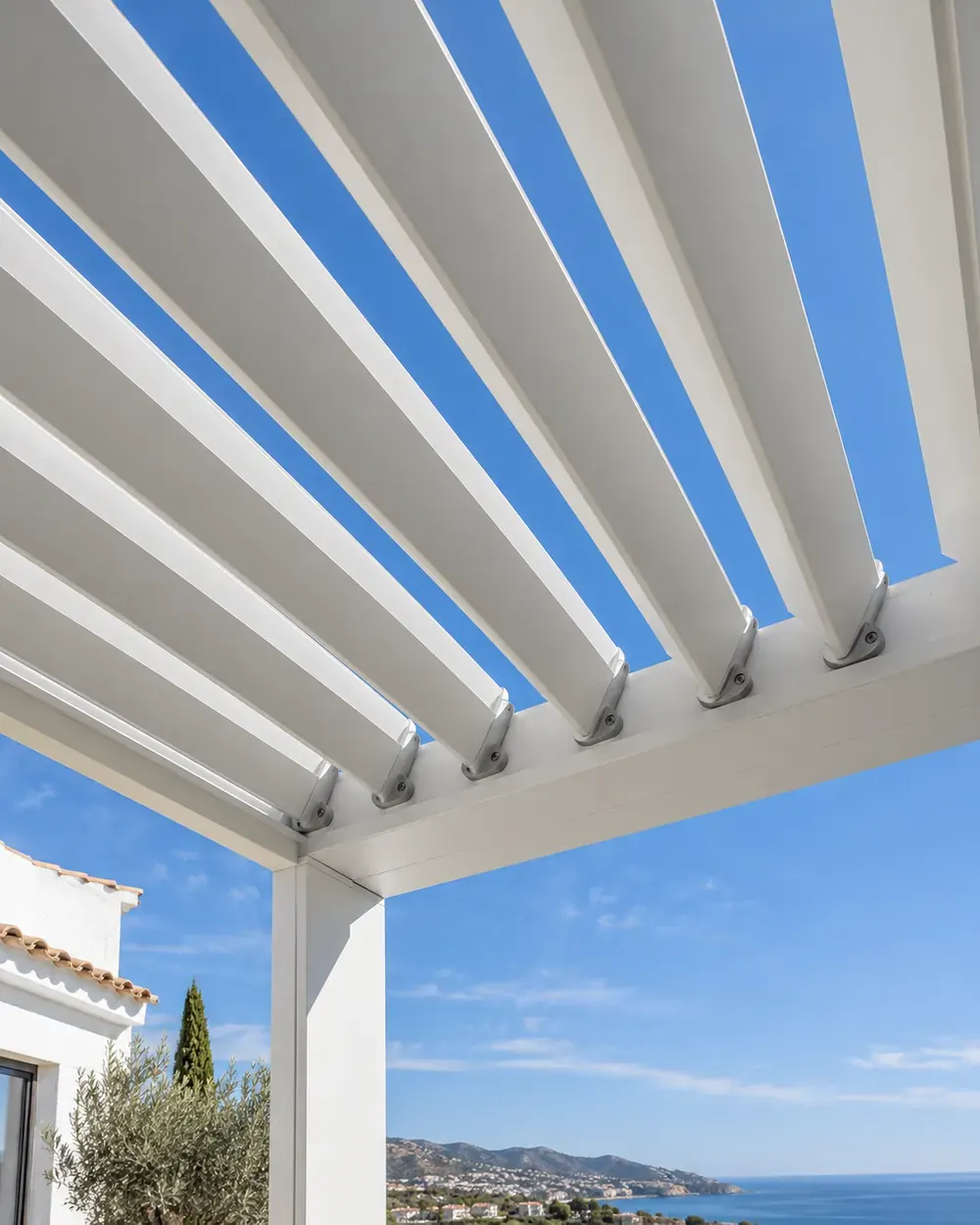
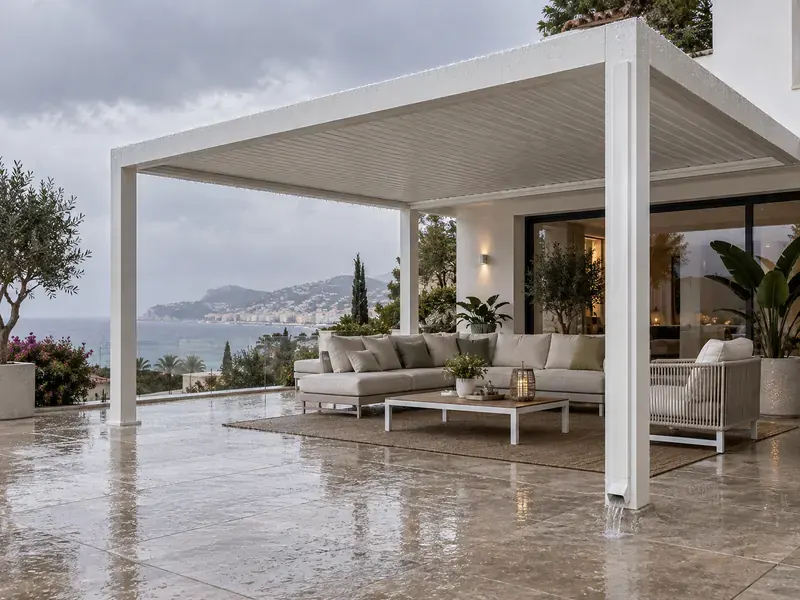
A bioclimatic pergola is an aluminium structure with a roof made of adjustable louvres, which is why it’s also called a louvred pergola. With a remote control you turn them to let the light in, block direct sun or close them completely. Open them slightly and the hot air that builds up under the roof escapes through the top, so the terrace can breathe. Closed, they form a continuous roof: rainwater runs along the louvres into a gutter hidden around the edge and down through the inside of the posts.
On the Malaga coast and in the Axarquia we have strong sun almost all year, gusts of levante (easterly) and poniente (westerly) wind, and rainy days that arrive all at once. An awning solves part of that; a bioclimatic roof solves it all at once, with nothing to retract. That’s why more and more families choose one for the porch, the penthouse or the pool area, and many businesses choose one for their terrace.
At QUBRE we don’t sell a catalogue model: we come to your home, look at the orientation, the wind and the anchoring, and suggest the louvred roof pergola that makes the most of your space.
Where do our customers install them?
- Penthouse terrace
- Villa porch
- Pool area
- Garden or patio
- Outdoor dining area
- Bar or restaurant terrace
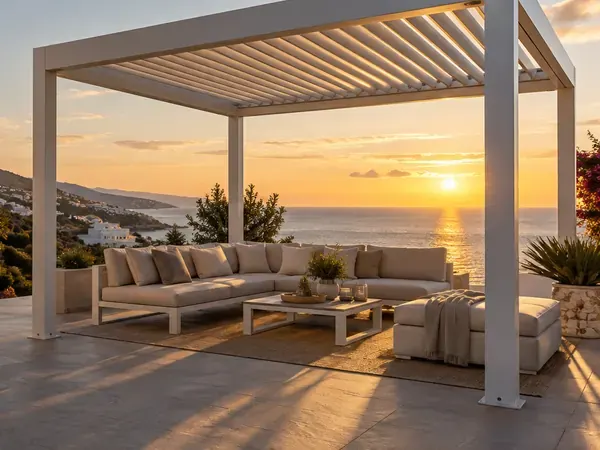
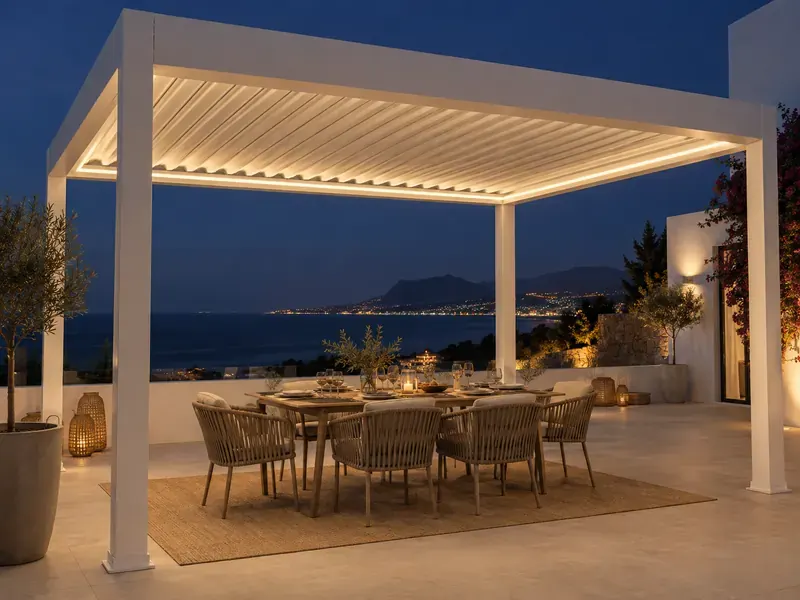
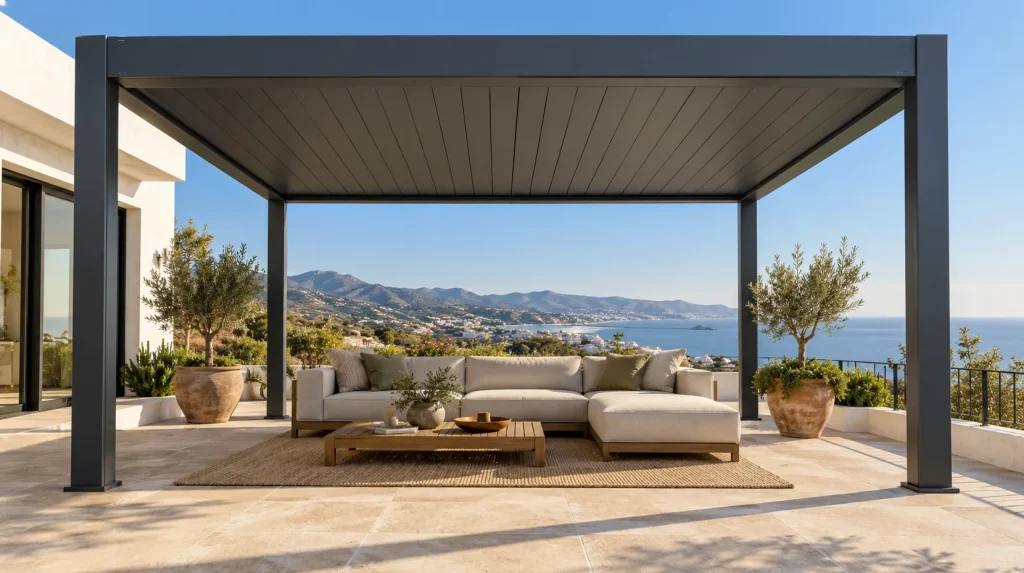


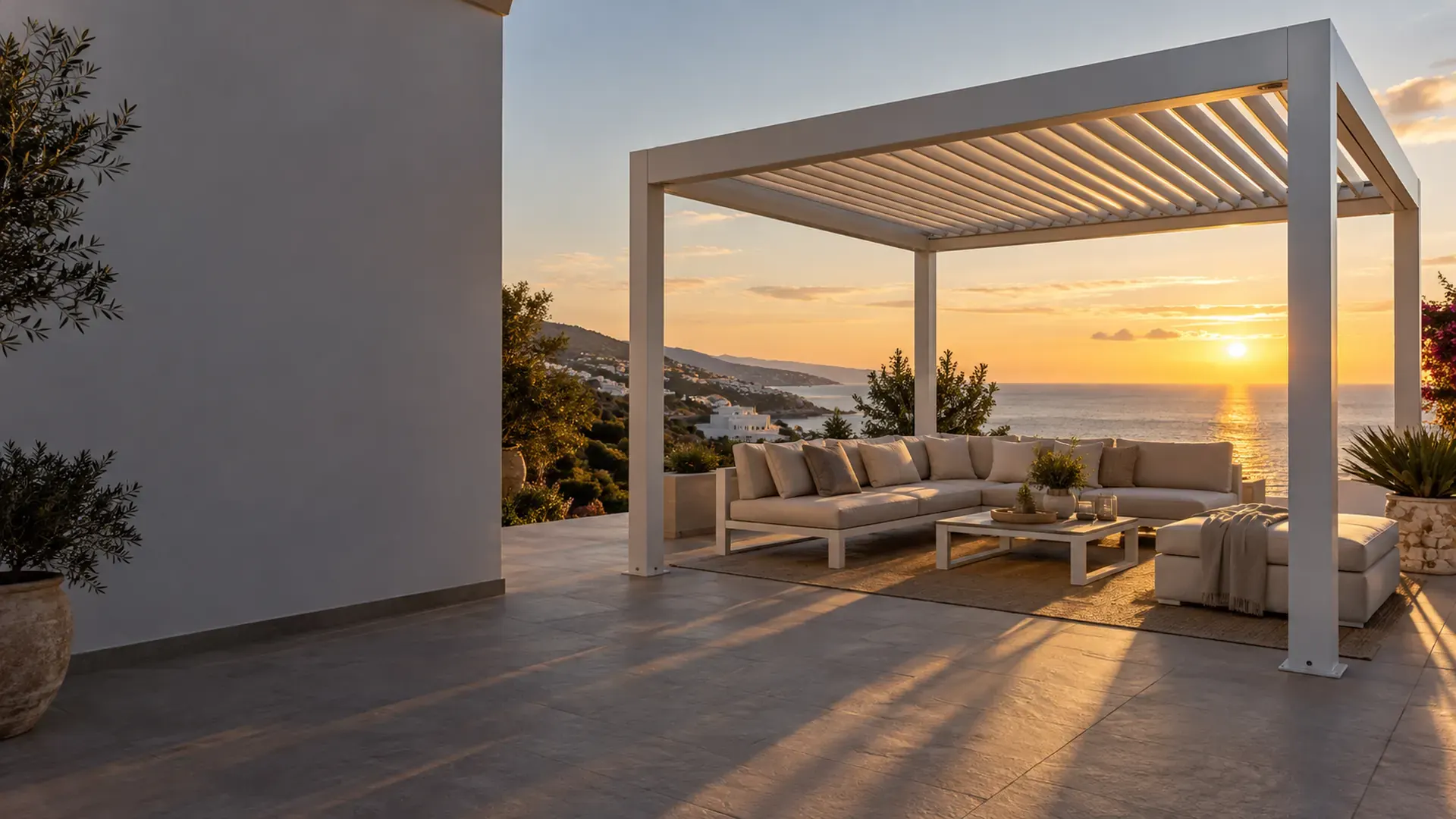
Morning · Louvres closed
Bioclimatic pergola in Málaga
Your terrace, at any time of day
Scroll down and watch a whole day go by under a bioclimatic pergola, from morning shade to evening light.
Adjustable louvres
Open the louvres and let the light in
The aluminium louvres turn with the remote. Closed, they give full shade; open, they let the breeze and the sun through in strips.
Mid-afternoon
Shade, right where you want it
Change the angle as the sun moves and decide how much light falls on the sofa, without moving a thing.
Side screens
When the sun comes in from the side
With vertical awnings or zip screens on the sides, you block the low afternoon sun and the easterly levante wind without losing the view.
LED lighting
And at night, it is still yours
LED lights built into the frame keep the terrace going through dinner. We will show you the options at your home.
Scroll to see the day
Illustrative imageWall-mounted, freestanding or enclosed bioclimatic pergolas
Three ways to install one, depending on your space. At the visit we’ll tell you which one makes the most of your terrace or garden.
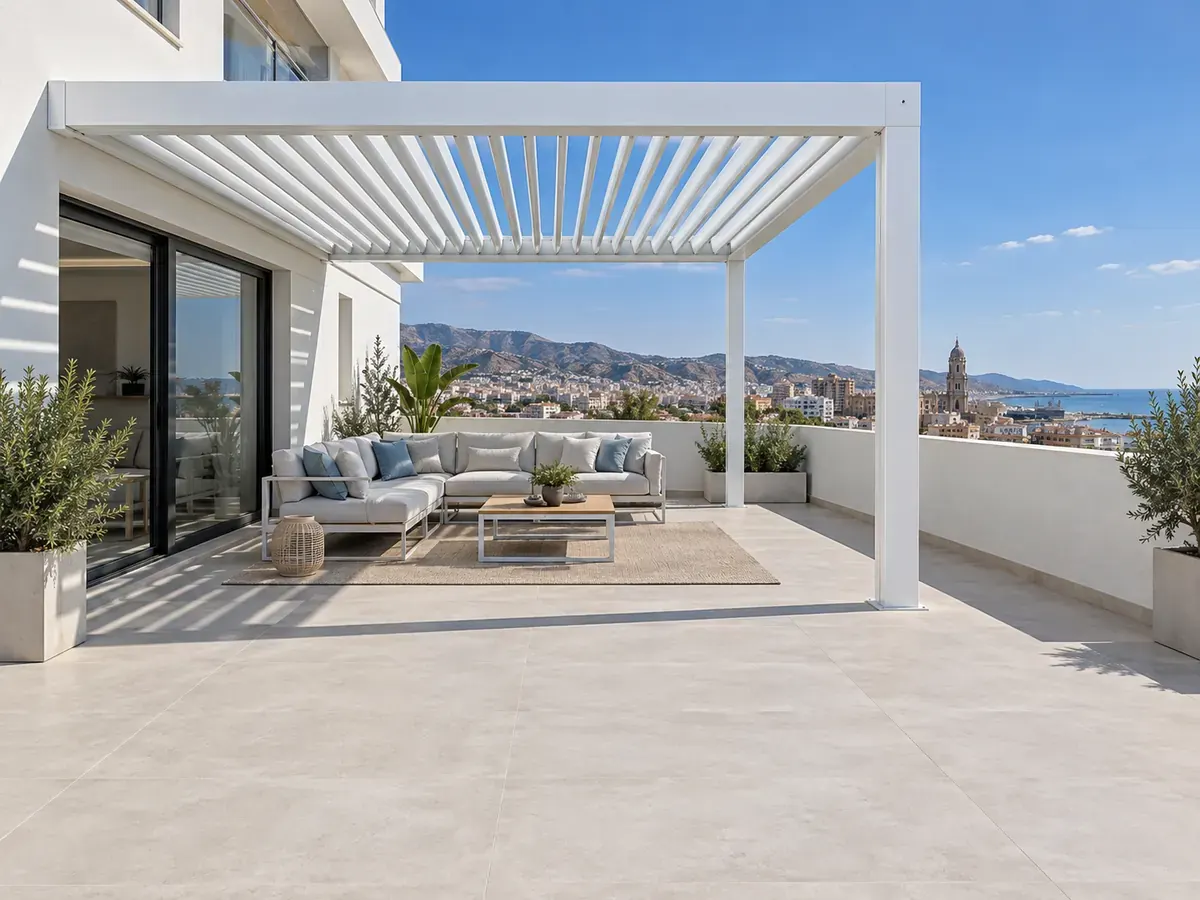
Wall-mounted bioclimatic pergola
Anchored to the facade on one side and resting on two posts on the other. It’s the most common option on penthouses and home terraces, because it extends the living room outdoors and makes use of every centimetre. Find out more about wall-mounted pergolas.
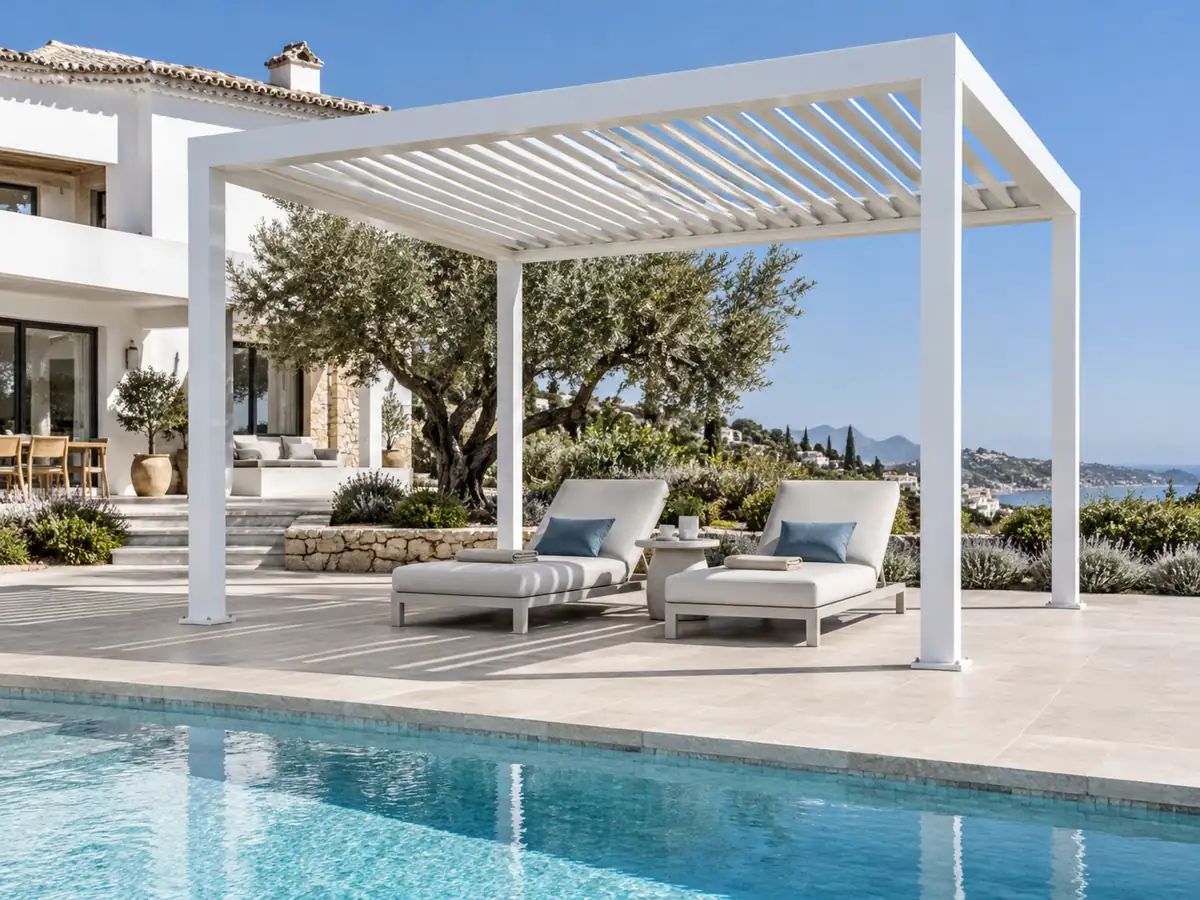
Freestanding bioclimatic pergola
Four posts and no support from the house. It creates a separate seating area in the middle of the garden, beside the pool or in a patio with no wall to anchor to. It’s the answer when the wall can’t take the load or is best left alone.
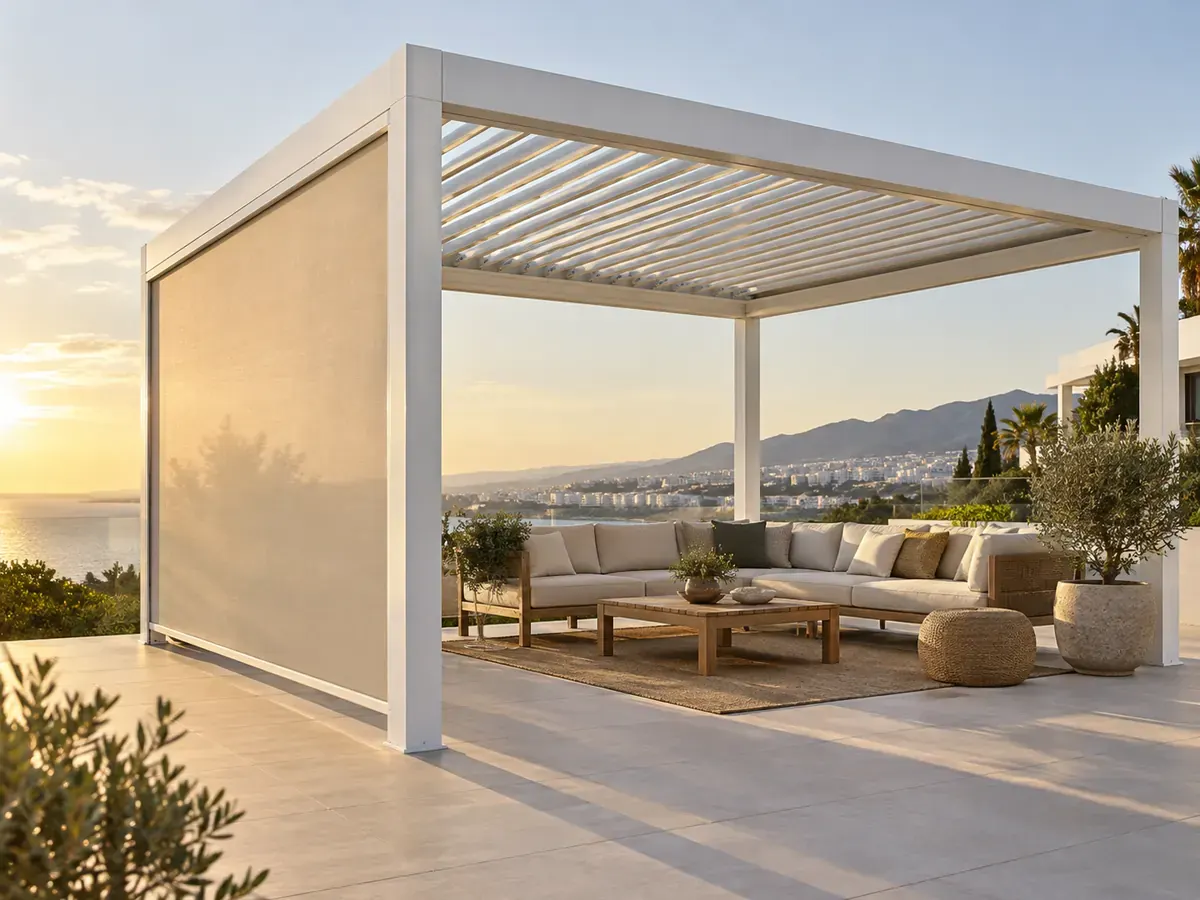
Bioclimatic with enclosures
Close in the sides with a zip screen, windbreak awnings or a glass enclosure and you’ll have an outdoor room you can use in winter and when the levante blows.
Depending on the model, the louvres can be adjustable (they rotate on their axis) or adjustable and retractable (they also slide back to leave the sky clear). For large areas, such as bar and restaurant terraces, several modules are joined into a single structure. If you run a business, take a look at our awnings and pergolas for bars and restaurants too.
See how your bioclimatic pergola would look in 30 seconds
Choose the model, colour and enclosures, move the louvres and see how it looks at night with LED lighting. When you like it, request a quote with your design and we’ll fine-tune it at the visit.
1. Model
2. Frame colour Anthracite
4. Side enclosures
5. Approximate size
Your design
This simulation is a guide only. We confirm the final sizes, model and finishes with you at the free technical visit.
What’s included when we install your bioclimatic pergola
We take care of everything, from the first visit until you’re trying it out with the remote in your hand. No middlemen: the same technicians who measure up are the ones who fit it.
- Free technical visit, measuring and orientation study
- A design made to measure for your space
- Powder-coated aluminium frame and adjustable louvres
- Drainage built into the gutter and posts
- Motor with remote control
- Stainless anchoring and fixings
- Installation by our own technical team
- Adjustment, testing and a run-through of how to use it
- Paperwork and permits handled if needed
- Guarantee and after-sales service
Built for the coast. On the seafront, salt air eats away at poorly protected fixings and profiles. That’s why we work with powder-coated aluminium and stainless fixings, and choose the anchoring to suit the type of facade or floor at each home.
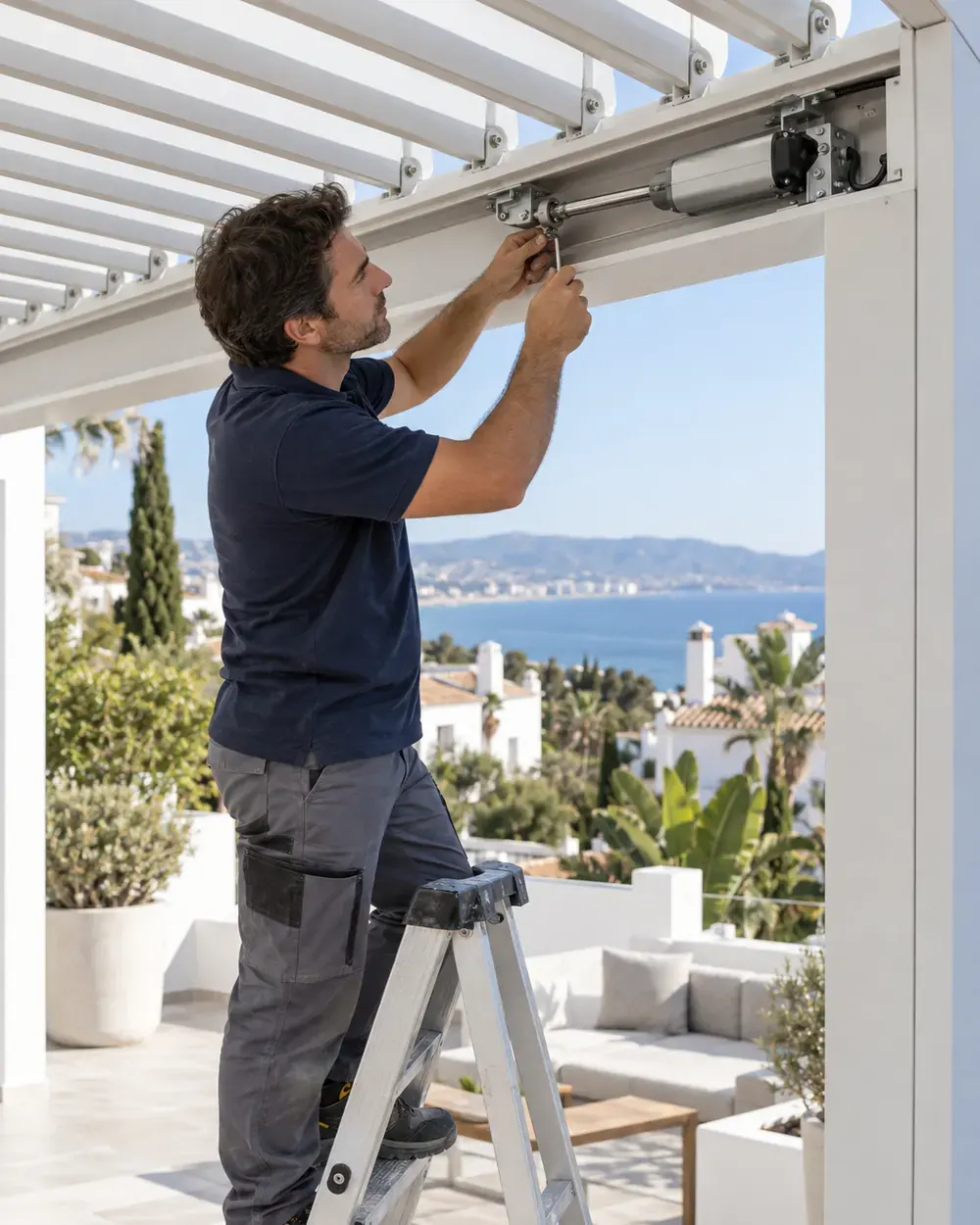
How we install your bioclimatic pergola
Six clear steps, a single point of contact and a price that doesn’t change along the way.
- Visit and measuringWe come to your home at no cost. We measure up and look at the orientation, the wind, where to anchor and where the water will drain.
- Proposal and quoteWe show you the options that fit and give you a written quote with a fixed price and no obligation, often in under 24 hours.
- PermitsIf your community of owners or the town hall requires any paperwork, we’ll tell you what it is and prepare the documents.
- Made to measureWe order your pergola with the exact sizes, the frame colour and the extras you’ve chosen.
- Installation by our own teamWe anchor it, level it, connect the drainage and install the motor. We leave the area clean.
- Testing and handoverWe test it with you, adjust whatever is needed and explain how to use it. From that day on, you have your guarantee and after-sales service.
Send us a photo of your terrace? We’ll tell you which model suits it before we even come to measure.
Send a photo on WhatsAppBioclimatic pergola or pergola with an awning?
Both give shade, but they don’t work the same way. This is how they perform day to day on a terrace on the coast.
| Feature | Bioclimatic pergola | Pergola with an awning or retractable roof |
|---|---|---|
| Roof | Aluminium louvres that rotate and, depending on the model, slide back | Fabric that extends and retracts over the frame |
| Rain | Closed louvres with a built-in gutter and downpipes | Depends on the fabric and the pitch; in heavy rain it’s best retracted |
| Heat | Open the louvres slightly and the hot air escapes through the top | With the fabric extended, heat tends to build up underneath |
| Light | You adjust the angle degree by degree | Full shade or open sky |
| Wind | A rigid aluminium roof, more stable | The fabric catches the wind; it must be retracted in strong gusts |
| Maintenance | Clean the louvres and gutters | Clean the fabric and replace it when it wears out |
| Investment | Higher, designed to last many years | More modest |
If you’re after a lighter solution, take a look at retractable roof pergolas or aluminium pergolas. If you prefer natural materials, we also install wooden pergolas. You’ll find every option on our pergolas in Malaga page.
Bioclimatic pergola prices in Malaga: what affects them
We don’t give guide prices because every pergola is built for one particular place and a generic figure would only mislead you. This is what makes one cost more or less:
A fixed-price quote, in writing, in under 24 hours
We come and measure for free, explain every option and give you a price that won’t change halfway through the job. No obligation.
Bioclimatic pergolas in Malaga, the Axarquia and the Costa Tropical
We’re based in Velez-Malaga and come out to measure free of charge across the whole area. Inland in the Axarquia we look for shade and airflow for the days when the hot terral wind blows; on the seafront, materials that stand up to salt air; on the Costa del Sol, a structure built for the levante and poniente winds.
Malaga and Costa del Sol
Costa Tropical and Granada
Can you picture your terrace with a bioclimatic pergola?
Tell us what you need in four quick steps and we’ll call you to arrange the visit. No obligation.
- Free home visit and measuring
- A fixed, written quote in under 24 hours
- Fitted by our own team, no subcontractors
- Guarantee and after-sales service close to you
Frequently asked questions about bioclimatic pergolas in Malaga
How much does a bioclimatic pergola cost in Malaga?
The price of a bioclimatic pergola depends on so many variables that any generic figure, whether per square metre or a ‘from’ price, usually ends up a long way from what you’ll actually pay. That’s why at QUBRE we don’t give guide prices: we’d rather come to your home, measure up and give you a real figure.
What drives the quote most is the area you want to cover, whether the pergola is wall-mounted or freestanding (a freestanding one has four posts plus their anchoring), the type of louvre (adjustable, or retractable as well), the motor and automation, such as wind and rain sensors or LED lighting, and whether you add side enclosures. The type of floor or facade we anchor to and how easy it is to get the materials up, to a penthouse for example, also play a part.
So you can compare at your leisure, the visit, measuring and quote are free and with no obligation. We give it to you in writing, with every item clearly listed and a fixed price: what you sign is what you pay, with no surprises halfway through the installation. Often you’ll have it in under 24 hours.
If your budget is tighter, we’ll show you alternatives such as an aluminium pergola or a retractable roof pergola. You can book your visit using the form or on our contact page.
Is a bioclimatic pergola waterproof when it rains?
Yes. With the louvres closed, a bioclimatic pergola forms a continuous roof that keeps the rain off. The louvres interlock and each one works like a small channel: the water runs along them into a perimeter gutter hidden in the structure and down through the inside of the posts to the ground or to whatever drain we’ve planned. That’s why at the visit we look at where the water will come out, so it doesn’t end up flooding your terrace or pouring onto your neighbour’s.
There are two things worth knowing. First, in very heavy rain or when the wind drives the rain sideways, some water can get in through the open sides, just as it would under any porch. If you want a fully sheltered terrace, the answer is to close the sides with a zip screen or a glass enclosure.
Second, many models can take a rain sensor that closes the louvres automatically as soon as the first drops fall, even if you’re not at home. It’s very useful on the Malaga coast, where showers arrive out of nowhere after weeks of sunshine.
To keep the pergola watertight over the years, all you need to do is keep the gutter and downpipes clear of leaves and dust. We’ll show you how on the day we hand it over.
Can a bioclimatic pergola withstand the levante and poniente winds?
A bioclimatic pergola has a rigid aluminium roof, with no fabric to act as a sail, so it copes with wind far better than an awning. Even so, how well a structure holds up depends above all on how it’s anchored. In the Axarquia and on the Costa del Sol the levante and poniente winds blow hard several times a year, so we size the posts and choose the anchoring according to how exposed your terrace is and the type of facade or floor.
Each manufacturer states the wind resistance of its model with the louvres closed and with them open, and those are the figures we use to recommend one model or another. As a general rule, when the wind is very strong it’s advisable to set the louvres in the position the manufacturer specifies; some models can take a wind sensor that does it for you.
If your terrace is very exposed and you want to be able to sit under it when it’s windy, side enclosures are the perfect addition. A zip screen holds the fabric in the guides all the way down, so it doesn’t flap loose in the gusts, and a windbreak awning with side guides stops the wind without blocking the light.
At the technical visit we’ll tell you honestly which model and which anchoring your space needs. If something isn’t a good idea on your terrace, we’ll tell you before you spend any money.
Do I need a licence or permission from my community to install a bioclimatic pergola?
It depends on three things: your local town hall, the size and type of pergola, and whether you live in a community of owners. A bioclimatic pergola is a fixed structure, so in many municipalities in Malaga and Granada it’s processed as minor works, either with a licence or a «declaración responsable» (a sworn statement to the town hall). Every town hall, from Velez-Malaga to Marbella or Motril, has its own bylaws, and what applies in one doesn’t necessarily apply in the next.
If you live in an apartment building or an urbanisation, the facade, and in many cases the penthouse terrace, involve common elements. The community may need to approve the installation or set a model and colour so every home matches. We explain it in more detail in our guide to awnings and pergolas in communities of owners.
You don’t have to work it out yourself. Before installing, we check which procedure applies to you and, if the project requires it, we handle the paperwork and permits for you, including anything that needs to go before the owners’ meeting.
If you’d like to read up beforehand, our article Do I need permission to install an awning or a pergola? covers the most common cases in Malaga and Granada.
Can I close in the sides of a bioclimatic pergola to use it in winter?
Yes, and it’s one of the reasons a bioclimatic pergola is such good value in Malaga. With the louvred roof closed and the sides covered, you turn your terrace into an outdoor room you can use in winter, on afternoons when the levante blows or when it turns chilly at night. There are three ways to close it in, and they can be combined:
Zip screen. A vertical awning whose fabric is held by a zip inside the side guides, so it stays taut and doesn’t flap loose in the wind. It filters the sun, cuts out the wind and, with a Cherubini motor, you raise and lower it with a remote control. You’ll find everything on our zip screen page.
Windbreak awning with side guides. A very practical option for bar terraces and windy spots, with clear or micro-perforated fabrics. Find out more in windbreak awnings.
Glass enclosure. Aluminium and glass sliding panels that close it in without losing the views or the light. It’s the most sheltered solution and the closest thing to gaining an extra room. We explain it in terrace and porch enclosures.
Ideally, plan the enclosures from the start, even if you install them later, so the structure is ready for them.
What’s the difference between a wall-mounted and a freestanding bioclimatic pergola?
The difference is in how it’s supported. A wall-mounted bioclimatic pergola is anchored to the facade of the house on one side and rests on two posts on the other. A freestanding bioclimatic pergola, also called a self-supporting pergola, stands on four posts and doesn’t touch the house.
Wall-mounted is the most common choice for penthouses, flat terraces and porches right off the living room. It extends the home outdoors, needs fewer posts and leaves more free space. To install one, the facade has to be solid enough for secure anchoring, which we check at the visit. If you’re unsure about your wall, our wall-mounted pergolas page explains what we look at.
Freestanding is the best option for gardens, pool areas and patios where you want to create a separate space, or when the facade can’t take fixings, for example because of a delicate cladding or community rules. As it rests only on the ground, anchoring the posts is key, and we work it out according to the type of paving.
Both have the same adjustable louvred roof and the same options for motors, automation and side enclosures. If you’re not sure, send us a photo of your space on WhatsApp and we’ll point you in the right direction before we come to measure.
What maintenance does a bioclimatic pergola need near the sea?
Very little, and that’s one of its big advantages over a pergola with fabric. Powder-coated aluminium doesn’t rot, doesn’t need varnishing and has no fabric to fade. Even so, on the Malaga and Granada coast salt air and dust build up, and a little care goes a long way towards extending the life of the pergola and keeping it looking good.
We recommend cleaning the louvres with fresh water and a mild soap a couple of times a year, and a bit more often if you live on the seafront. Avoid abrasive products and scourers that could scratch the powder coating. Also check that the gutter and downpipes are clear of leaves, especially before autumn, so rainwater can drain away freely.
Move the louvres from time to time even if you don’t need to, so the mechanism keeps working, and listen out for any odd noises from the motor. That’s why we use stainless fixings and powder-coated aluminium: they’re the materials that best withstand the sea air.
If you ever notice something isn’t right, our after-sales service is there for you. As well as our own installations, we check and repair those fitted by other installers. If you have awnings too, our blog explains how to clean and look after an awning, and when it’s needed we take care of repairs and fabric replacement.
How long does it take to install a bioclimatic pergola?
It’s worth separating the overall project time from the installation time at your home. The installation is carried out by our own team and, for a bioclimatic pergola of a typical size for a terrace or porch, it’s usually done in one or two days. Larger projects, with several modules or side enclosures, may need a day or so more.
Before the installation comes the visit and measuring, which we arrange around your availability, and the quote, which we often send you in under 24 hours. Once you accept it, the pergola is made to measure with your dimensions, the frame colour and the extras you’ve chosen. The manufacturing time depends on the model and the manufacturer, and we state it in writing in the quote itself so you can plan ahead.
If your case needs a town hall licence or community approval, that procedure is added to the timeline. We spot it at the visit and handle it so it doesn’t take any longer than necessary.
If you have a date in mind, such as the start of summer or a family celebration, tell us from the outset and we’ll plan everything backwards from it. It’s best not to leave it to the last minute: spring is when most people start thinking about their terrace. Book your visit using the form or see how we work on our about us page.