Home › Awnings › Awning with support legs
Awnings with support legs · Malaga, Axarquia and Costa TropicalAwnings with support legs in Malaga more projection, more stability
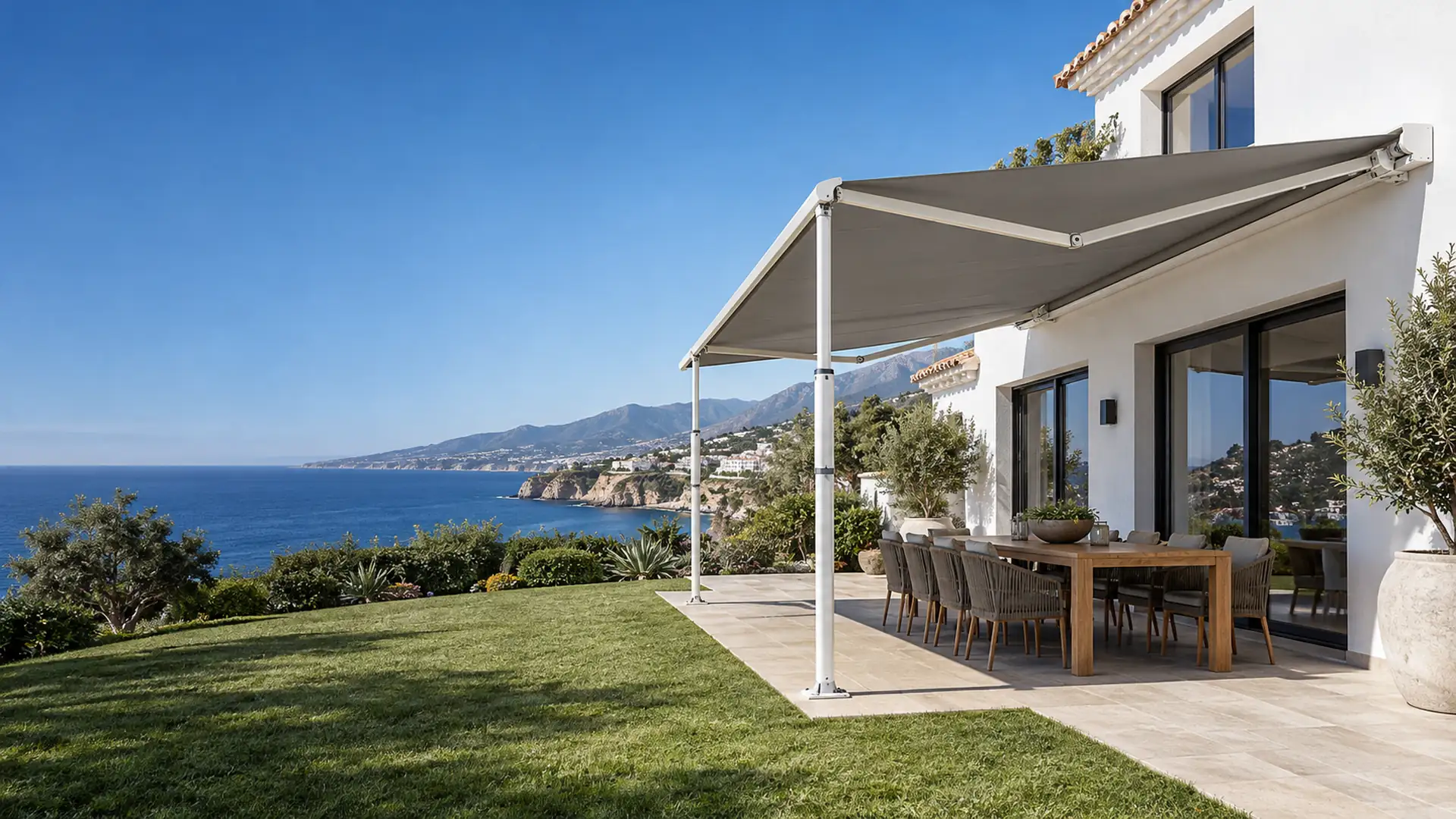
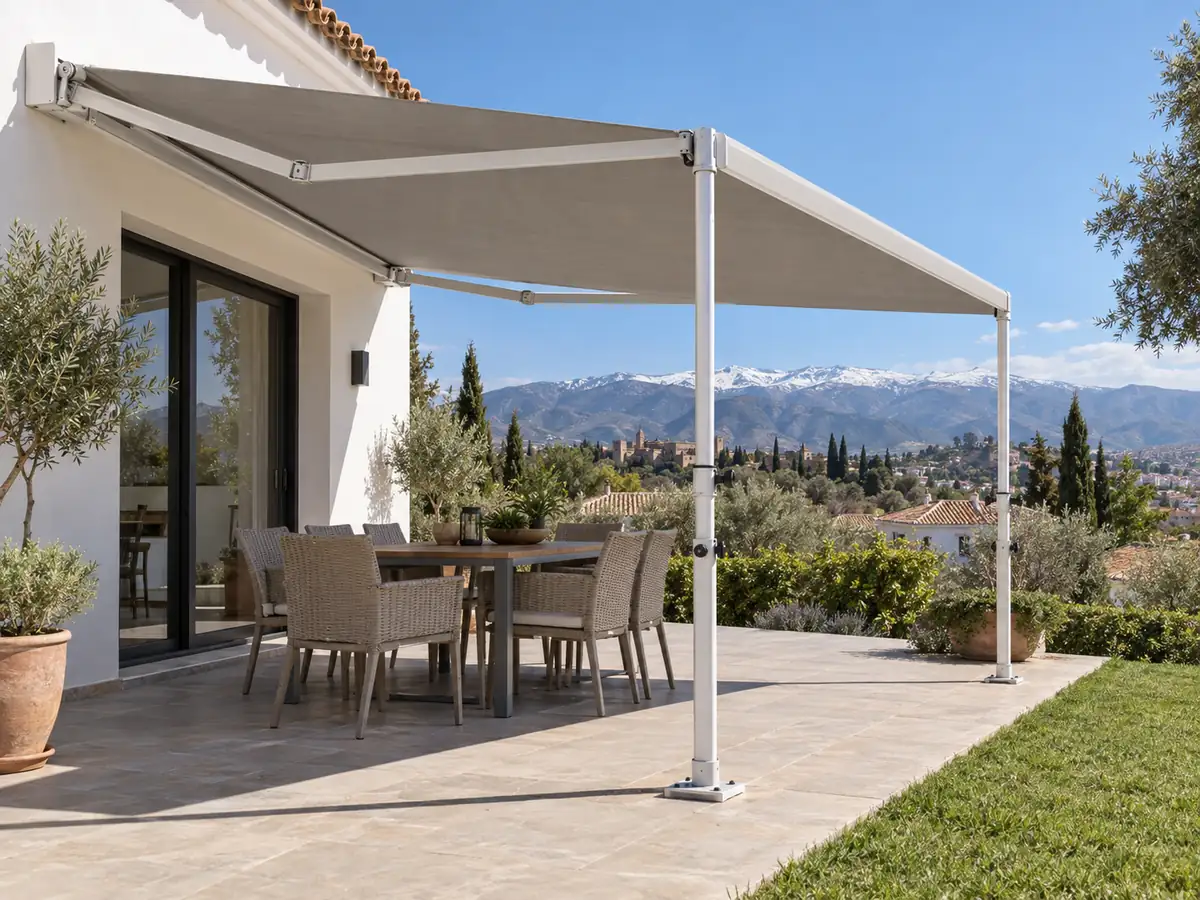
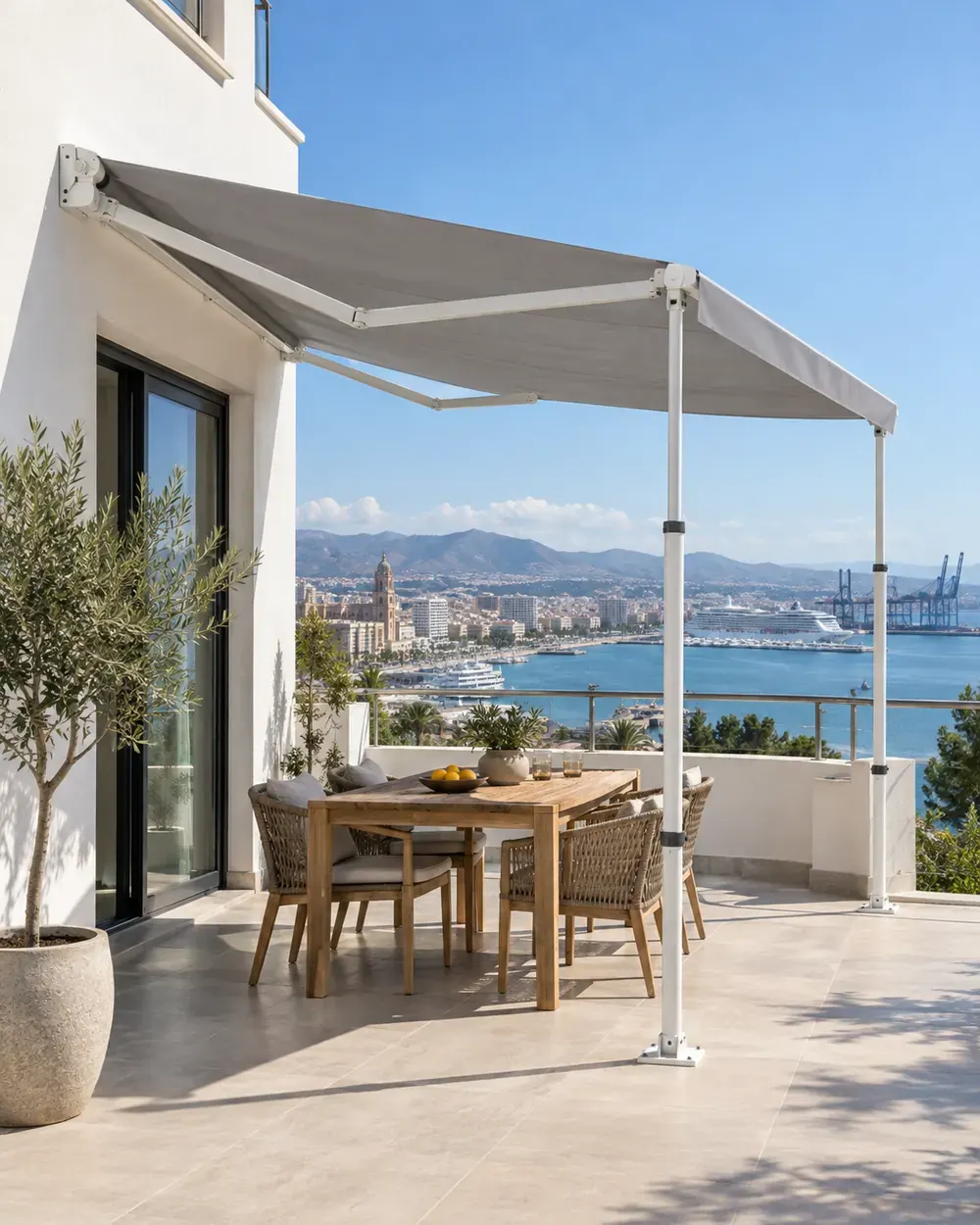
An awning with support legs is a retractable awning that, as well as its arms, rests on the ground on two adjustable telescopic legs. It’s steadier in the wind, lets you lower the front when the sun comes in from the side and covers projections a standard awning can’t reach. We install awnings with support legs in Malaga with our own team, right across the province and the Costa Tropical.
- Our own team, no subcontractors
- Home visit and measuring free
- Fixed-price quote in under 24 hours
- Powder-coated aluminium and stainless fixings
- Guarantee and after-sales service
In short
An awning with support legs in Malaga is a folding-arm awning that also rests on the ground on two adjustable legs: it is steadier in the wind and covers a longer projection. QUBRE fits them in gardens, terraces and bars with our own team, after a free visit and with a written fixed price.
Updated · QUBRE technical team, Velez-Malaga
What is an awning with support legs and how is it different from a standard one?
An awning with support legs is a folding-arm awning with two adjustable legs added to the front bar. The legs lengthen or shorten like a tripod and rest on the ground, so the awning no longer hangs from the wall alone: it’s supported at the front too. When people look for awnings with support legs in Malaga, they usually have one of three problems: wind, low sun or a very large projection.
With support at the front, the whole awning moves less in the gusts, which you’ll appreciate when the poniente or the levante blows. Because the legs adjust the height, you can lower the front to block the afternoon sun coming in from the side, or raise it so you can walk underneath comfortably. And as the weight is spread, the awning can cover a deeper projection, depending on the model.
At QUBRE we look at your terrace or garden before suggesting it: where the legs will stand, what kind of floor you have and how to fix them. It’s a variant of the retractable awning, with the same Sauleda or Dickson fabric and the option of a Cherubini motor.
Where do we fit them?
- Villa gardens
- Pool areas
- Bar or restaurant terraces
- Large home terraces
- Outdoor dining areas
- Terraces with afternoon sun
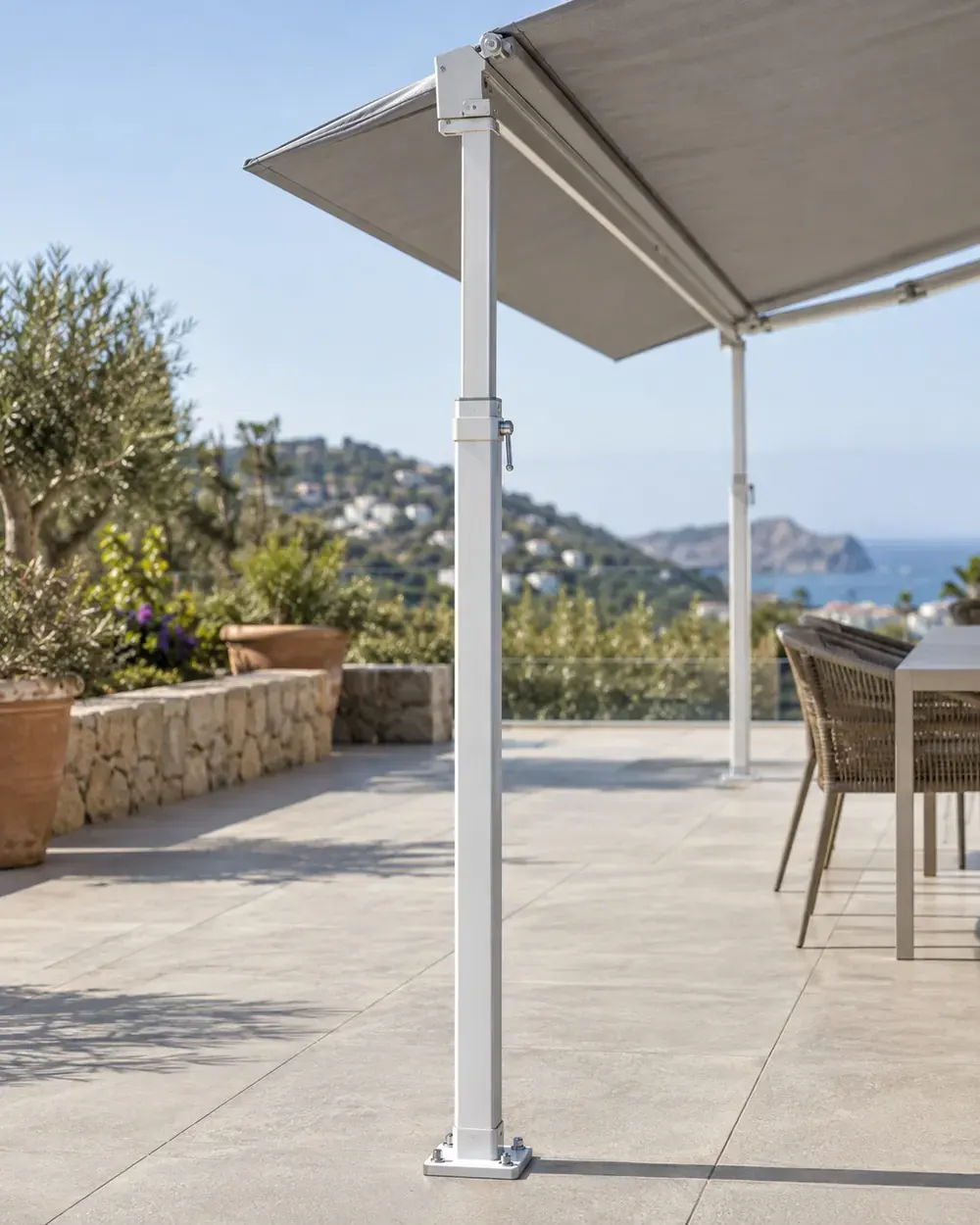
Awnings with legs for gardens, terraces and hospitality
The system is the same; what changes is where it rests and how you use it. These are the three situations where we fit it most often.
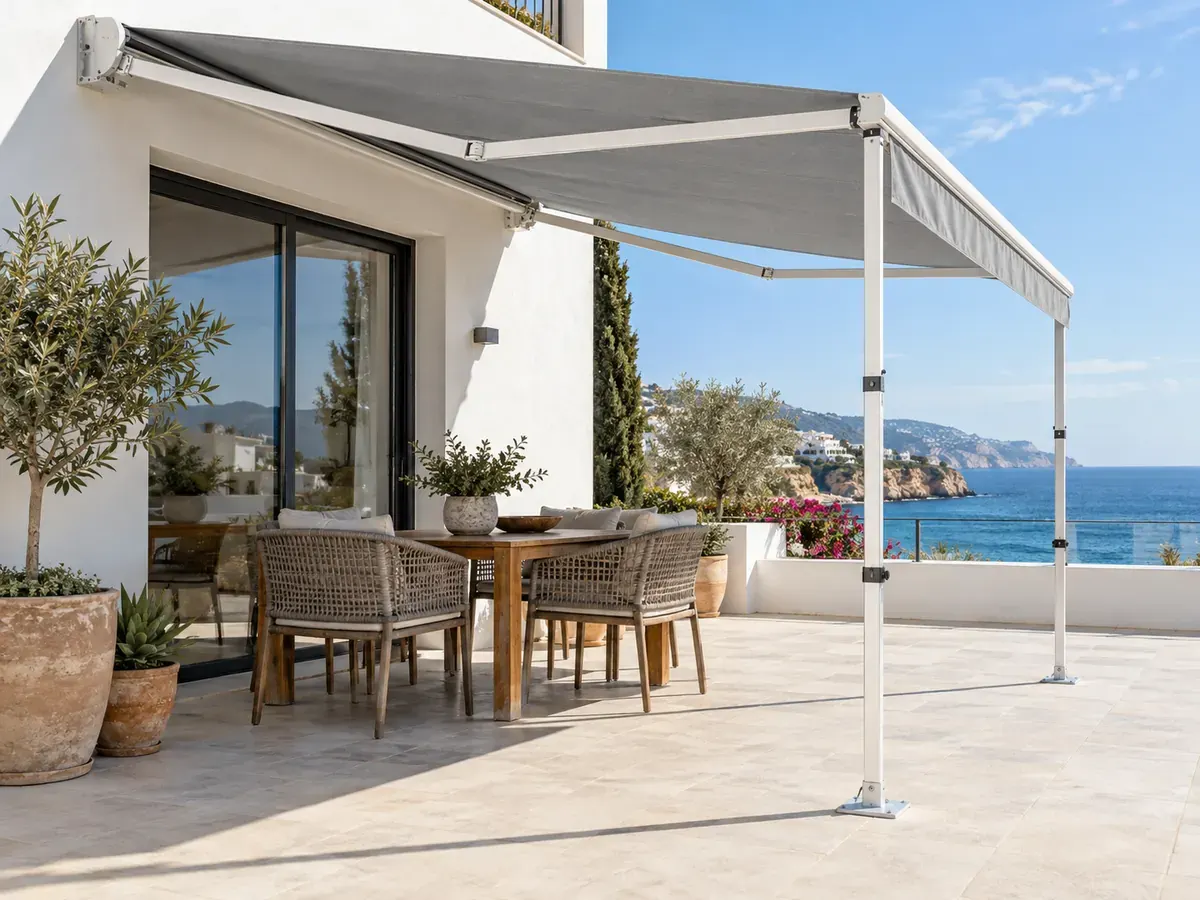
Awning for a large terrace
On long, exposed terraces, the legs give the awning the support the arms alone don’t have. You can lower the front to block the low westerly sun and eat in the shade at any time of day.
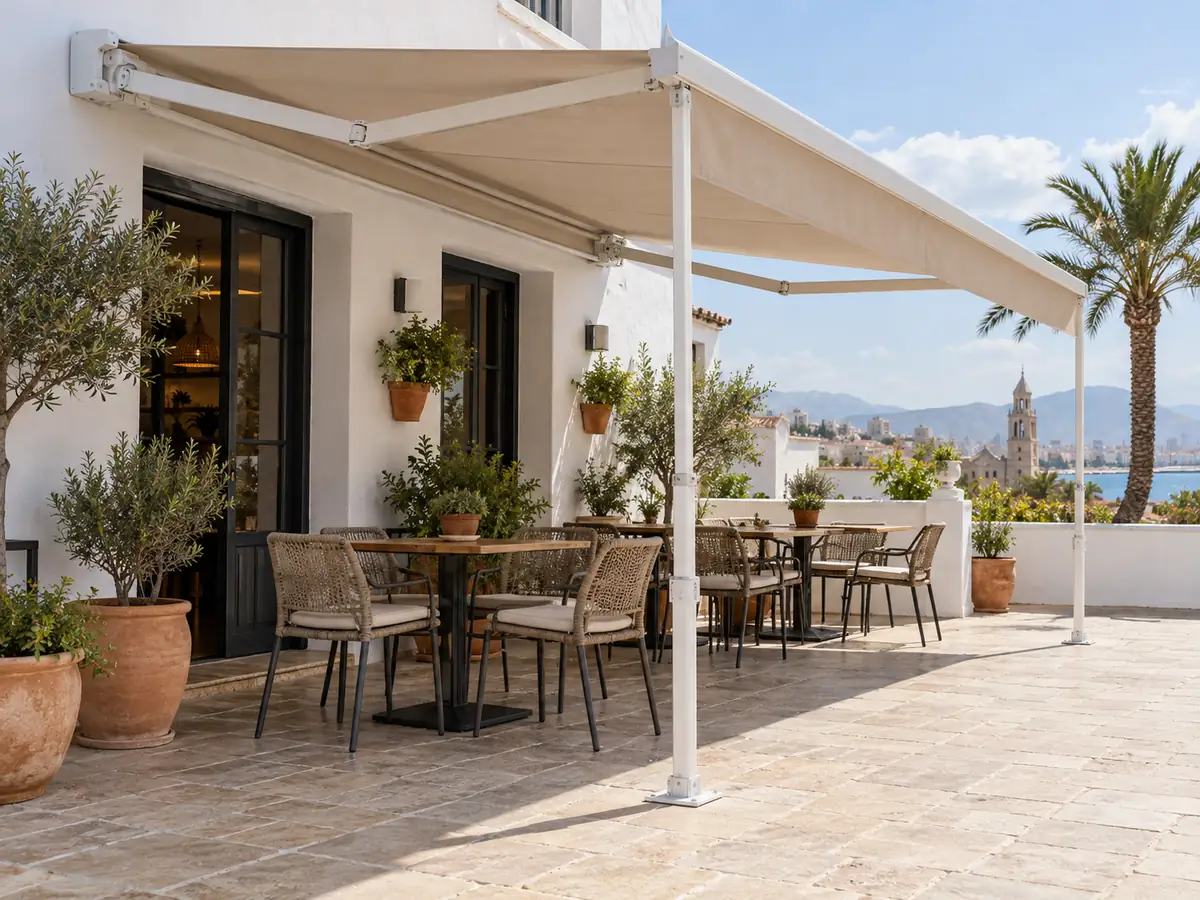
Awning for a bar terrace
More shade for more tables, and an awning that stays put when a gust comes through. The legs also mark out the edge of the terrace. Take a look at our awnings for bars and restaurants too.
Awning for gardens and pools
Takes the shade well away from the facade, out to the lawn or the edge of the pool, with the legs resting on a firm base. If there’s no wall to anchor to, we’ll look at a standalone structure or an aluminium pergola.
The legs can be fixed to the ground with anchors or rest on bases, depending on the model and the type of paving. When you retract the awning, the legs fold away or are removed, depending on the system, and the terrace is left clear. If you want to operate it effortlessly, add motorisation with a Cherubini motor.
Design your retractable awning in a minute
Choose the fabric, the frame colour and the size, extend the awning and add the motor. We’ll position the telescopic legs with you at the visit, based on your floor and your terrace.
1. Type of awning
2. Sauleda or Dickson fabric Beige stripes
3. Frame colour White
5. Approximate size
Your design
For guidance only. Colours are approximate: at the visit we’ll show you the real fabric sample book and confirm sizes and finishes.
What’s included with your awning with support legs
We leave it installed, levelled and tested. The same technicians who measure up do the installation, with no subcontractors.
- Free home visit, measuring and advice
- A look at the floor and the support points
- Made-to-measure folding-arm awning
- Height-adjustable telescopic legs
- Your choice of Sauleda or Dickson fabric
- Powder-coated aluminium frame
- Stainless anchors and fixings
- Crank handle or Cherubini motor with remote
- Installation by our own technical team
- Guarantee and after-sales service
Supports designed for the coast. The legs sit at ground level, where sand, water and salt air build up. That’s why we take care over the anchors, fit stainless fixings and show you how to clean the bottom of the legs so the adjuster keeps sliding smoothly.
How we install your retractable awning with legs
Six clear steps, one point of contact and a fixed price.
- Home visit and measuringFree of charge. We measure the facade and the projection, and look at the floor where the legs will stand and where the sun comes from.
- Proposal and quoteWe suggest the size, fabric and operation, and give you a written quote with a fixed price and no obligation, often in under 24 hours.
- PermitsIf the awning goes on public land or in a community of owners, we tell you which procedure is needed and prepare the paperwork.
- Made to measureWe order the awning with the width, projection, fabric and frame colour you’ve chosen.
- Fitted by our own teamWe anchor the awning, position the legs, level them and set the height of the front.
- Testing and handoverWe extend and retract it with you, show you how to adjust the legs and explain how to look after it.
Send us a photo of your terrace or garden? We’ll tell you whether support legs are a good idea before we come to measure.
Send a photo on WhatsAppRetractable awning with or without legs
Both use the same arms and the same fabric. The difference is the support at the front and what that lets you do.
| Feature | Retractable with telescopic legs | Standard retractable |
|---|---|---|
| Support | On the wall and on the ground, with two legs at the front | On the wall or ceiling only; the front is unsupported |
| Wind | Steadier in gusts, though it should still be retracted in strong wind | The arms do all the work; retract it sooner |
| Projection | Can cover a deeper area, depending on the model | Limited by the length of the arms |
| Low sun | Lower the front on the legs to block sun from the side | The pitch is set at the brackets, with less leeway |
| Walking underneath | The legs take up two points on the ground | Clear floor, no obstacles |
| Floor | Needs a firm base or somewhere to fix the legs | Doesn’t depend on the floor |
| Where it fits | Gardens, large terraces, bars and windy spots | Terraces, large balconies and penthouses with a solid wall |
If you want the awning to retract into a protective case, take a look at the cassette awning; for very wide terraces, the monobloc awning. You’ll find every option on our awnings in Malaga page.
Price of an awning with support legs: what affects it
We don’t give ballpark prices, because every awning is made for a specific spot. These are the factors that drive the quote:
A fixed, written quote in under 24 hours
We come and measure for free, explain each option and give you a price that won’t change halfway through the job. No obligation.
Awnings with support legs in Malaga, the Axarquia and the Costa Tropical
From Velez-Malaga we come out to measure free of charge across the whole area. At villas in Torrox, Nerja and Algarrobo people ask for them for the garden and pool; in Fuengirola, Torremolinos and Marbella, for bar terraces; and in Motril and Granada, to stretch the shade over large terraces.
Malaga and Costa del Sol
Costa Tropical and Granada
Shall we give your terrace more shade and more support?
Tell us what you need in four quick steps and we’ll call you to arrange the visit. No obligation.
- Free home visit and measuring
- A fixed, written quote in under 24 hours
- Fitted by our own team, no subcontractors
- Guarantee and after-sales service close to you
Frequently asked questions about awnings with support legs in Malaga
Can the legs let me put up an awning without fixing it to the wall?
It’s the question we hear most, and it’s worth being clear about: the telescopic legs support the front of the awning, but the awning still needs a solid support at the back, which is where the roller tube and the arms go. The legs don’t replace that anchoring; they complement it and take some of the strain off it.
Normally the back is anchored to the facade or the ceiling and the legs rest on the ground. If the facade is weak, clad or best left untouched, the front support helps spread the weight, but we still check the wall and choose the right fixings.
When what you really want is a freestanding awning with no wall fixings, for example in the middle of a garden or beside the pool, the answer is to mount the awning on its own structure with posts at the front and back, or on a pergola. That way the whole thing stands on its own, depending on the model. In those cases an aluminium pergola or a retractable roof pergola, which are already designed to stand alone, can sometimes be the better option.
At the free visit we look at your space and tell you plainly which option is safe and which makes the best use of the shade. If you live in a community of owners, have a look at our guide to awnings and communities of owners as well.
When is a retractable awning with legs worth it over a standard one?
A retractable awning with legs isn’t always better; it’s better in certain situations. If your terrace is small, sheltered and has a solid wall, a standard retractable awning is usually enough and leaves the floor clear. The legs make sense when there’s something a standard awning can’t handle well.
The first is wind. In spots exposed to the levante or the poniente, like many frontline terraces in Torre del Mar or Fuengirola, the front support means the awning moves less in the gusts. Even so, any awning should be retracted in strong wind, which is why we usually recommend a motor with a wind sensor.
The second is low sun. Because you can lower the front on the legs, you block the afternoon sun coming in from the side, which slips in underneath a standard awning. The third is projection: if you need to cover a lot of depth, the legs let you gain extra metres, depending on the model.
The floor matters too. The legs need a firm base to rest on or be fixed to; on lawn or soil that support has to be prepared. If you’re unsure, compare it with the standard retractable awning and the monobloc awning, and we’ll help you choose at the visit.
Is an awning with support legs a good idea for the garden?
Yes, it’s one of its best uses. A garden awning usually has to take the shade well away from the facade, out towards the lawn, the dining table or the edge of the pool, and that’s where an awning with no front support falls short or ends up under a lot of strain.
With legs, the awning can cover more depth and stays steadier. What matters is where they rest. On tiles, concrete or stone they can be fixed with ground anchors. On lawn or soil we prepare a firm base or a concrete pad to sit them on, because a leg resting on soft ground ends up sinking or shifting.
Think about how you’ll use it, too. If the awning will be out for many hours in summer, we recommend a fabric that stands up well to the sun, and at the visit we’ll show you the Sauleda and Dickson sample books. In the Axarquia, with strong sun almost all year round, the colour of the fabric makes a big difference to how hot it feels; we explain it in which awning keeps the heat out best.
If you want a shaded area that’s completely independent of the house, in the middle of the garden, we’ll look with you at whether a freestanding structure or a pergola would suit better. We give you both options with a fixed-price quote so you can decide with all the facts.
What are the advantages of an awning with legs for a bar terrace?
In hospitality every shaded table counts, and an awning for a bar terrace with telescopic legs can cover more space than a standard awning. On top of that, the front support keeps it steady when a gust comes through, which happens a lot on the promenades of Malaga, Torremolinos and Marbella.
Another advantage is that you can adjust the height of the front. At midday you raise it so the terrace can breathe and people can walk through comfortably; late in the afternoon you lower it to block the sun coming in from the side, which bothers the front row of tables. The legs also help mark out the edge of the terrace visually.
Before installing on public land you need to check your town’s terrace bylaw, as it may regulate how much space you occupy, the height, or how things are fixed to the ground. We handle the paperwork and permits when they’re needed; there’s more detail in our guide to permits for installing an awning.
For businesses we usually recommend a motor, because the awning goes out and in every day, and fabric in your business colours so the terrace is recognisable from a distance. If you also want to close off the sides when it turns cooler, combine it with windbreak awnings. There are more ideas on our awnings for bars and restaurants page.
Do I need to retract an awning with legs when the wind blows?
Yes. The legs make the awning steadier, but they don’t turn it into a fixed structure. The fabric is still a large surface that catches the wind, and in strong gusts of levante or poniente the sensible thing is to retract it, always following the manufacturer’s instructions.
The difference compared with a standard awning is the margin. In light or moderate wind an awning with legs moves less, and the arms and fixings take less strain. But an awning left out in a storm can damage the fabric, the arms or even the facade, and no support can prevent that.
That’s why on exposed terraces we recommend motorisation with a Cherubini motor and a wind sensor. The sensor picks up the vibration from the gusts and tells the awning to retract even when you’re not at home, depending on the model. Bear in mind that if the legs are anchored, the retraction system has to be compatible with them; we check this when we configure the awning.
If the wind has ever damaged your awning, we check the arms, brackets and fabric. We do this through our awning repairs and fabric replacement service, including on awnings installed by other companies. We give you a fixed-price quote before we touch anything, so you know from the start what’s being fixed and what it costs.
How do you adjust the telescopic legs, and how low can they go?
Each leg is made of two tubes that slide one inside the other. To adjust it, you release the catch, raise or lower the inner section to the height you want and lock it again. It’s a simple job that takes seconds, and we’ll show you how to do it at handover.
How far they adjust depends on the model and how the awning is installed. That’s why we don’t give generic measurements: at the visit we measure the height of your facade, the projection and any slope in the floor, and tell you how far you’ll be able to lower the front in your particular case. What they all have in common is that the adjustment lets you tilt the awning further to block low sun, or keep it higher so you can move around underneath.
A practical tip: if the awning is going to stay in one position for most of the summer, it’s best to set the legs at a height that gives the fabric a bit of a slope. That way, if there’s an unexpected shower, the water runs off and doesn’t pool in the middle.
With the salt air and sand on the coast, clean the bottom of the legs with fresh water now and then so the mechanism keeps sliding smoothly. There are more tips in how to clean and look after an awning, and if anything sticks, our after-sales service will take a look.
Can I add telescopic legs to a retractable awning I already have?
Often, yes, but it depends on the awning. The legs are fixed to the front bar, so the profile needs to take the brackets, and the arms, fabric and rear fixings need to be in good condition. There’s no point adding supports to an awning with tired arms or torn fabric, because the problem would still be there.
At the visit we check the whole awning: the condition of the arms and joints, the fabric tension, how it’s fixed to the wall and whether the front bar is compatible. If everything’s fine, we suggest the type of leg and ground fixing that suit it best. If something isn’t right, we tell you what’s worth fixing first.
It doesn’t matter if the awning was installed by another company. Our after-sales service also covers installations by other installers, and we often use the visit to replace the fabric with a new Sauleda or Dickson one or to motorise it.
If we find that the awning falls short of what you need, we’ll also explain the alternatives: a new awning with more projection, or a cassette awning if you want the fabric protected when it’s retracted. Always with a free visit, a written quote and a fixed price, so you can compare at your leisure before you decide.
Can an awning with support legs be motorised?
Yes, and in many cases we recommend it. Awnings with legs tend to be large, and extending and retracting several metres of fabric with a crank handle every day soon becomes a chore. With a Cherubini motor you operate it by remote control or a wall switch, effortlessly and without having to go out onto the terrace.
There’s one important detail. If the legs are anchored to the ground, the awning can’t retract while they’re fixed, so they have to be released first or the system has to be designed for it. That’s why, when we configure a motorised awning with legs, we agree with you how you’ll use it: with fixed legs only while it’s out for the season, with supports that move with the awning, or with another solution, depending on the model.
The motor lets you add automation such as a wind sensor, which retracts the awning when it detects gusts, or a sun sensor, which extends it when the heat builds up. They’re very useful in second homes on the coast, where nobody is around to keep an eye on the weather.
You’ll find all the information on our awning motorisation page and in the article on which motor to choose for your awning. At the visit we’ll tell you which set-up suits your terrace and give you a written, fixed-price quote for your awning with support legs in Malaga.