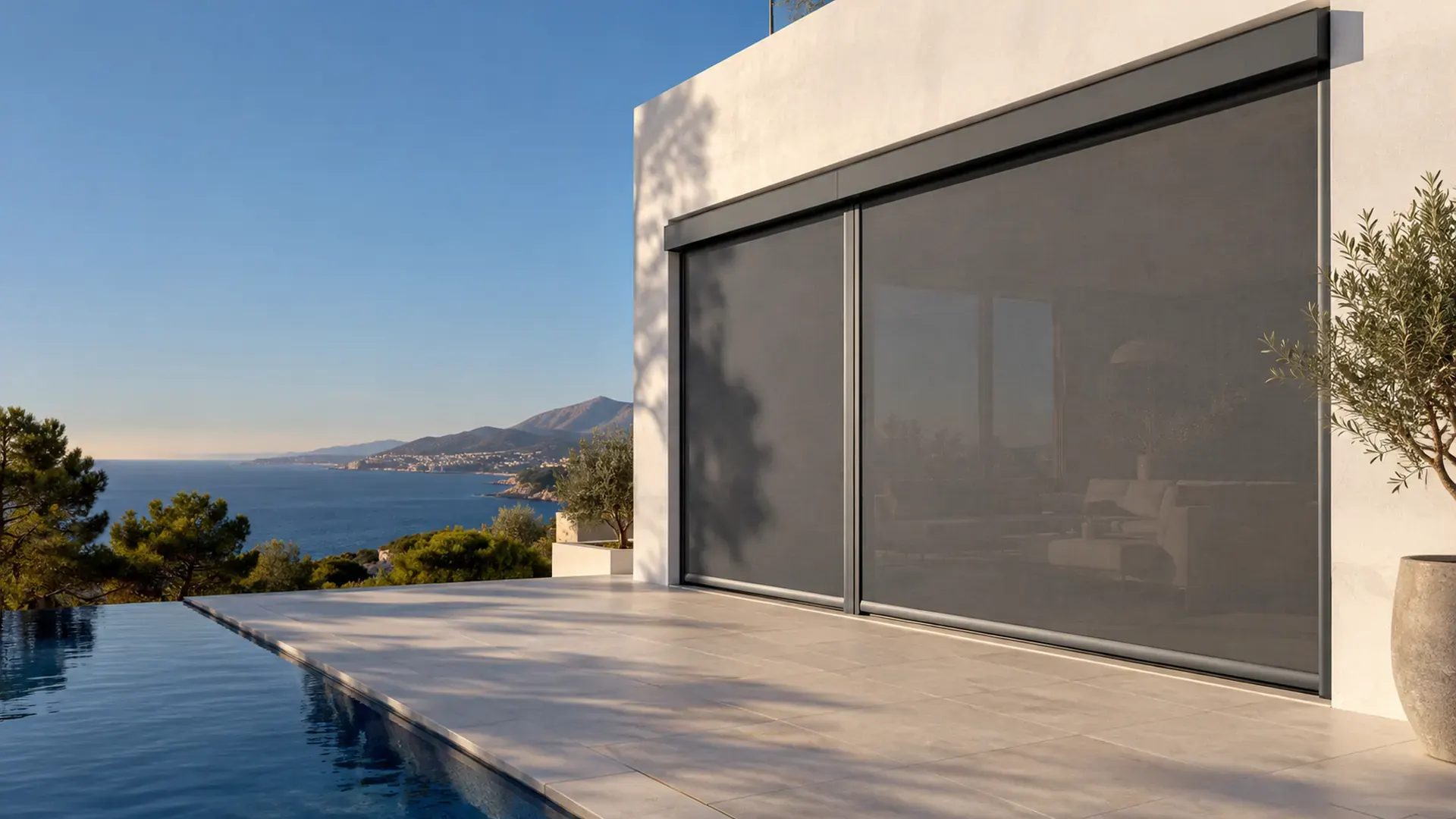
Zip screens in Malaga the outdoor blind that stays put
An outdoor blind with a zip along its edges that runs inside side guides, so the fabric stays taut, with no gaps and no flapping in the wind. It filters the sun, gives you privacy and keeps your view. We install made-to-measure zip screens in Malaga and on the Costa Tropical, with a Cherubini motor and our own team.
- Our own team, no subcontractors
- Home visit and measuring free
- Fixed-price quote in under 24 hours
- Powder-coated aluminium and stainless fixings
- Guarantee and after-sales service
In short
A zip screen in Malaga is an exterior blind with a zip along its edges that runs inside side channels: the fabric stays taut, with no gaps, and holds up in the wind. It filters the sun and gives privacy without losing the view. QUBRE fits them to measure on large windows, porches and pergolas, with a Cherubini motor and our own team.
Updated · QUBRE technical team, Velez-Malaga
What is a zip screen and why does it work so well on the coast?
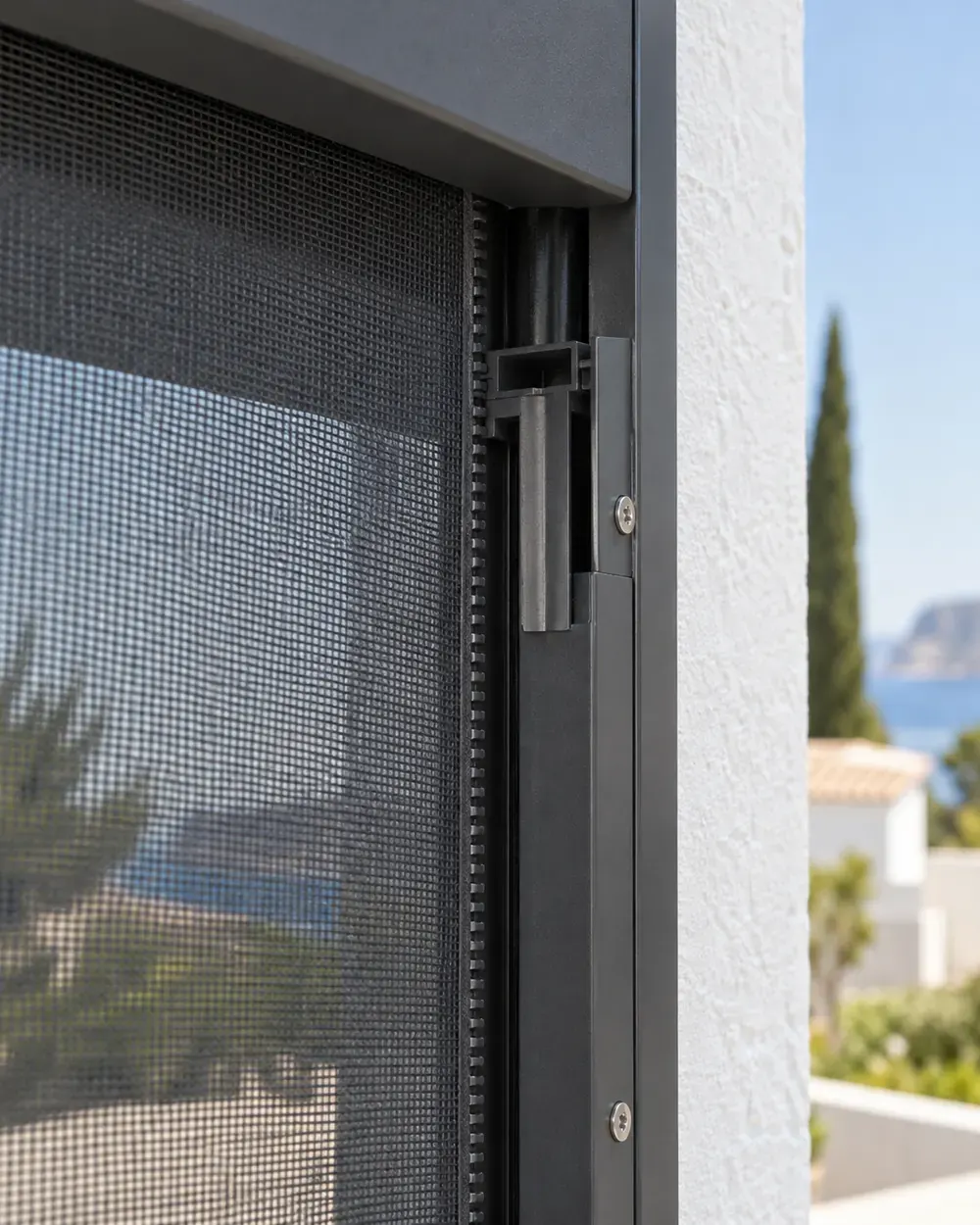
A zip screen is an outdoor roller blind whose fabric has a zip welded along both sides. That zip runs inside an aluminium guide from top to bottom, so the fabric is held along its full height: it can’t pull away at the sides, it doesn’t bang about and it stays taut. That’s why more and more people in Malaga are choosing zip screens, also known as zip blinds, for picture windows, porches and pergolas exposed to the wind.
The usual fabric is a micro-perforated screen fabric. During the day it filters light and heat before they reach the glass, and from inside you can still see out through the weave, while from outside very little can be seen. It’s a way to have shade and privacy without living with the shutters down.
At QUBRE we make them to measure for picture windows, the sides of porches and pergolas. Almost all of them are motorised with a Cherubini motor. If what you’re after is keeping the wind off a bar terrace with clear windows, a windbreak awning with side guides will suit you better.
Where do we install them?
- Picture window or patio door
- Side of a porch
- Side of a pergola
- Glazed penthouse
- West-facing facade
- Shopfront or business
Zip screens for picture windows, porches and pergolas
It’s the same system used in three different ways. At the visit we work out which one is yours and how to fix the guides.
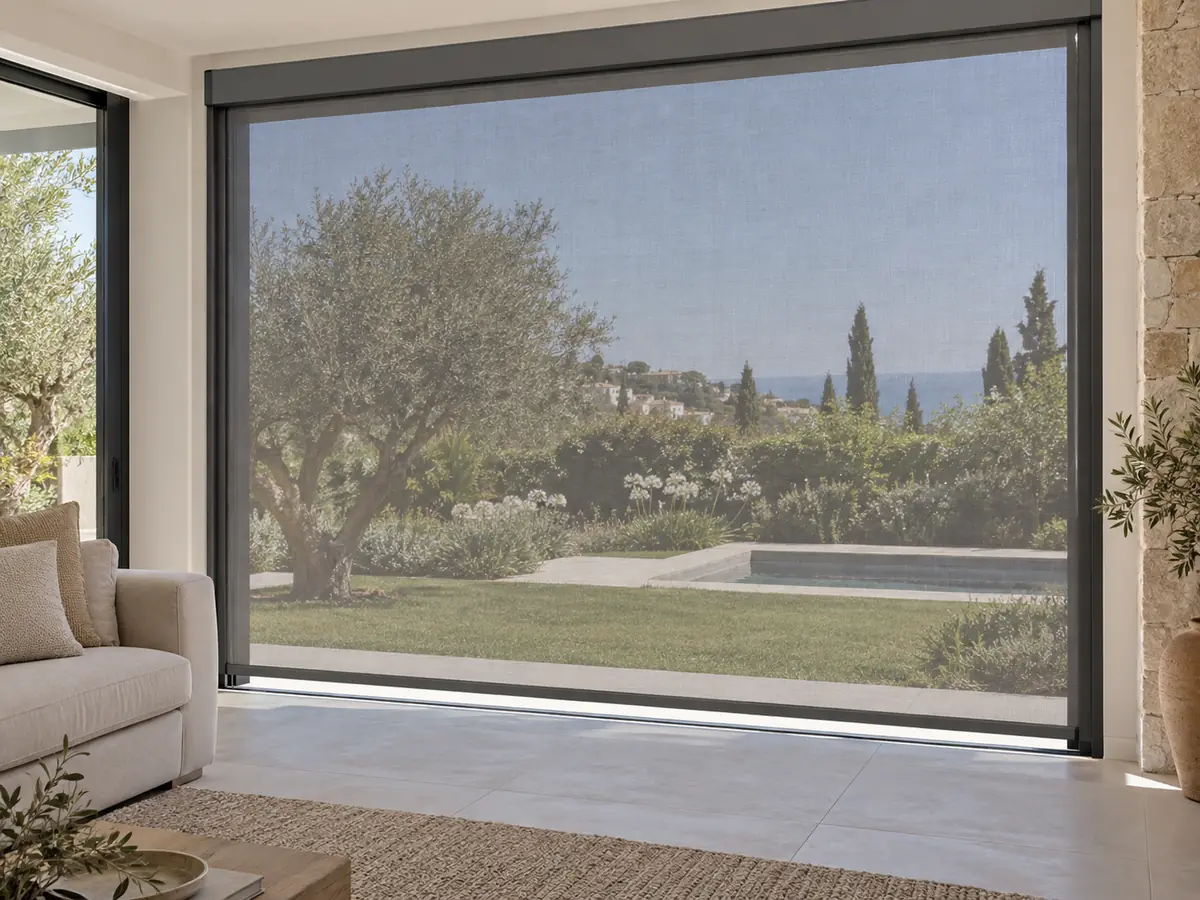
Outdoor roller blind for picture windows
In front of a picture window or patio door, a zip screen stops the heat before it reaches the glass. Ideal for west-facing facades and glazed penthouses that overheat in the afternoon.
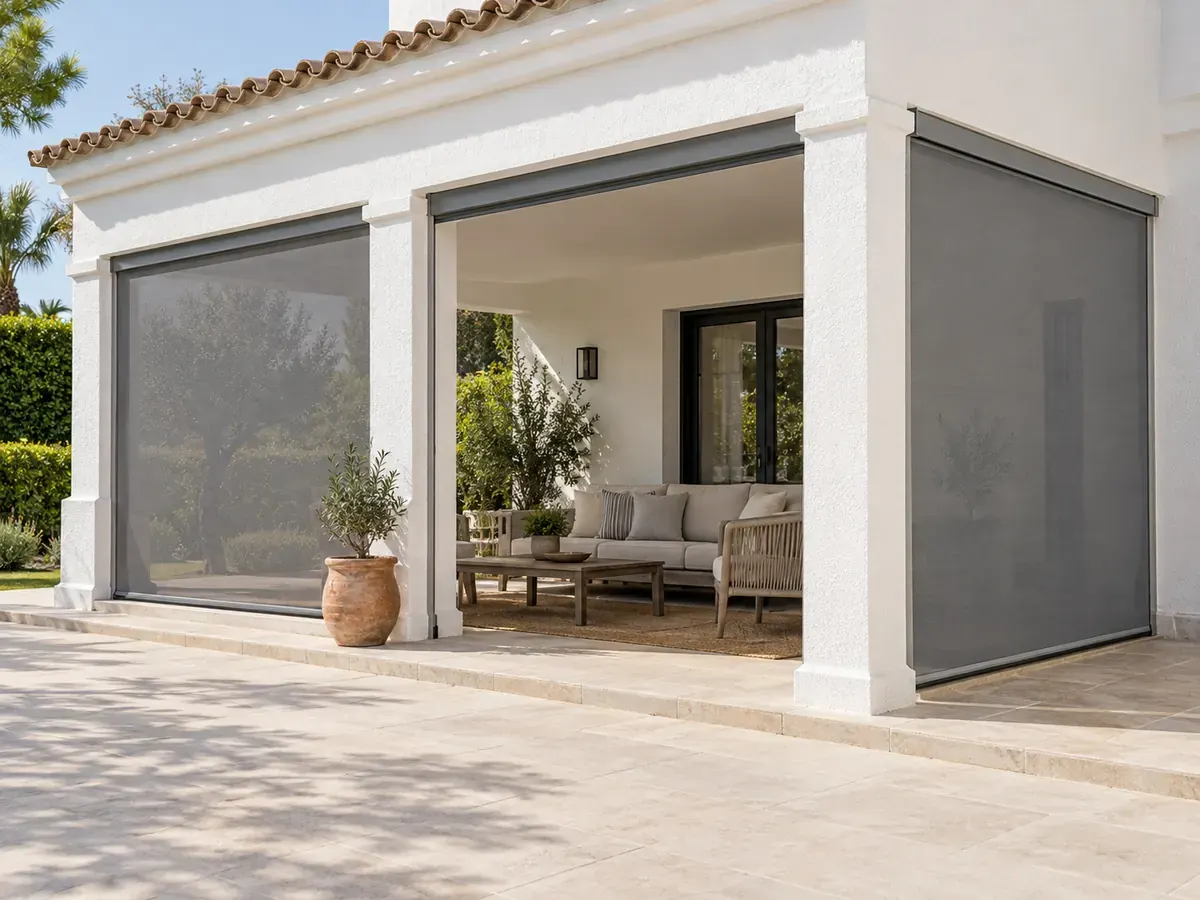
Zip awning to close in a porch
It closes off the sides of the porch when the sun is low or you want privacy from the neighbours, and rolls up when you want it all open. We combine it with roller and vertical awnings where needed.
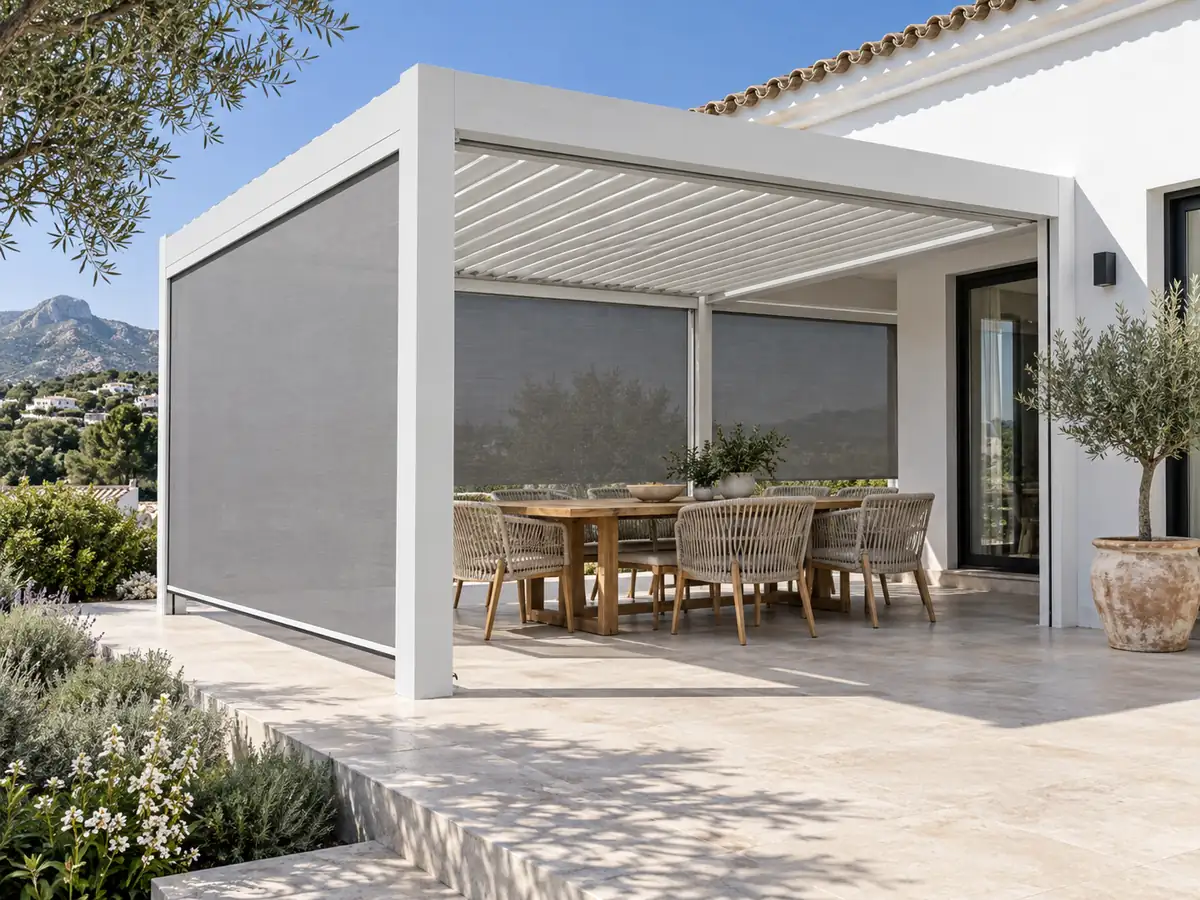
Screens for pergolas
On a bioclimatic pergola or an aluminium pergola, the screen fits between the posts and turns the pergola into a room sheltered from the sun and from prying eyes.
Screen fabric comes in different openness factors and colours, depending on the model: more open if you want to keep your view, more closed if you’re after privacy and light control. We bring the sample book to the visit. For easy everyday use, take a look at awning motorisation.
What’s included when we install your zip screen
We leave it installed, motorised and tested. The same technicians who measure up are the ones who fit it, with no subcontractors.
- Free home visit, measuring and advice
- Survey of the opening and where to fix the guides
- Top cassette and guides in powder-coated aluminium
- Made-to-measure screen fabric with zip edges
- Sample book of colours and openness factors
- Cherubini motor with remote control or wall switch
- Stainless anchors and fixings
- Fitted by our own technical team
- Tension adjustment and test run
- Guarantee and after-sales service
Guides aligned to the millimetre. A zip screen works well if the guides are parallel and plumb; if not, the zip rubs or pops out. That’s why we measure the opening in person, correct any uneven surfaces and fit everything with stainless fixings, ready for the salt air on the coast.
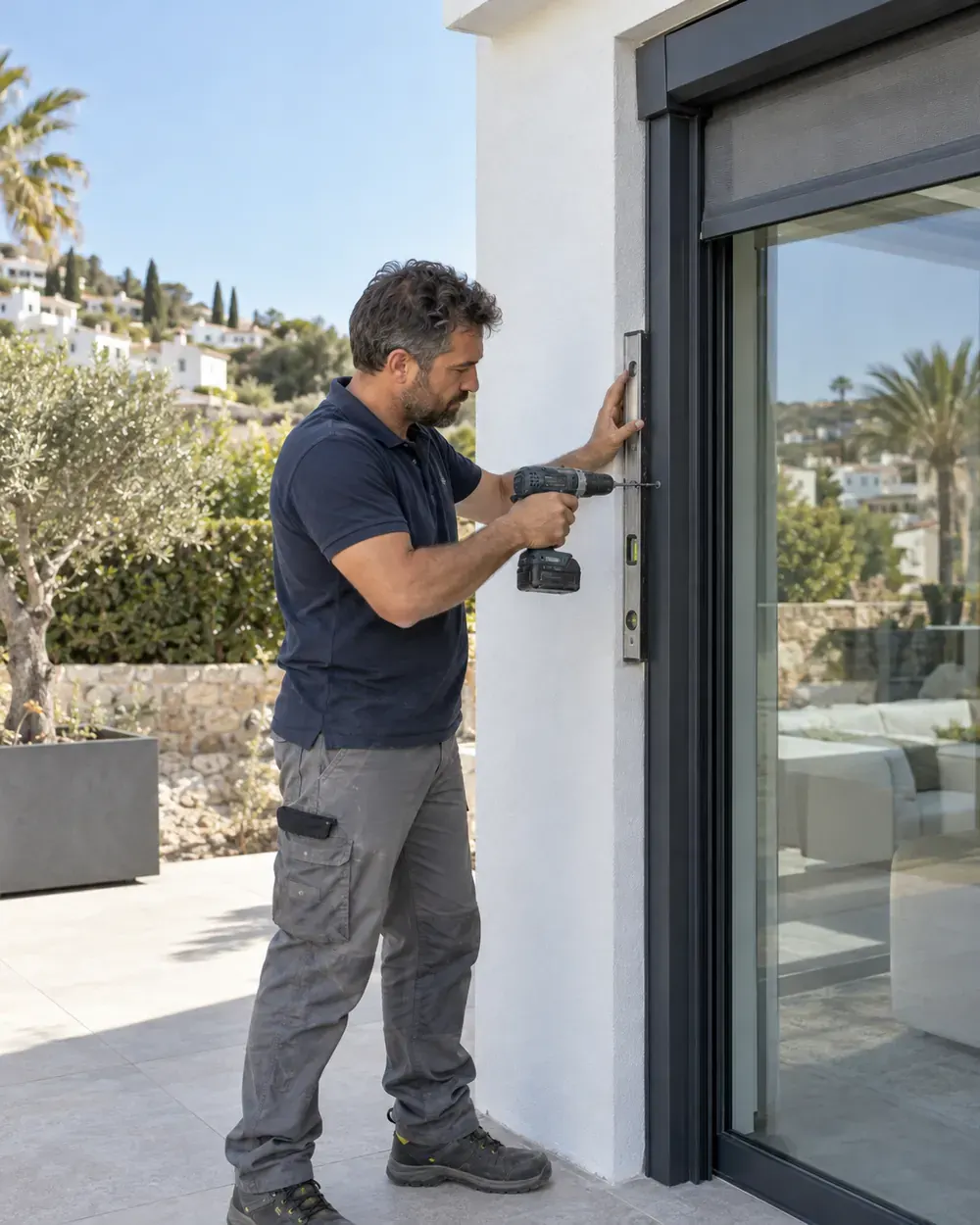
How we install your zip awning
Six steps, one point of contact and a fixed price from day one.
- Visit and measuringFree of charge. We measure the opening at several points, because walls are rarely perfectly square, and check which way it faces.
- Proposal and quoteWe suggest the fabric, colour and motor, with a written, fixed-price, no-obligation quote, often in under 24 hours.
- PermitsIf your community wants a uniform facade or there’s any paperwork to do, we’ll tell you and prepare the documents.
- Made to measureWe order the cassette, guides and zip-edged fabric to the exact size of your opening.
- Fitted by our own teamWe fix and plumb the guides, mount the cassette, feed in the fabric and connect the motor.
- Testing and handoverWe raise and lower it with you, set the end stops and show you how to use the remote.
Can you send us a photo of the window, porch or pergola? We’ll tell you whether a zip screen will work before we come to measure.
Send a photo on WhatsAppZip screen or a traditional roller awning?
Both are outdoor blinds that drop vertically. The difference is how they hold the fabric and how they behave when the wind gets up.
| Feature | Zip screen | Roller or vertical awning |
|---|---|---|
| How the fabric is held | Zip edges inside the guide, along the full height | Free-hanging fabric or cables or simple guides, depending on the model |
| Side gaps | None: the fabric seals against the guide | Small gaps at the sides |
| Wind | Very stable; doesn’t flap or bang | Needs rolling up early when it’s windy |
| Usual fabric | Micro-perforated screen fabric | Acrylic fabric or screen fabric |
| View | You see out through the weave | Depends on the fabric; acrylic fabric blocks the view |
| Operation | Usually motorised | Manual or motorised |
| Best for | Exposed picture windows, porches and pergolas | Windows and balconies on homes |
If your window or balcony doesn’t catch much wind, a roller awning or a drop arm awning may be all you need. You can see every system on our awnings in Malaga page.
Zip screen prices in Malaga: what affects them
We don’t give generic prices: every zip screen is made to the exact size of its opening. These are the factors that make the price vary:
Fixed-price written quote in under 24 hours
We come and measure for free, explain every option and give you a price that won’t change halfway through the job. No obligation.
Zip screens in Malaga, the Axarquia and the Costa Tropical
From Velez-Malaga we come out to measure for free right across the area. We fit them on penthouses in Malaga city and Benalmadena that get the afternoon sun, on sea-view porches in Nerja and Torrox, and on pergolas in Marbella, Estepona and Motril, where the wind never leaves an ordinary blind in peace.
Malaga and Costa del Sol
Costa Tropical and Granada
Shall we fit a zip screen at your home?
Tell us what you need in four quick steps and we’ll call you to arrange the visit. No obligation.
- Free home visit and measuring
- A fixed, written quote in under 24 hours
- Fitted by our own team, no subcontractors
- Guarantee and after-sales service close to you
Frequently asked questions about zip screens in Malaga
What’s the difference between a zip screen and an ordinary outdoor roller blind?
Every zip screen is an outdoor roller blind, but not every outdoor blind is a zip screen. The difference lies in the edges of the fabric. On a conventional blind, the fabric hangs freely or is guided by cables or simple channels, and there’s some play between the fabric and the guide. When it’s windy, the fabric moves, bangs about and lets light in at the sides.
On a zip screen, the fabric has a welded zip along both sides that slots into the guide and runs inside it along the full height. The fabric is held taut from top to bottom, with no gaps. That’s why it copes far better with wind, makes no noise and shades more evenly, depending on the model.
You really notice the difference on the coast. On a penthouse in Malaga city or a porch in Torre del Mar, an ordinary blind has to go up as soon as the wind picks up. A zip screen, on the other hand, can stay down in a moderate breeze, always within the limits the manufacturer sets for each size.
If your window is sheltered and small, a roller awning may be enough and simpler. If it’s exposed or it’s a large picture window, a zip screen is worth it. We’ll look at it during the free visit, which you can book using the form.
Can a zip screen stand up to the levante and poniente winds?
That’s its great strength. Thanks to the zip, the fabric can’t come out of the guides or flap, which makes a zip awning far more stable than a conventional outdoor blind. On terraces and porches where the levante (easterly) or poniente (westerly) wind comes in from the side, you’ll notice the difference from day one.
Even so, no fabric screen is a wall. Wind resistance depends on the model, width and height of each unit and on how the guides are anchored. A very wide zip screen takes more wind load than a narrow one, so for large openings it’s sometimes better to split it into two units. We always follow the manufacturer’s guidance for each size.
In a storm or very strong gusts, the sensible thing is to roll it up. If you’d rather not have to think about it, a motorised zip screen can have a wind sensor that retracts it automatically, depending on the model. It’s very handy for holiday homes in the Axarquia and on the Costa del Sol.
At the visit we look at where the wind comes from at your home and suggest the size of each unit and the safest anchoring. If you want to shield a bar terrace from the wind with clear windows, compare it with the windbreak awning with side guides. There’s more on automation on our awning motorisation page.
Can you see out through screen fabric? And can people see in?
Yes, you can see out from inside. Screen fabric is micro-perforated: it’s a weave with tiny openings that let some light through and allow you to see through it. During the day, because it’s brighter outside than in, you can see the garden, the street or the sea quite clearly from inside, as if through a sheer curtain.
From outside it’s the other way round: during the day very little of what’s going on inside can be seen. That’s why a zip screen is so useful for gaining privacy on porches and living rooms overlooking the street or the neighbours. Bear in mind that at night it reverses: if the lights are on inside and it’s dark outside, people will see more from outside.
How much you can see depends on the fabric’s openness factor and its colour, depending on the model. A more open fabric gives a better view and lets in more light; a more closed one filters more sun and gives more privacy. Darker colours usually give a clearer view out; lighter ones reflect more heat. We bring samples to the visit so you can check for yourself.
If heat is your main concern, read our article on which awning keeps the heat out best. And if you want total privacy, you can also combine the zip screen with other vertical awnings.
Can I add a screen to a pergola I already have?
In many cases, yes. A pergola screen is fitted between the posts, with the cassette at the top and the guides at the sides, and turns the pergola into a room sheltered from the low sun and from prying eyes. It’s one of the most worthwhile upgrades for an existing pergola.
The first thing we check is the structure. The top beam needs to carry the cassette and the posts need to be plumb so the guides sit parallel. If the pergola is aluminium, we normally fix it to the frame; if it’s wooden, we check the condition of the timber and choose suitable fixings. If anything isn’t right, we’ll tell you before suggesting anything.
It doesn’t matter if another company installed the pergola. Our after-sales service also covers work by other installers, and we assess compatibility just as if it were our own. For new pergolas, the ideal is to plan the zip screen from the start and run the motor cabling inside the structure, so no cables are on show.
A bioclimatic pergola with zip screens on the sides is the closest thing to an outdoor room you can use almost all year round. If you’d prefer a simpler structure, take a look at our aluminium pergolas. Either way, you get a written, fixed-price quote.
How does a motorised zip screen with a Cherubini motor work?
A motorised zip screen has a tubular motor inside the roller in the top cassette. When you press the remote or the wall switch, the motor rolls the fabric up or down, and the zip guides it inside the channels to the end of its travel. The end stops are set during installation so the fabric stops exactly where it should.
We install Cherubini motors, which you can operate with a remote control or a wall switch. If you have several zip screens, for example on three sides of a porch, they can be programmed to move all together or one by one, depending on the set-up.
You can also add automation, such as a sun sensor that lowers the zip screen when the facade starts to heat up, or a wind sensor that raises it in strong gusts, depending on the model. The motor needs a power point near the cassette; at the visit we tell you where to run the cable and, if it’s a new installation, we allow for it.
You’ll find more details on our awning motorisation page and in our article on which motor to choose for your awning. There we also explain how remotes and sensors work and what to bear in mind before you choose.
How much does a zip screen cost in Malaga and what affects the price?
The price of a zip screen depends on lots of factors, which is why we don’t give ballpark figures: each unit is made to the exact size of its opening, and two picture windows that look the same may need different solutions. We’d rather come out, measure for free and give you a real price for the zip screen you need in Malaga.
What matters most is the size of each unit (width by height) and how many units you need: one picture window isn’t the same as three sides of a porch. Then there’s the fabric you choose, with its openness factor and colour; the motor and automation; and where the cassette and guides are fixed, whether on the facade, inside the window opening or on the frame of a pergola.
Height and access count too. A zip screen on a penthouse where the materials have to be carried up the stairs isn’t fitted the same way as one at garden level. Taking all that into account, we give you a written, fixed-price, no-obligation quote, often in under 24 hours.
If, once we’ve seen it, we think a roller awning or a drop arm awning will do the job just as well, we’ll tell you. Book your visit using the form or on our contact page.
How do you clean and maintain a zip awning near the sea?
Looking after a zip awning is easy, but on the coast it’s best not to neglect it. Salt and sand settle on the fabric and, above all, in the guides, which is where the zip runs. If dirt builds up there, the fabric starts to rub and the motor has to work harder than it should.
A couple of times a year, or more often if you’re on the seafront, clean the inside of the guides with fresh water and a cloth or soft brush. Clean the fabric while it’s down, with water, mild soap and a sponge, without scrubbing hard or using harsh products, solvents or pressure washers. Let it dry fully before rolling it up.
Avoid leaving it rolled up wet for days: like any fabric, it can get marks or smells. And if you notice the zip is noisy, the fabric isn’t coming down straight or the motor stops early, let us know. Very often it’s just a matter of adjusting the end stops or cleaning the guides. You’ll find more tips in how to clean and maintain an awning.
From the outset we use powder-coated aluminium guides and stainless fixings, designed for a salty environment. If the fabric wears out over the years, it can be replaced without changing the whole system, depending on the model. We do this through our awning repairs and fabric replacement service.
Do I need my community’s permission to fit a zip screen on the facade?
It depends on where it goes and on your building’s rules. A zip screen fitted on the facade or terrace of a flat changes the outside appearance of the building, and in many communities that requires approval or, at the very least, sticking to a common model and colour. If you live in a detached house, there’s usually no community to consult, but there may be local town hall rules.
Most often, the community has set a fabric or frame colour to keep the facade uniform. In that case, we choose the zip screen within those conditions. If nothing has been decided, it’s best to raise it at the owners’ meeting before installing, to avoid problems later. We explain it in our guide to awnings in communities of owners and the Spanish Horizontal Property Act.
If you’re the administrator or president of a community and you want the same system on several homes, we can also help you agree on a common model. There’s more information on our awnings for communities of owners page.
At QUBRE we handle the paperwork and permits when they’re needed, and at the visit we tell you which procedure applies in your case. For questions about local council licences, see also our guide to permits for installing an awning or a pergola.