A bioclimatic pergola is an aluminium roof made of louvres that you turn with a remote control to decide how much light, air and shade reaches your terrace. In Malaga, the Axarquía and the Costa Tropical it has become one of the most requested outdoor home improvements, because it deals at once with strong sun, sudden downpours and the heat that builds up under an awning.
But it isn’t a magic solution, and it doesn’t suit every home. Before asking for a quote, it’s worth knowing its real pros and cons and when it pays off compared with an awning or a fabric pergola. In this guide we explain it from our installation team’s experience, without made-up figures and with the coastal climate in mind.
What a bioclimatic pergola is and how it works
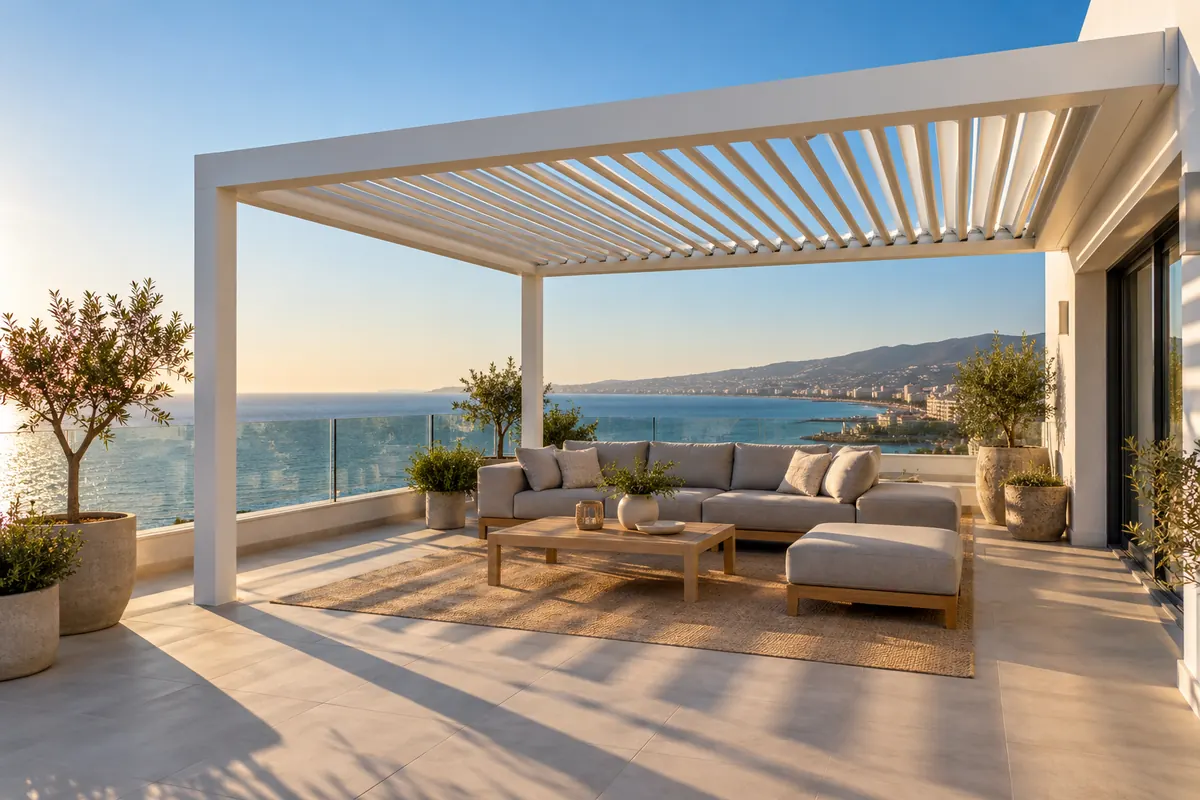
A bioclimatic pergola is an aluminium structure, either attached to the facade or freestanding, whose roof is made of adjustable louvres. With the remote, a motor turns the louvres on their axis: open, they let light and air through; tilted, they block direct sun; and closed, they form a continuous roof that keeps the rain off.
The name comes from that ability to adapt to the weather at any moment. It isn’t a fixed roof that always gives the same shade, nor an awning you have to retract whenever the weather changes: it’s a roof you adjust throughout the day and the year.
Parts of a bioclimatic pergola
Knowing the parts helps you compare quotes and understand why two pergolas that look the same don’t behave the same way:
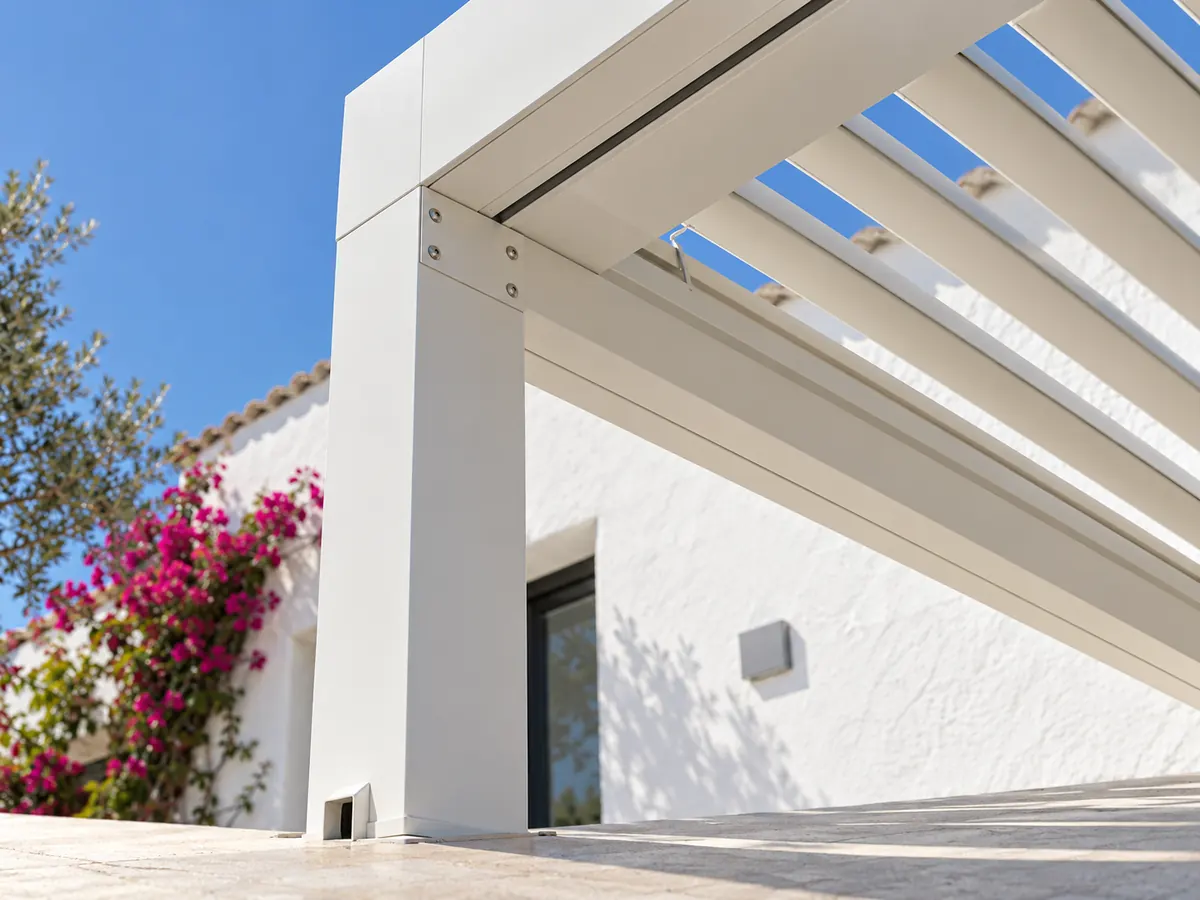
- Structure: powder-coated aluminium posts and beams. On the coast, the coating and stainless-steel fixings make all the difference against salt air.
- Louvres: aluminium profiles that turn on their axis. Their shape lets water run to the sides when they are closed.
- Gutter and downpipes: they collect the water from the louvres and take it down inside the posts, with no visible pipes.
- Motor and remote: they move the louvres. Depending on the model, they accept rain and wind sensors.
- Extras: built-in LED lighting and side screens (zip screen, windbreak or glass), depending on the model.
Adjustable louvres or adjustable and retractable louvres
Depending on the model, the louvres can be adjustable only (they turn but stay in place) or adjustable and retractable (they also stack at one end to leave the sky clear). The first type is the most common in homes; the second makes sense when you want full sun on the terrace in winter. The retractable mechanism is more complex, and that shows in the quote.
Pros of a bioclimatic pergola
These are the reasons why more and more families and businesses on the coast choose a bioclimatic pergola for their terrace, porch or pool area.
1. You control light and shade degree by degree
With an awning you have two positions: shade or sun. With adjustable louvres you decide how much light comes in at each time of day. In the morning you can open them to let the soft sun in, and at midday tilt them to block direct sun without being left in the dark.
2. It ventilates: hot air doesn’t get trapped
This is the advantage you notice most in summer. Under an extended fabric the heat tends to build up; with the louvres slightly open, the hot air rises and escapes through the top and the terrace breathes. If you want to understand why the material matters so much for heat, we explain it in our guide to the best awning to keep the heat out.
3. It keeps the rain off without retracting anything
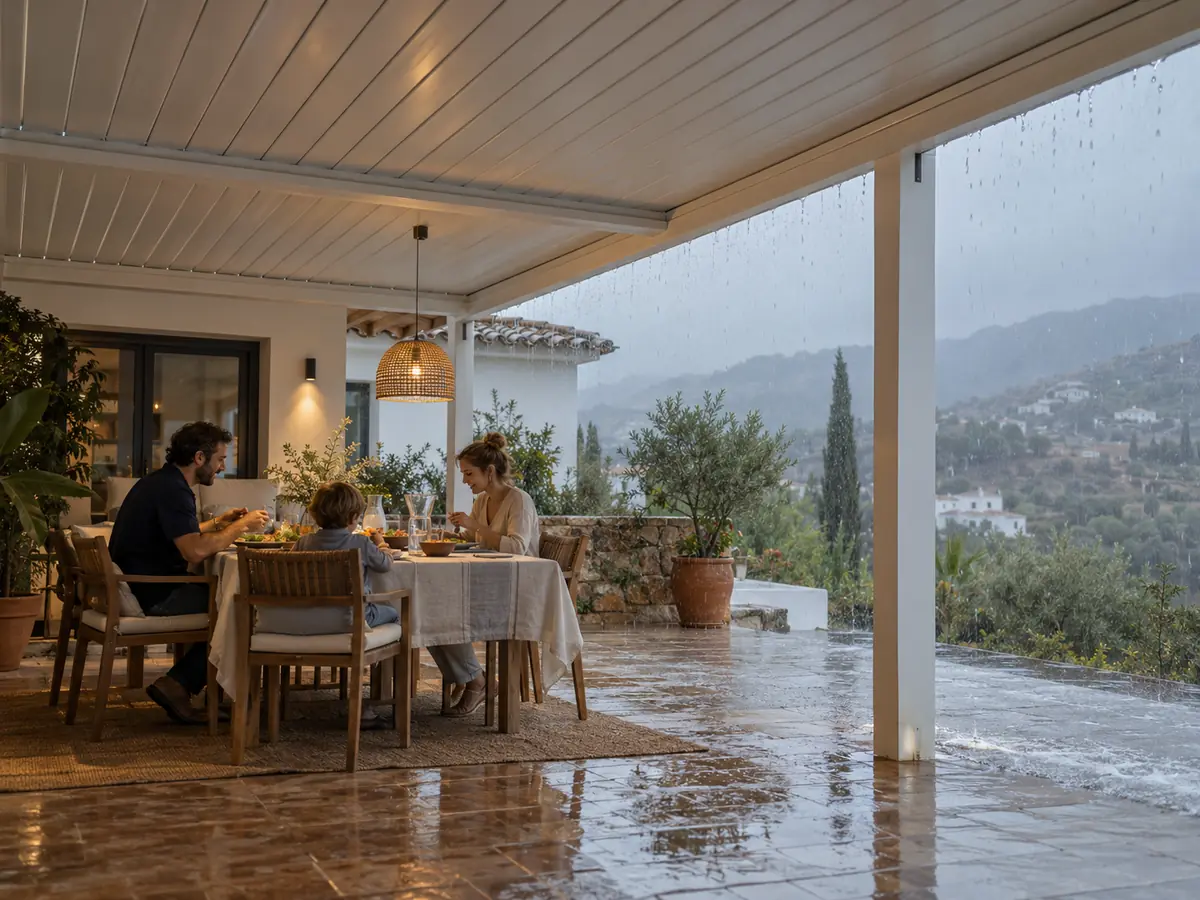
With the louvres closed, the pergola forms a continuous roof and the water drains through the gutter and the posts. In an area like ours, where rain falls on few days but hard, that means you can leave the furniture outside and keep using the terrace during a shower. With a rain sensor, the louvres close by themselves even when you’re not at home.
4. It handles wind better than fabric
An aluminium roof is far more stable than tensioned fabric, which works with every gust. On days of levante or poniente wind you don’t have to rush out to retract anything. Even so, every model has its limits, and in very exposed areas we recommend a wind sensor that sets the louvres in the safest position.
5. Low maintenance
There’s no fabric to replace every few years. Looking after a bioclimatic pergola comes down to cleaning the louvres and gutters, especially on the seafront, where sand and salt build up, and checking that the water drains properly through the downpipes.
6. A terrace you can use all year round
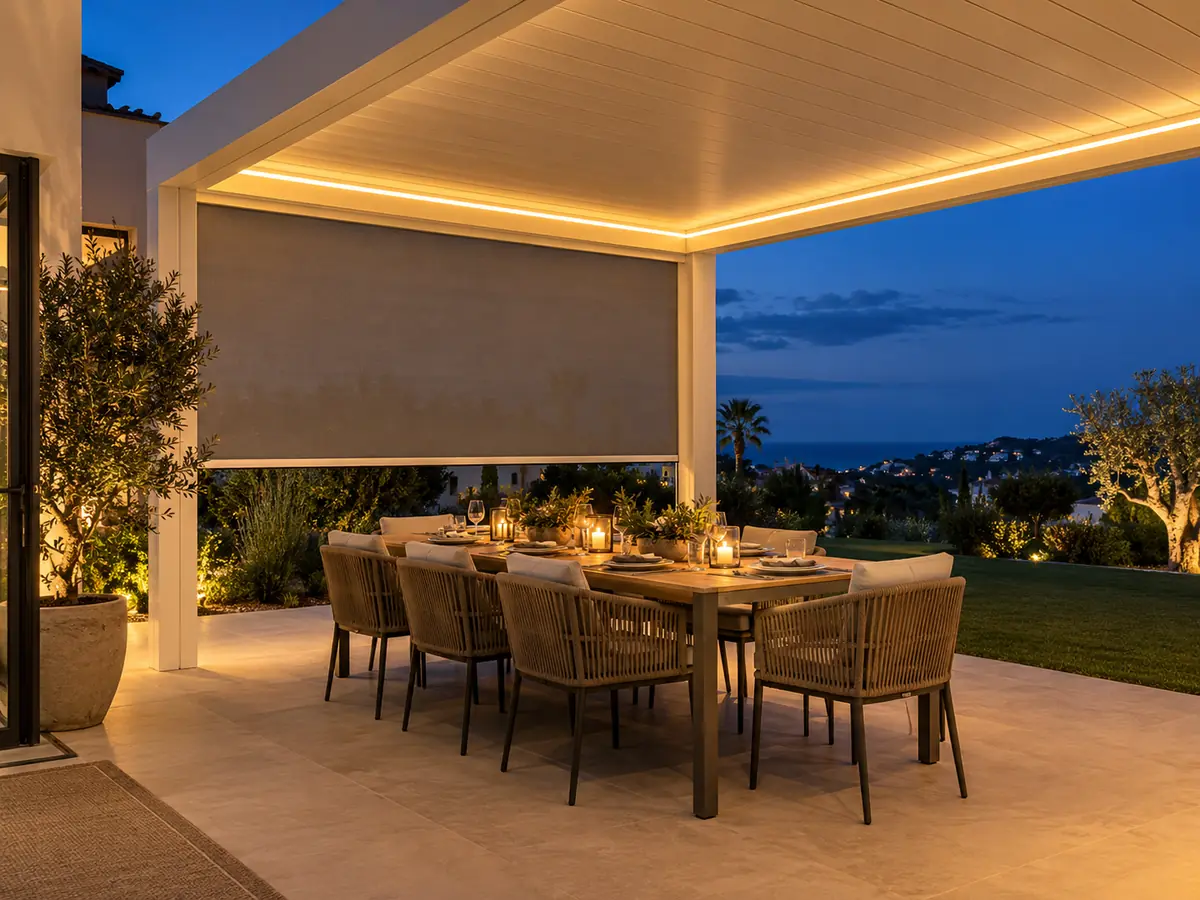
If you close the sides with zip screens, windbreak awnings with side channels or a glass enclosure, the terrace becomes a room you use in winter, in the levante wind or at night. With built-in LED lighting, depending on the model, dinner goes on without the need for lamps.
7. Looks and home value
A well-proportioned bioclimatic pergola, in the same colour as your window frames, ties the terrace in with the house and gives it a well-kept look. For many families it’s the way to gain an outdoor room they notice every day.
Cons of a bioclimatic pergola
It also has weak points. We’ll tell you exactly what they are, because choosing well starts with knowing what a bioclimatic pergola doesn’t do.
1. It’s a bigger investment than an awning
A bioclimatic pergola has a structure, louvres, a motor, gutters and fixings sized for its dimensions. That’s why it costs more than an awning or a fabric pergola. It’s designed for many years of use; if you only need shade a few months a year, a simpler option may suit you better.
2. Without side screens, wind-driven rain comes in sideways
The roof keeps off rain that falls from above, but if the rain comes with a side wind, it will get in through the sides just as it would in any open porch. If you want to use it on those days, you need to plan screens on the most exposed side.
3. It needs a good base and good fixings
It can’t be fitted just anywhere without a survey. The facade has to take the fixings of the wall-mounted version, and the floor has to allow the posts of the freestanding version to be secured. That’s why we always measure and check the support before giving a price.
4. It may need permits
A fixed structure changes the look of the facade or the roof terrace, so in many cases you need to speak to your community of owners and check with the town hall. It isn’t a technical drawback, but it’s worth factoring into the timeline. We explain it in our guides on permission for awnings and pergolas in Spain and on awnings and pergolas in a community of owners.
5. It needs to be used properly in summer
With the louvres fully closed in full sun, the aluminium heats up and the air doesn’t circulate. The key is to leave them slightly open to ventilate. It’s easy, but you have to get used to angling them according to the time of day.
6. You can hear the rain, and gutters need cleaning
In heavy rain you hear the water on the aluminium, as with any lightweight roof. And if there are trees nearby or you live on the seafront, leaves and sand end up in the gutters: regular cleaning prevents blockages.
Summary of pros and cons
| Aspect | Pro | Con |
|---|---|---|
| Light and shade | You set the louvre angle degree by degree | You need to angle them according to the time of day |
| Heat | With the louvres half open, hot air escapes through the top | Closed in full sun, heat builds up |
| Rain | Continuous roof with built-in gutter and downpipes | With side wind, water comes in at the sides without screens |
| Wind | Rigid aluminium roof, more stable than fabric | Every model has its limits; a wind sensor is advisable |
| Maintenance | No fabric to replace | Clean louvres and gutters, especially on the seafront |
| Investment | Designed for many years of use | Higher than an awning or a fabric pergola |
| Paperwork | We handle the documents when they’re needed | May need approval from the community and the town hall |
Is your terrace a good fit for a bioclimatic pergola? We’ll come and measure for free, check the fixings and the orientation, and give you a written, no-obligation quote with a fixed price in under 24 hours. Ask for your free quote or call us on +34 694 57 17 33.
Is a bioclimatic pergola worth it in Malaga?
It depends on how you use the terrace and where it is. The coastal climate works in its favour: strong sun almost all year, levante and poniente gusts, the hot terral wind in summer and rain concentrated on a few days, as shown by AEMET’s climate data. These are the situations where we recommend it most:
Penthouses and seafront terraces
In Torre del Mar, Rincón de la Victoria, Fuengirola or Benalmádena, sun and wind take their toll on awnings. A bioclimatic pergola gives shade with no fabric flapping and, with powder-coated aluminium and stainless-steel fixings, stands up well to salt air. You’ll find local examples on our pages for awnings and pergolas in Torre del Mar and in Fuengirola.
Villas with a pool in the Axarquía
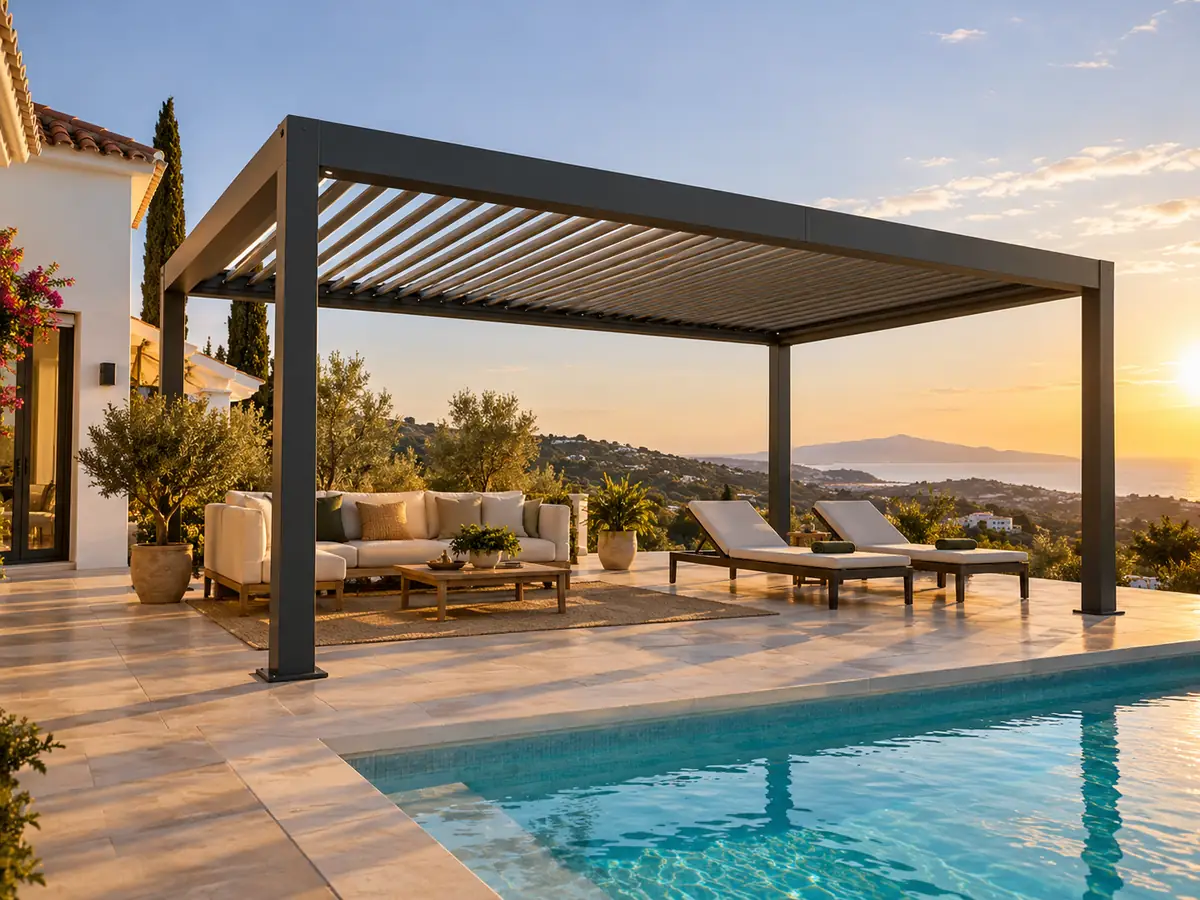
Inland in the Axarquía and around Vélez-Málaga, the terral wind pushes temperatures right up in summer. By the pool, a freestanding pergola with the louvres half open creates a ventilated shaded area that stays comfortable even in the hottest hours. From our base in Velez-Malaga we see it every summer.
Villas on the Costa del Sol
In Marbella and Estepona, many villas want a roof that blends in with the architecture and works over large areas. There, several modules are joined into a single structure. You can see more on our page about pergolas in Marbella.
Granada and the Costa Tropical
In Motril, Salobreña or Almuñécar the climate is similar to the Axarquía, but in Granada city the winters are cold. There, combining a pergola with side screens lets you use the terrace for much of the year. We explain it in bioclimatic pergolas in Granada.
Bar and restaurant terraces
For a business, a bioclimatic pergola with screens lets you serve on the terrace in sunshine, light rain and winter, with a smart look. If you run a venue, also see our awnings and pergolas for bars and restaurants.
When it may not pay off: if you only use the terrace a few weeks in summer, if the facade or floor won’t take reliable fixings, or if your community doesn’t allow fixed structures. In those cases, a well-chosen awning or a pergola with a retractable fabric roof can give you what you need for a smaller investment.
Wall-mounted or freestanding bioclimatic pergola
How it’s installed depends on your space. These are the two main options:
- Wall-mounted: fixed to the facade on one side and resting on two posts on the other. It’s the most common in penthouses and home terraces, because it extends the living room outwards. If this format interests you, also see our wall-mounted pergolas.
- Freestanding: four posts and no support from the house. It creates a separate seating area in the garden or by the pool, and it’s the answer when the wall can’t take the load or shouldn’t be touched.
Bioclimatic pergola vs awning and fabric pergola
If you’re weighing up several options, this comparison helps you place the bioclimatic pergola:
- Compared with an awning: an awning costs less and retracts fully, but you have to retract it in the wind and it gives little protection from rain. A bioclimatic pergola works in any weather without retracting anything.
- Compared with an aluminium pergola with fabric: the fabric version gives full shade or open sky and needs a smaller investment; the bioclimatic one regulates light, ventilates better and keeps the rain off. You can see both on our page about aluminium pergolas.
- Compared with a wooden pergola: wood brings warmth but needs more maintenance near the sea. We cover it in wooden pergolas.
And if what you want is to close the terrace completely, read our terrace enclosure guide. All the pergola options are on our page about pergolas in Malaga.
Bioclimatic pergola: price and what affects it
We don’t give ballpark prices, because every bioclimatic pergola is made for a specific space and a generic figure would mislead you. These are the factors that make one cost more or less:
- Size and area: the more square metres it covers, the more louvres, profiles and posts it needs.
- Wall-mounted or freestanding: fixing it to the facade saves posts; the freestanding version needs four and their fixings.
- Type of louvre: adjustable and retractable louvres have a more complex mechanism than adjustable-only ones.
- Automation: rain and wind sensors or LED lighting add to the base price.
- Side screens: zip screens, windbreaks or glass turn the pergola into a room.
- Floor, facade and access: the type of fixing, the height and how easy it is to get the materials in.
The most reliable thing is to measure the space. At QUBRE the visit is free and we give you a written quote with a fixed price in under 24 hours. If you’d like an idea first, our page on bioclimatic pergolas in Malaga has a simulator to try out models, colours and screens.
Common mistakes when choosing a bioclimatic pergola
These are the faults we see most often when we’re called to check bioclimatic pergolas fitted by others:
- Not surveying the fixings: a facade or floor that can’t take the load means redoing the job.
- Forgetting where the water goes: the drain from the posts has to end somewhere that doesn’t soak the neighbour or flood the terrace.
- Choosing from a photo alone: the colour, height and proportions have to suit the house.
- Not planning the screens: if you know the levante hits you from the side, it’s better to prepare the system from the start.
- Materials not made for the coast: unprotected fixings or poorly coated profiles end up corroded by salt air.
- Skipping the community: installing without asking can end with an order to take it down.
How we install your bioclimatic pergola at QUBRE
From our base in Vélez-Málaga we work with our own technical team across the Axarquía, Malaga city, the Costa del Sol and the Costa Tropical of Granada:
- Free visit and measuring: we measure and study the orientation, the wind, where to fix it and where to take the water.
- Proposal and quote: we explain which model suits you and give you a written, no-obligation quote with a fixed price in under 24 hours.
- Permits: if your community or town hall needs any paperwork, we tell you which and prepare the documents when they’re needed.
- Installation by our own team: no subcontractors, with powder-coated aluminium and stainless-steel fixings.
- Testing, guarantee and aftercare: a 2-year guarantee on materials, depending on the manufacturer and product, a guarantee on the structure and installation, and after-sales service.
We’ll show you on your own terrace how your bioclimatic pergola would look. Free measuring and a no-obligation quote with a fixed price in under 24 hours. Ask for your free quote or call us on +34 694 57 17 33.
Frequently asked questions about the bioclimatic pergola
What is a bioclimatic pergola?
It’s an aluminium structure with a roof of adjustable louvres that you turn with a remote. Open, they let light and air through; tilted, they block the sun; and closed, they keep the rain off, which drains through a gutter and the posts.
What are the main advantages of a bioclimatic pergola?
It regulates light degree by degree, ventilates the terrace, keeps the rain off without retracting anything, handles wind better than fabric and needs little maintenance. With side screens, you can use the terrace all year round.
And its disadvantages?
It’s a bigger investment than an awning, it needs good fixings, it may need permits and, without side screens, wind-driven rain comes in at the sides. You also have to clean the louvres and gutters from time to time.
Does a bioclimatic pergola get hot in summer?
If the louvres are left fully closed in full sun, heat builds up. With the louvres slightly open, the hot air escapes through the top and the terrace stays ventilated and shaded.
Do I need permission to install a bioclimatic pergola?
It depends on the building and the municipality. In a community of owners you usually need their approval, and the town hall may ask for a licence or a responsible declaration. We tell you what applies in your case and prepare the documents when they’re needed.
Can a bioclimatic pergola be closed at the sides?
Yes. You can add zip screens, windbreak awnings with side channels or glass enclosures, depending on the model. That way it’s protected from wind and side rain, and you can use the terrace in winter too.
How much does a bioclimatic pergola cost?
It depends on the size, whether it’s wall-mounted or freestanding, the type of louvre, the automation and the screens. At QUBRE we measure for free and give you a written quote with a fixed price in under 24 hours.
Conclusion: a bioclimatic pergola is worth it if you use your terrace all year
The bioclimatic pergola is the most complete way to enjoy your terrace in sun, heat, rain and wind without retracting anything. Its drawbacks, mainly the investment and the paperwork, are outweighed if you use it every day and choose a model and materials designed for the coast.
At QUBRE we help you decide with good judgement, with a free visit and measuring in Malaga, the Axarquía, the Costa del Sol and the Costa Tropical of Granada. Ask for your no-obligation quote and we’ll send it in under 24 hours.