A roll-up awning is any awning whose fabric winds onto a roller tube when you retract it. It’s by far the most widely installed system in homes in Malaga, the Axarquia and the Costa Tropical, because the fabric is protected when you’re not using it and the same principle works for terraces, balconies, porches and any window that gets too much sun.
The trouble is that “roll-up awning” covers lots of different types of awning: folding-arm, cassette, monobloc, drop arm, roller, zip screen… Each one solves a particular problem and, if you pick the wrong one, you end up with an awning that doesn’t give shade where you need it or struggles in the wind. In this guide we explain the types available, how to choose according to your space and which way it faces, which fabric works best and which mistakes to avoid.
What a roll-up awning is and why it’s the most popular type
What defines a roll-up awning is the way it retracts: the fabric doesn’t fold up like a concertina or come down, but winds around a tube (the roller tube) until it sits compactly against the facade or inside a case. When you need it, the fabric unrolls and a system of arms, guides or simple gravity takes it into position.
This approach has three advantages that explain why it’s the most common choice for houses and flats:
- Shade only when you want it: in winter you can retract it and let the sun in, something a fixed roof won’t let you do.
- Better-protected fabric: when it’s rolled up, most of the fabric is safe from rain, dust and UV, so it lasts longer.
- Versatility: the same principle works horizontally (terraces), at an angle (balconies) or vertically (windows and sides).
If you’re more interested in how it works inside, how long it lasts and how to maintain it, we explain all that in detail in our guide to the retractable awning. Here we focus on something more practical: which model to choose for each corner of your home.
The basic parts of a roll-up awning
Although the shape and size vary, all roll-up awnings share the same parts. Knowing them helps you compare quotes and understand what you’re buying:
- Roller tube: the steel or aluminium tube the fabric winds onto. Its diameter depends on the width of the awning.
- Fabric: acrylic, micro-perforated screen fabric or PVC. It’s the part that has the biggest effect on how much heat the awning keeps out.
- Extension system: folding arms, drop arms, side guides, cables or a front bar that comes down under its own weight.
- Operation: manual with a winding handle, or electric with a tubular motor inside the roller tube.
- Brackets and fixings: the parts that hold everything to the wall, ceiling or floor. On the coast they make all the difference: at QUBRE we use powder-coated aluminium and stainless fixings so the salt air doesn’t corrode them.
Types of awning for every space
The best way to choose a roll-up awning is to start with the space you want to cover, not with the catalogue. These are the models we install and where each one fits.
Terraces: folding-arm and cassette awnings
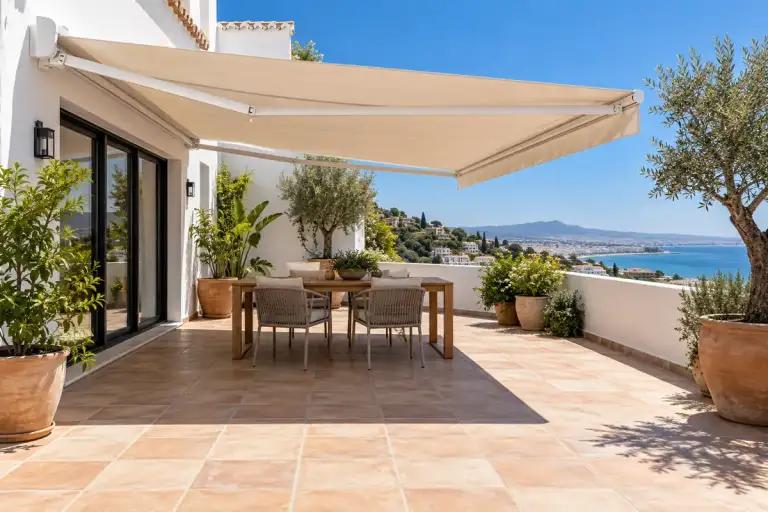
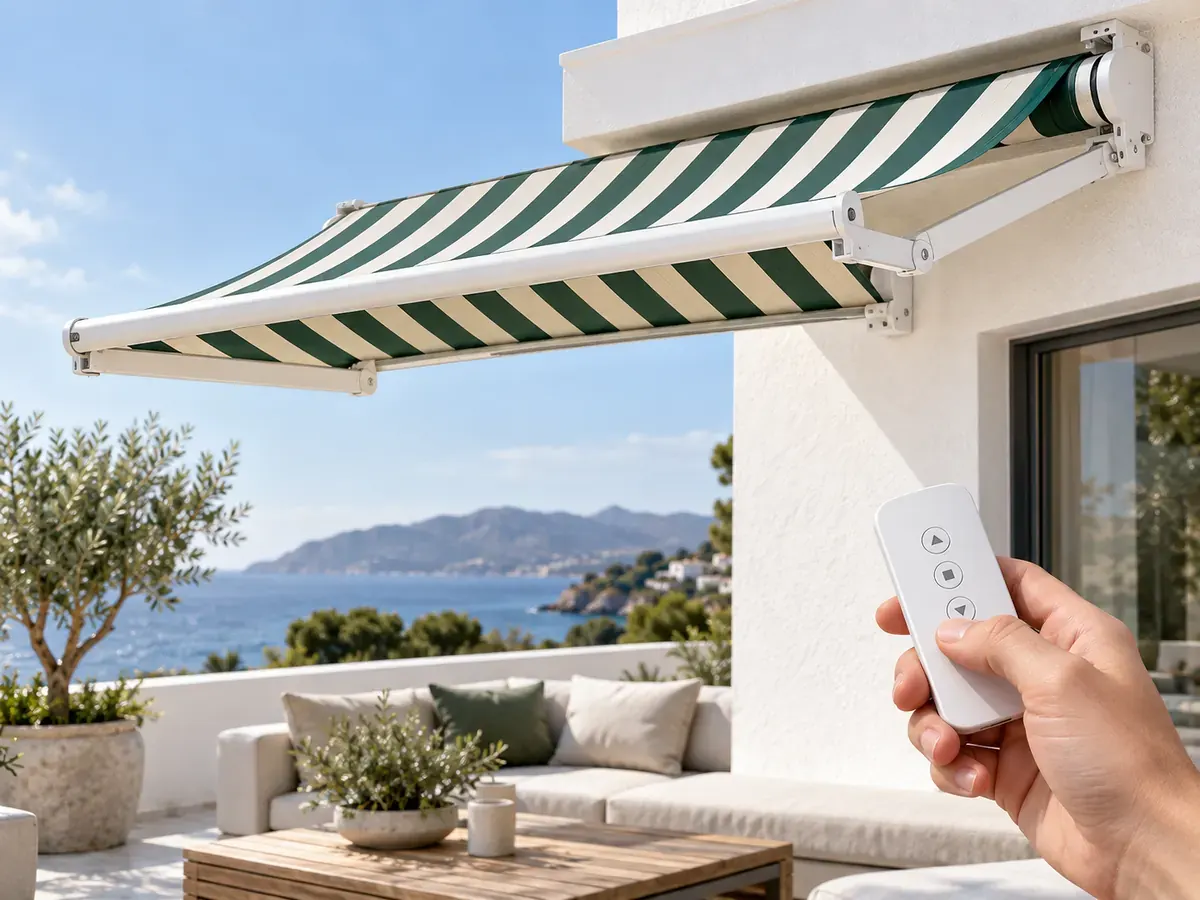
A folding-arm awning extends the fabric on folding arms that straighten out like an elbow, with no posts getting in the way on the floor. It’s the most versatile option for terraces on flats, penthouses and houses, and it comes in a wide range of widths and projections.
A cassette awning is a folding-arm awning with an aluminium case that encloses the fabric and arms when it’s retracted. The fabric is fully protected and the facade looks neater, which is why it’s the roll-up awning we recommend most for terraces that get a lot of sun or are close to the sea.
Very large terraces: monobloc awning
When the terrace is very wide or the projection is large, a monobloc awning mounts all its brackets on a square bar that spreads the load along the facade. It’s sturdier than a standard folding-arm awning and copes better with daily use on villas and large penthouses.
No solid wall: awning with support legs
If the wall won’t take reliable fixings or you want to cover a garden, an awning with support legs rests its front on two adjustable telescopic legs. The fabric still rolls up, but the weight no longer depends on the facade alone.
Balconies: drop arm awning
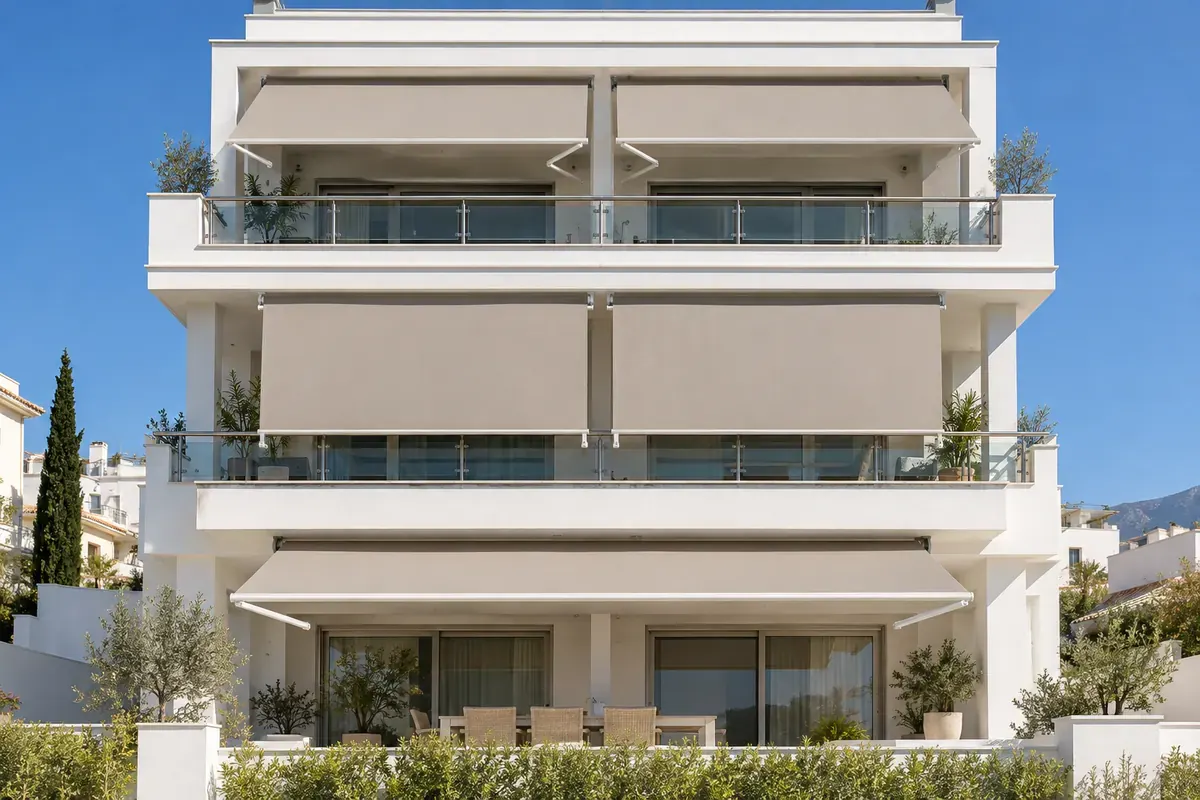
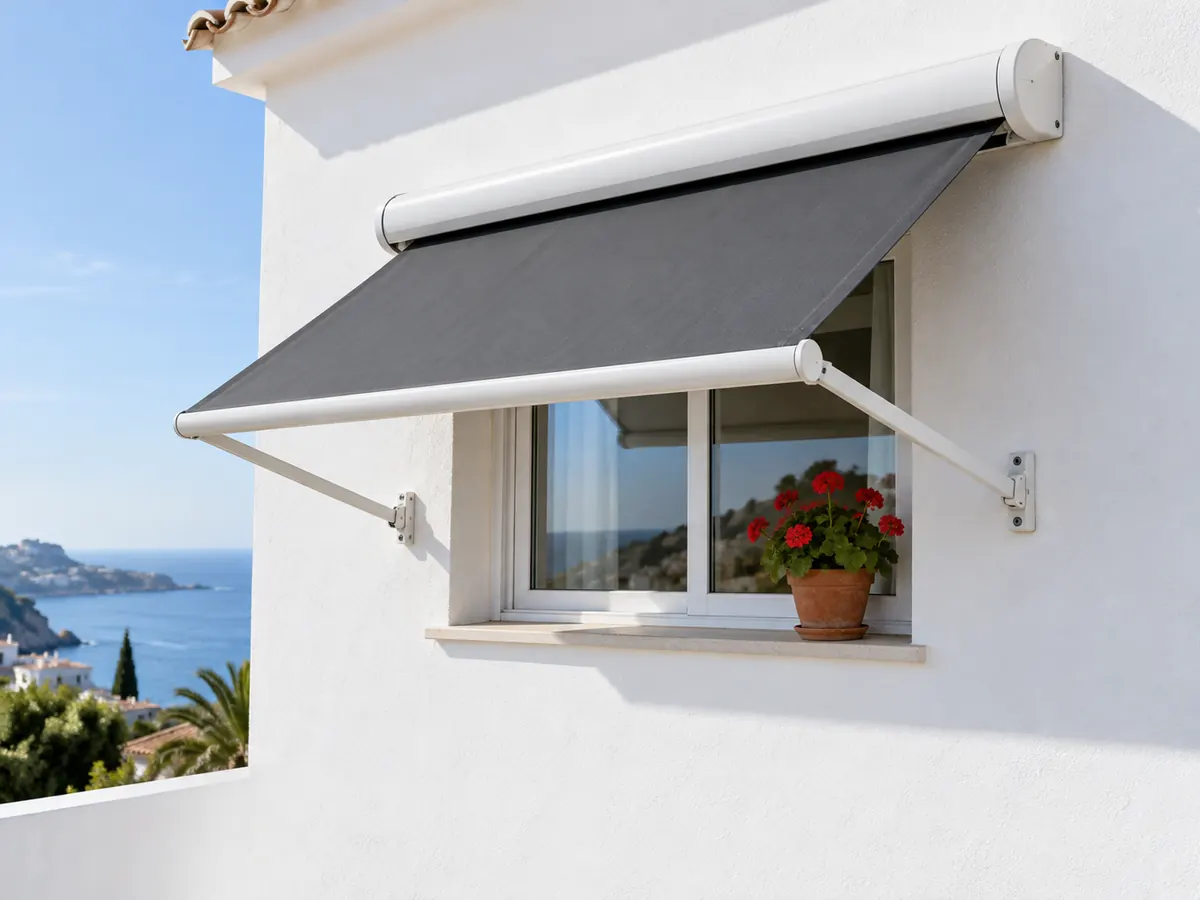
A drop arm awning is fixed above the window or the railing, and pivoting arms push the fabric out at an angle. It shades the balcony and the room inside without taking up any space, and it can be fitted with a cassette to protect the fabric.
Vertical window awnings: roller awnings and zip screens
When the sun comes in low and from the side, a horizontal awning isn’t enough. That’s where vertical awnings come in: the fabric drops parallel to the window and blocks the sun before it reaches the glass.
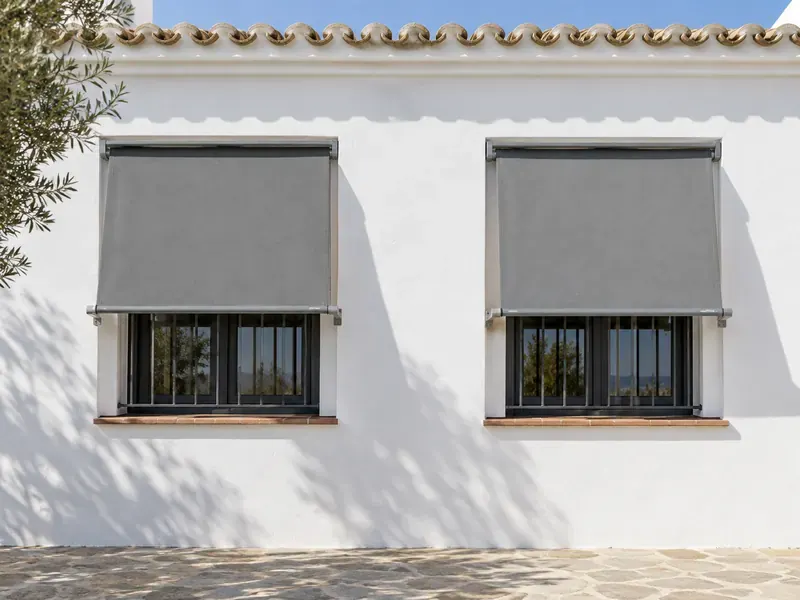
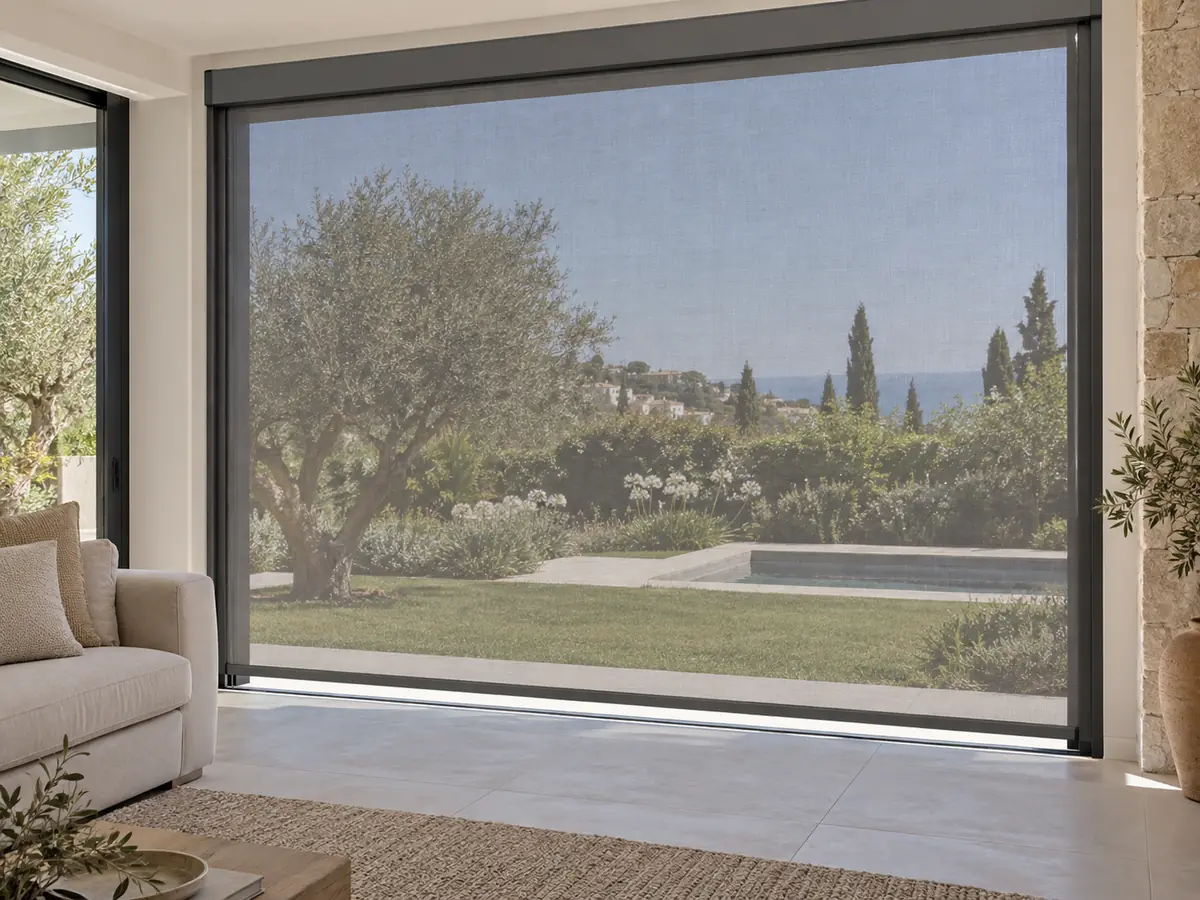
A roller awning (an outdoor blind) comes down guided by cables or rods and is a simple solution for windows and balconies. A zip screen has the edges of the fabric held inside zip guides, so it always stays taut, doesn’t flap in the wind and does a better job of keeping out light and insects. That’s why these are the two most popular systems for window awnings.
Sides of terraces and businesses: windbreak awning
If what you need is to close off one side of your terrace, your porch or a bar terrace, a windbreak awning with side guides drops vertically with a tough fabric and stops the wind from the side without any building work.
Types of awning compared
This table sums up where the most common roll-up awnings stand out. It’s a guide only: the final choice depends on the measurements, the available fixing points and which way the space faces, which we always check at the home visit.
| Model | Best suited to | How the fabric extends | Key strength |
|---|---|---|---|
| Folding-arm | Terraces on flats and houses | Folding arms | Versatile, no posts |
| Cassette | Exposed terraces and smart facades | Folding arms inside a case | Fabric fully protected |
| Monobloc | Very wide terraces or large projections | Arms on a square bar | Sturdiness |
| Telescopic legs | Gardens or weak walls | Arms and adjustable legs | Doesn’t rely on the facade alone |
| Drop arm | Balconies and windows | Pivoting arms | Shade without taking up space |
| Roller | Windows and balconies | Vertical cables or rods | Simple and lightweight |
| Zip screen | Large windows, porches and pergolas | Side guides with a zip | Taut fabric even in the wind |
| Windbreak | Sides of terraces and bars | Side guides | Stops wind from the side |
Torn between several models? We come to your home, measure up for free and give you a written quote, with no obligation and a fixed price, in under 24 hours. Get a free quote or call us on +34 694 57 17 33.
How to choose a window awning according to which way it faces
The direction your window faces decides when and at what angle the sun comes in, and that completely changes which awning works. Before you choose your window awning, notice when the light bothers you.
South-facing windows
In summer the midday sun is high. An awning that projects outwards, such as a drop arm awning, creates a canopy of shade over the glass and still lets you see out underneath. In winter, when you retract it, the low sun comes back in and warms the house.
West-facing windows
These are the trickiest: the afternoon sun comes in very low and almost horizontal, just when the house has built up the most heat. Here a horizontal awning falls short and what works is a vertical awning, roller or zip screen, that covers the whole pane. With screen fabric you can still see out while keeping the sun at bay.
East-facing windows
The morning sun also comes in low, although it’s usually less hot. As a window awning, a roller awning or a light drop arm awning is normally enough, especially in bedrooms where the early light is a nuisance.
North-facing windows
They rarely need a window awning. If you’re after privacy or want to keep insects out, consider a made-to-measure fly screen or a vertical awning with screen fabric rather than a shade awning.
Which fabric to choose for your roll-up awning
The fabric is the part that has the biggest effect on how cool you’ll be underneath and how long your roll-up awning will last. These are the usual options:
- Acrylic fabric: the most widely used on terrace and balcony awnings. It stands up well to the sun, keeps its colour and breathes, so less heat builds up under the awning.
- Micro-perforated screen fabric: typical of vertical awnings and zip screens. It lets a little light and air through and lets you see out, while blocking a good deal of the sun’s radiation.
- PVC fabric: waterproof and very tough, but it gets hotter and breathes less well. It makes sense for businesses or when rain, not heat, is the priority.
Colour counts too: light shades reflect more radiation, while dark ones give denser shade but get hotter. We go into this in depth in which awning keeps the heat out best.
At QUBRE we work with fabrics from Sauleda and Dickson, two leading manufacturers of awning fabrics, with wide sample ranges of plains and stripes. We bring samples to the home visit so you can see the colour in the real light on your terrace.
Manual or motorised roll-up awning
Every roll-up awning in this guide can be manual, with a winding handle, or motorised. The difference isn’t just about convenience:
- Manual: more affordable and doesn’t need electricity. It works well on small awnings that aren’t opened and closed very often.
- Motorised: it opens and closes with a switch or a remote, so you use it far more. It’s almost essential on large awnings or on windows that are hard to reach.
- With a wind sensor: the awning retracts on its own when the wind blows hard, even when you’re not at home. On the coast it’s the best protection against breakages.
We install Cherubini motors and can also motorise your current awning if the frame is in good condition. If you’d like to compare types of motor and sensors, read our guide to the awning motor.
A roll-up awning built for the coast
In Velez-Malaga, Torre del Mar, Nerja or Marbella, roll-up awnings don’t just have to cope with sun: they also face salt air, humidity and days of levante or poniente, the strong easterly and westerly winds. So, as well as the model, it’s worth looking closely at the materials:
- Powder-coated aluminium frame: it resists corrosion far better than untreated steel.
- Stainless fixings: they prevent rust stains on the facade and weakened anchoring.
- Cassette or case: it protects the fabric and arms from salt and dust when the awning is retracted.
- Fixings designed for the size: a large awning on an exposed facade needs brackets and wall plugs suited to the type of wall.
If you live in a block of flats, remember that the facade is a common element: before installing anything, check what your community of owners has agreed. We explain it in awnings in communities of owners and in our guide to permits for awnings and pergolas.
Common mistakes when choosing which awning to buy
These are the mistakes we see most often when we’re called out to check roll-up awnings fitted by other companies:
- Choosing on price rather than the space: a basic folding-arm awning on a very windy terrace suffers far more than a cassette or monobloc awning.
- Not enough projection: if the fabric doesn’t reach the table or the big window, the awning hardly gets used.
- A horizontal awning for the setting sun: with the low afternoon sun, only a vertical awning really protects you.
- Dark fabric on a terrace with no airflow: it gives good shade, but the heat stays trapped underneath.
- Not planning for a motor: if you might want to motorise it later, it’s worth knowing from the start where the power point will go.
- Ignoring the community of owners: installing without asking can end with you being made to take it down.
How QUBRE installs your roll-up awning
From our head office in Velez-Malaga we work with our own technical team across the Axarquia, Malaga city, the Costa del Sol and the Costa Tropical in Granada. The process is always the same:
- Free home visit and measuring: we come to your home, measure up and check the type of wall, which way it faces and the wind.
- Advice: we recommend the model, fabric and operation that suit your space.
- Written quote in under 24 hours: no obligation and a fixed price, with no surprises at the end.
- Installation by our own team: no subcontractors, with powder-coated aluminium and stainless fixings.
- Guarantee and after-sales: a 2-year warranty on materials, depending on the manufacturer and product, a guarantee on the structure and installation, and after-sales service.
If you already have an awning and the fabric is worn, you don’t need to replace the whole thing: we can carry out repairs and fabric replacement, including on awnings fitted by other installers. And to make it last longer, follow our tips on how to clean an awning.
You’ll find projects and details for each area on our pages for awnings in Velez-Malaga and awnings in Marbella, among other towns.
We’ll recommend the right roll-up awning in your own home. Free measuring and a no-obligation, fixed-price quote in under 24 hours. Get a free quote or call us on +34 694 57 17 33.
Frequently asked questions about types of awning
What is a roll-up awning?
It’s an awning whose fabric winds onto a roller tube when it’s retracted. Most terrace, balcony and window awnings are roll-up awnings: folding-arm, cassette, monobloc, drop arm, roller or zip screen.
Which type of awning is best for a window?
For windows, a drop arm awning, which projects the fabric outwards, and vertical awnings (roller or zip screen), which block the sun without taking away all the light, both work very well. With afternoon sun, a vertical awning is usually the best option.
Can a roll-up awning cope with the wind?
It depends on the model and the installation. Cassette, monobloc and zip screen awnings cope better, but the safest thing is to retract it in strong wind or fit a wind sensor that does it automatically.
What’s the difference between a roll-up awning and a retractable awning?
In practice the two terms are used almost interchangeably: both are put away when they’re not in use. “Roll-up” refers to the fabric winding onto a roller tube, and “retractable” to the awning folding back against the facade.
Can a manual roll-up awning be motorised?
Yes, in most cases. If the roller tube and the frame are in good condition, the winding handle is swapped for a tubular motor inside the roller tube, and a remote and wind sensor can be added.
Which fabric is best for a roll-up awning on the coast?
For terraces and balconies, a good-quality acrylic fabric in a light shade usually strikes the best balance between shade, coolness and durability. For vertical awnings, screen fabric lets you see out.
How much does a roll-up awning cost?
It depends on the model, the size, the fabric and whether it has a motor. The most reliable way is to measure the space: at QUBRE the home visit is free and we give you a written quote with a fixed price in under 24 hours.
Conclusion: which awning to choose depends on your space
No roll-up awning is better than another in the abstract: there’s a right one for each terrace, balcony or window. Start with the space and which way it faces, choose a good fabric and think from the outset about whether you want a motor and a wind sensor.
At QUBRE we help you get it right first time, with a free home visit and measuring in Malaga, the Axarquia, the Costa del Sol and the Costa Tropical in Granada. Ask for your no-obligation quote and we’ll send it to you in under 24 hours.