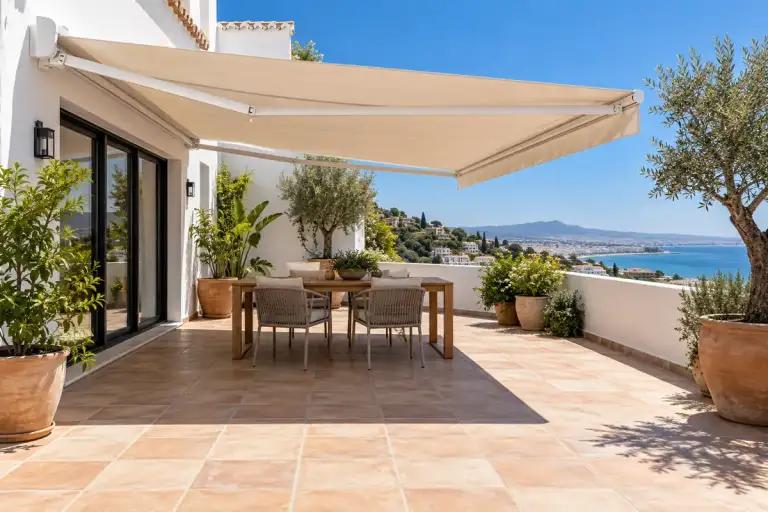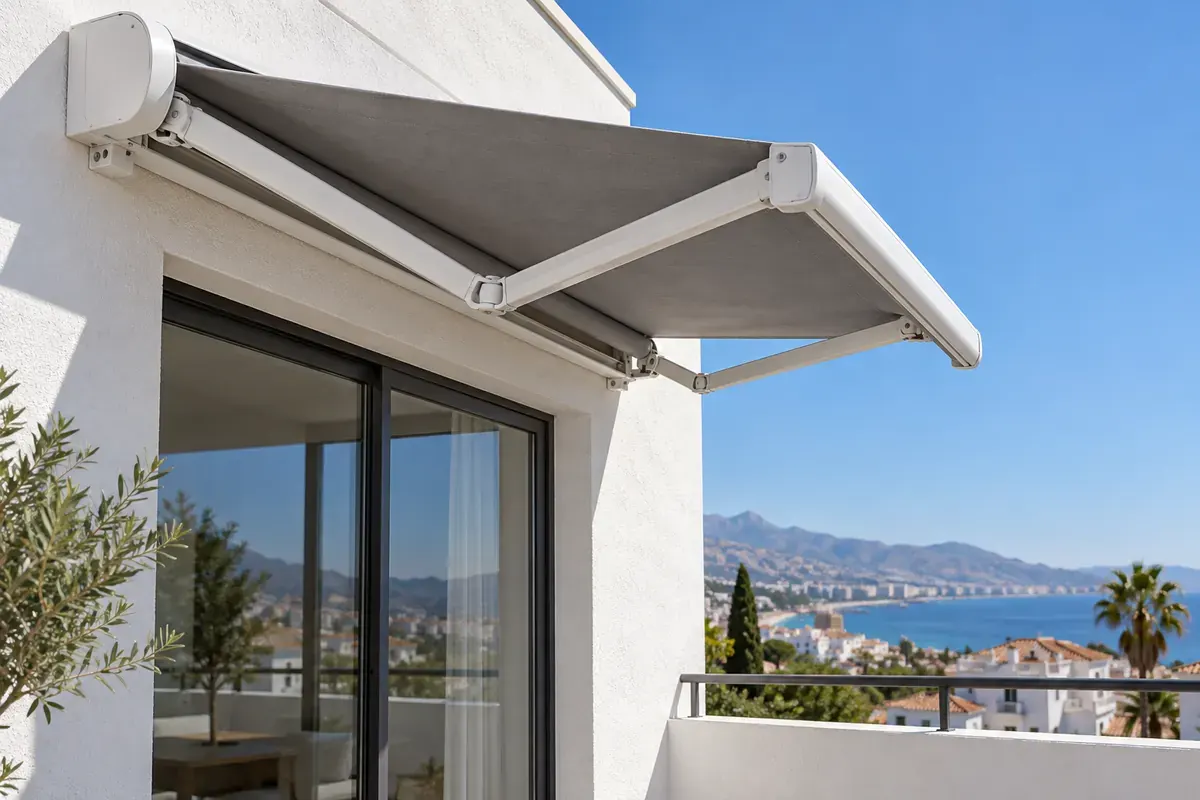
A retractable awning is one you can open when you need shade and put away when you don’t: the fabric rolls up onto a tube and the awning sits neatly against the facade. It’s the most widely installed type of awning on terraces, balconies and windows in Malaga and the Axarquia, because it gives you shade on demand while keeping the fabric far better protected than on a fixed awning.
In this guide we go beyond the definition. We explain how a retractable awning works on the inside, how long each part lasts, what maintenance it needs season by season, which faults are most common and when it’s worth motorising it. If what you really want is to decide which model to fit in each space, there’s a companion guide on roll-up awnings and which one to choose.
What is a retractable awning?
“Retractable” simply means it can be retracted, in other words drawn back in. Unlike a fixed awning or a tensioned shade sail, which are always exposed, a retractable awning only comes out when you want it to. When you close it, the fabric is rolled up and the arms are folded, so the sun, rain and dust barely touch it.
This has two practical consequences. First, you can enjoy the sun in winter and the shade in summer with the same awning. Second, the fabric lasts quite a bit longer than on a fixed system, because it spends a good part of the year protected.
How a retractable awning works on the inside
Understanding the parts of a retractable awning helps you use it properly, spot a fault in time and compare quotes with a critical eye.
The roller tube and the fabric
The heart of the awning is a horizontal tube, the roller tube, onto which the fabric rolls. One end of the fabric is attached to the tube and the other to the front bar, the profile at the front that keeps it straight. Turn the tube one way and the fabric unrolls; turn it the other way and it rolls back up.
The arms and fabric tension
On terrace awnings, folding arms push the front bar outwards. Inside they have a system of springs or tensioners that keeps the fabric taut. If that tension is lost, the fabric sags, collects water and flaps in the wind, which is exactly what speeds up wear.
How it’s operated: crank handle or motor
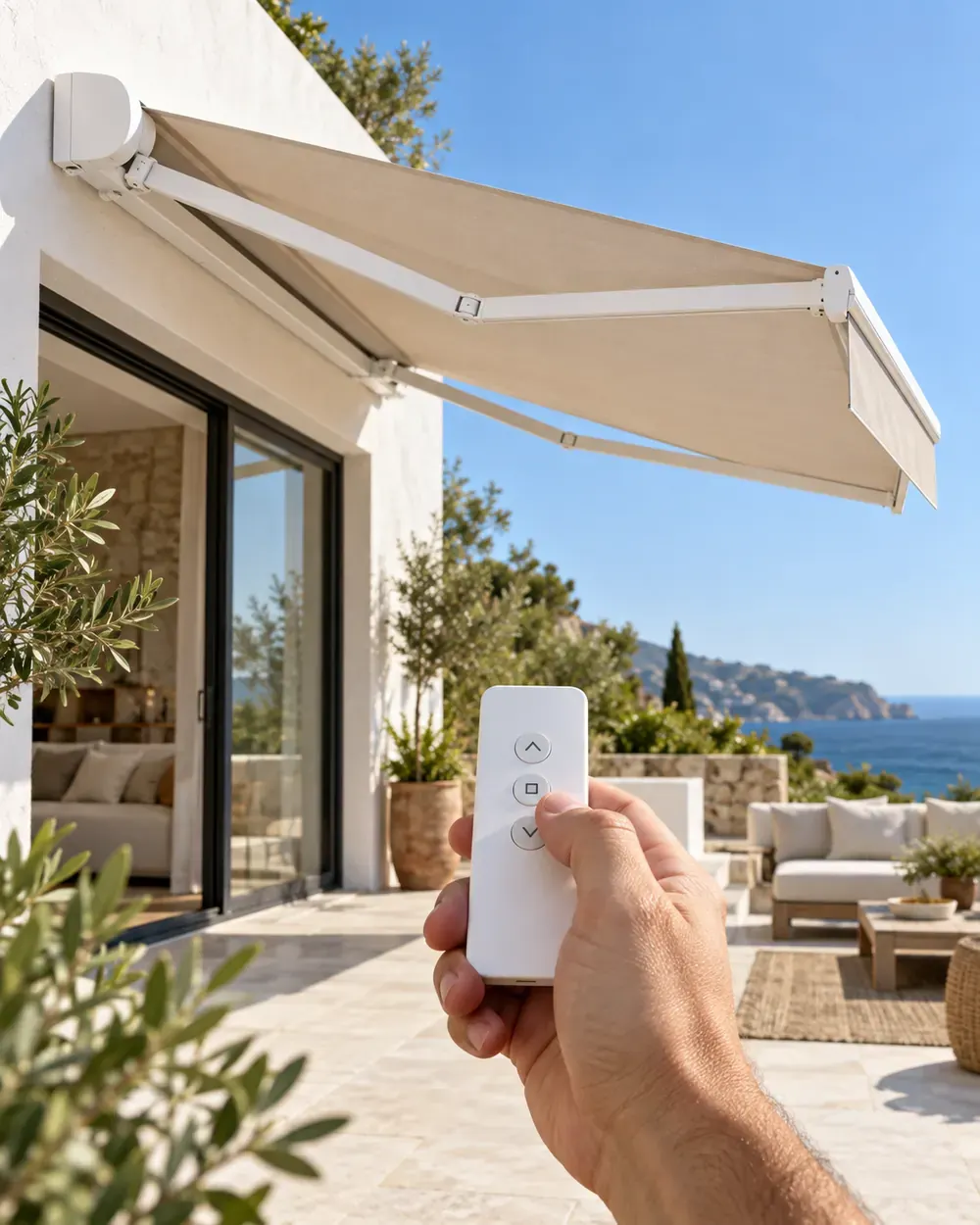
On a manual retractable awning, a crank handle drives a small gearbox that turns the roller tube. On a motorised one, a tubular motor hidden inside the tube itself does that job. The motor has limit switches that tell it where to stop when opening and closing, so the fabric is never left slack or overstretched.
Types of retractable awning
All retractable awnings share that basic mechanism, but they differ in how they extend the fabric and how they protect it when it’s rolled up.
Folding-arm awning
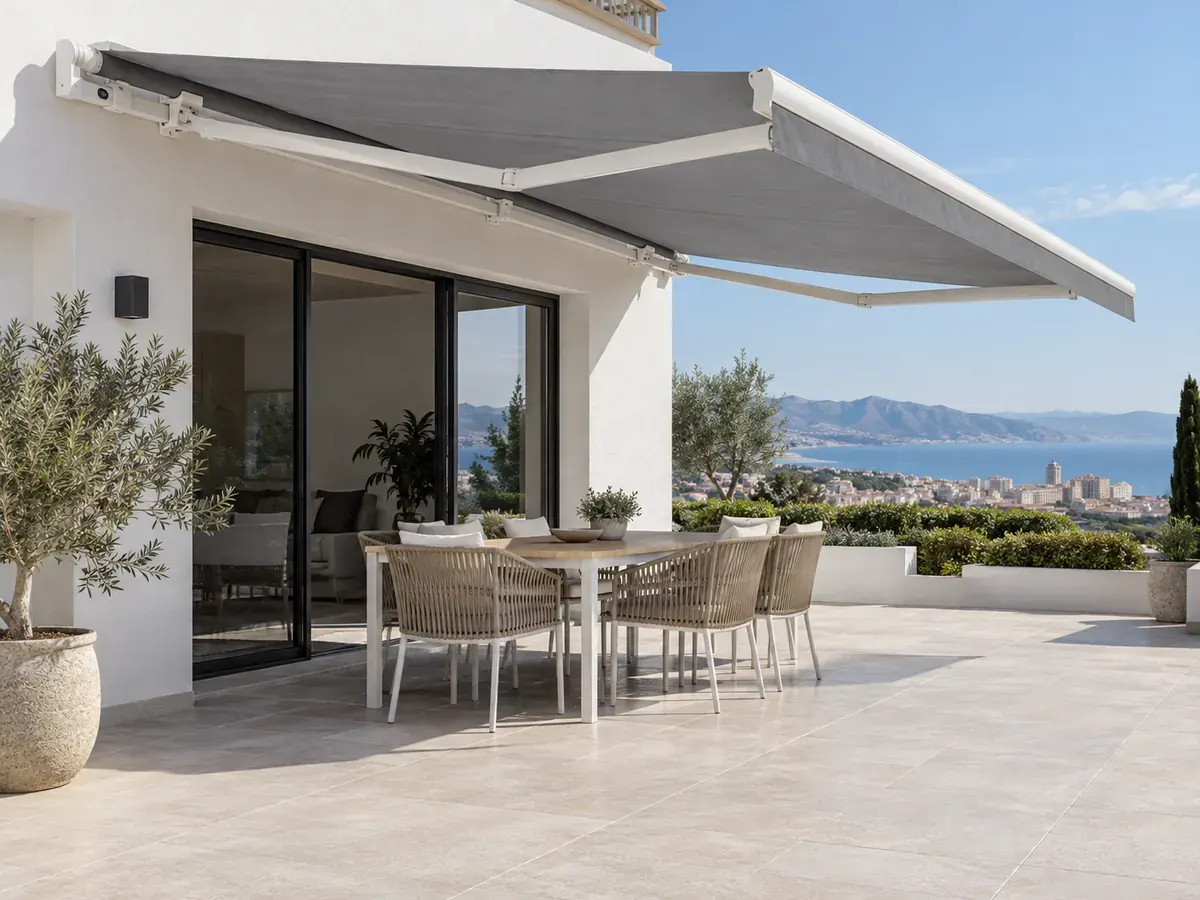
The arms fold like an elbow and push the fabric outwards without any posts. It’s the most common terrace awning on flats and houses. Find out more about our folding-arm awnings.
Cassette awning
This is a folding-arm awning with a case that encloses the fabric and arms when it’s retracted. Because everything is shut away, it’s the retractable awning that looks after its fabric best, which is a real advantage near the sea. See cassette awnings.
Monobloc awning
The arms are mounted on a square bar that spreads the load along the facade. It’s the sturdy option for very wide terraces or ones that need a long projection. See monobloc awnings.
Drop arm awning
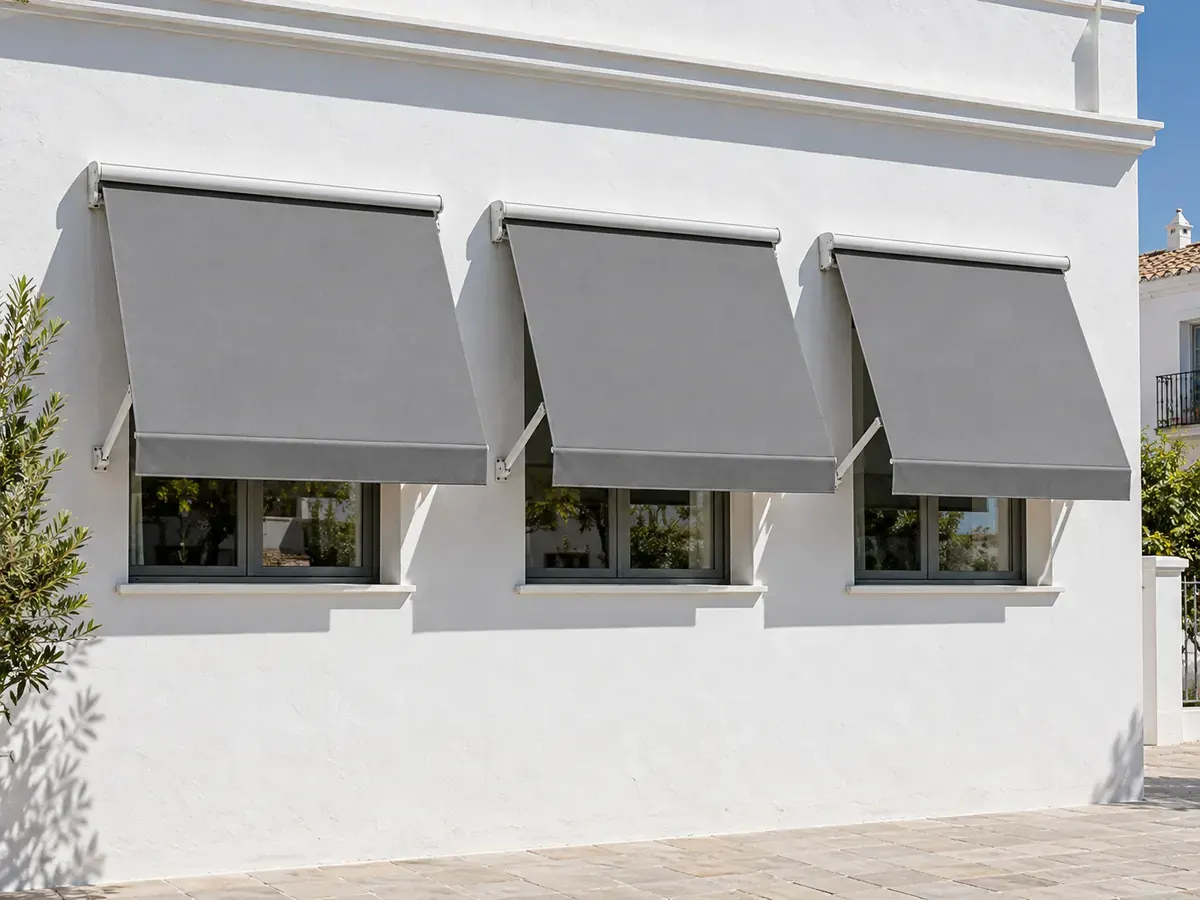
The arms pivot from the railing or the bottom of the window and hold the fabric at an angle, sloping outwards. It works very well on balconies and windows. See drop arm awnings.
Vertical awnings: roller awnings and zip screens
The fabric drops vertically to block sideways sun, wind or prying eyes. A roller awning comes down guided by cables or rods; a zip screen has its fabric held in side guides, so it always stays taut.
Retractable awning, fixed awning or pergola: the differences
Lots of people can’t decide between a retractable awning and a fixed structure. This comparison sums up the main differences:
| Feature | Retractable awning | Fixed awning or shade sail | Pergola |
|---|---|---|---|
| Shade | Only when you need it | All the time | All the time or adjustable, depending on the model |
| Fabric protection | High: it retracts and stays protected | Low: always exposed | Depends on the roof |
| Wind | Retracts; better with a wind sensor | Suffers on windy days | More stable structure |
| Floor space taken up | None (unless it has support legs) | Varies | Has posts |
| Paperwork | Generally simpler | Varies | More likely to need permission |
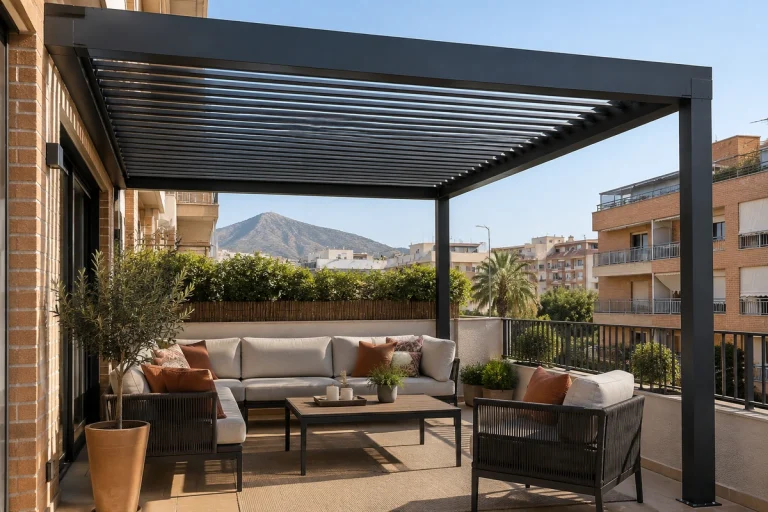
If you’re after a permanently shaded area, a pergola might suit you better. And if the terrace belongs to a community of owners or you’re going to anchor a fixed structure, have a look first at our guide to permits for awnings and pergolas.
Not sure what’s right for you? We’ll come to your home, measure up for free and give you a written quote with no obligation and a fixed price in under 24 hours. Get a free quote or call us on +34 694 57 17 33.
How long do retractable awnings last?
There’s no single figure, because a retractable awning doesn’t wear evenly: each part ages at its own pace, and a lot depends on the installation, how it’s used and how close it is to the sea.
The frame
A well-anchored powder-coated aluminium frame lasts for many years. On the coast, what usually fails first isn’t the aluminium but the screws and fixings, if they aren’t stainless. That’s why at QUBRE we always install with stainless fixings and brackets suited to the type of wall.
The fabric
This is the part that wears out first, especially on very sunny terraces close to the sea, where the sun and salt take their toll. With a quality acrylic fabric (we work with Sauleda and Dickson) and some basic maintenance, it will last several seasons. When it’s worn out, you can replace just the fabric without replacing the whole awning.
The mechanism and the motor
The crank gearbox and the motor work every time you open and close the awning. A motor that’s properly sized for the awning is under little strain; one that’s short on power overheats and fails sooner. That’s why we choose the motor after measuring up.
Why the coast is tougher on awnings
In Velez-Malaga, Torre del Mar, Nerja or Marbella an awning has to live with salt air, night-time humidity and days of levante or poniente wind. Salt settles on the fabric and the metal parts, and humidity encourages mould stains if the awning is rolled up before it’s dry. So the closer your home is to the sea, the more it matters to choose materials made for that environment and not to skip the cleaning. On the coast, a cassette that encloses the fabric, good fixings and a wind sensor are the best way to keep your awning in good shape for many seasons.
What shortens the life of a retractable awning
- Leaving it open in strong wind or heavy rain.
- Rolling it up wet and not opening it again to let it dry.
- Slack fabric that collects pockets of water.
- Rusty fixings or a wall that can’t take the weight.
- A motor that isn’t powerful enough for the size of the awning.
Looking after a retractable awning through the year
Maintaining a retractable awning is straightforward and comes down to checking, cleaning and not forcing it. Here’s a seasonal routine that works well in the Malaga and Granada climate:
- Spring: before the busy season, open it fully, clean the fabric with water and a mild soap and check that the arms are tensioning properly.
- Summer: this is when it gets the most use. Retract it if a strong levante or poniente blows, and make sure it isn’t left open when you go out.
- Autumn: clear away leaves and dirt, and don’t roll it up wet after the first rains.
- Winter: even if you hardly use it, open it now and then to air the fabric, and check the fixings and screws.
Good everyday habits
A large part of an awning’s lifespan depends on how it’s used day to day, not just on the check-ups. These simple habits make all the difference:
- Open and close it fully: leaving the fabric half rolled up for days on end leaves creases and makes the arms work in a strained position.
- Don’t hang from the front bar or lean anything on it: the arms are designed to keep the fabric taut, not to carry extra weight.
- If it’s manual, don’t force the crank at the end of its travel: when you feel resistance, stop; forcing it wears out the gearbox.
- Keep an eye on pot plants and climbers: constant rubbing against the fabric wears it down and traps moisture.
- If you’re going away for a few days, leave it retracted: a gust of wind with the awning open is the most expensive fault and the easiest one to avoid.
If you want a step-by-step guide to cleaning it without products that damage the fabric, take a look at how to clean an awning.
Common retractable awning faults and how to spot them
These are the signs we see most often during check-ups. Catching them early usually saves you a bigger repair:
- The fabric sags or won’t stay taut: the arms have lost tension or the fabric has stretched.
- One arm drops lower than the other: the pitch needs adjusting or the bracket needs checking.
- The crank slips or is very stiff to turn: the gearbox may be worn.
- The motor is noisy or stops halfway: it could be the limit switch, the motor itself or a power supply problem.
- The awning won’t close fully: the limit switches are out of adjustment or the fabric has rolled up unevenly.
- Rust stains on the facade: the screws aren’t stainless and should be replaced.
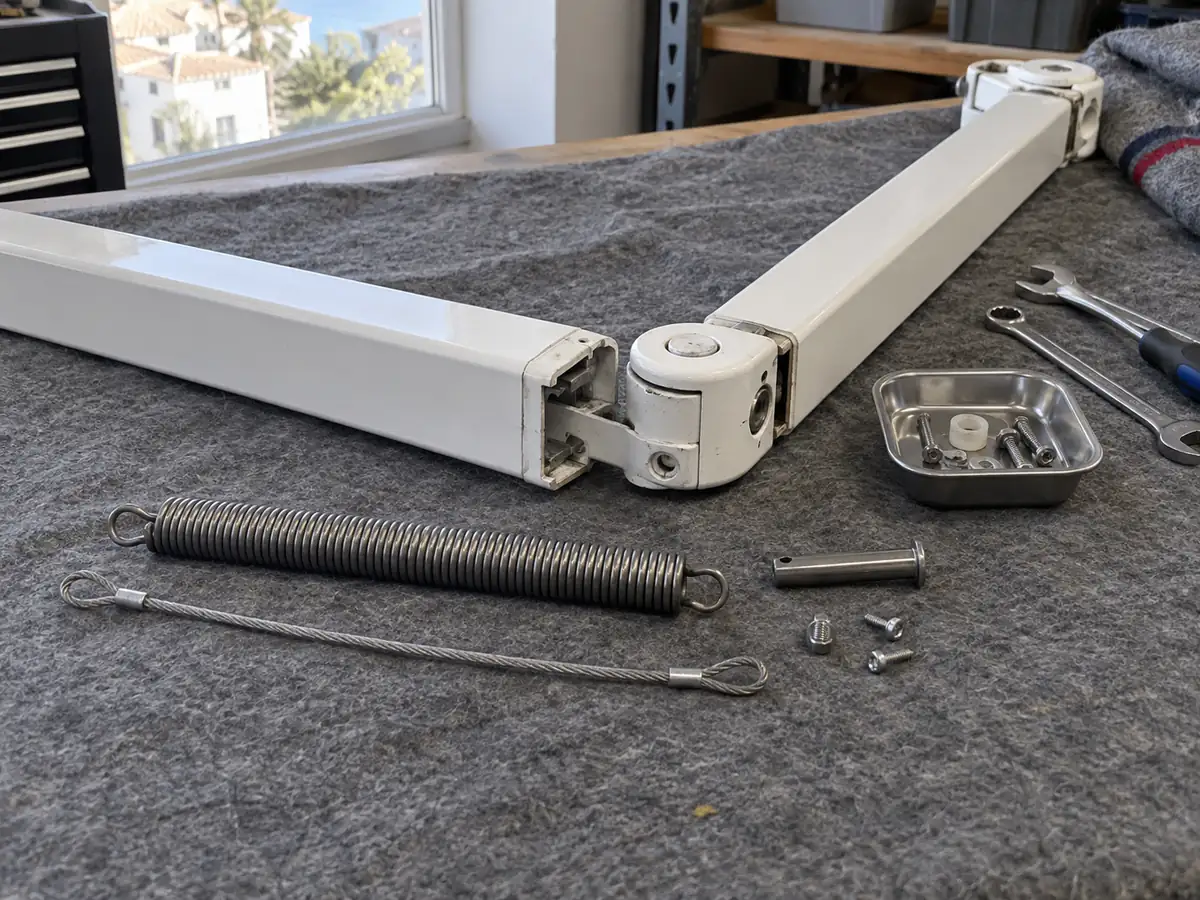
At QUBRE we carry out awning repairs and fabric replacement in Malaga and on the Costa Tropical, including on awnings installed by other companies.
Manual or motorised retractable awning?
Both options work, but they don’t suit everyone equally.
- Manual: cheaper and no power supply needed. Suits small awnings or ones that aren’t opened very often.
- Motorised: it opens and retracts in seconds at the touch of a button or a remote control, so it gets used far more. On large awnings, it saves you the effort of cranking.
- With a wind sensor: it retracts the awning automatically when the wind gets up. Wind is the most common cause of breakages, which is why on the coast this is the best investment you can make.
- With a sun sensor: it opens the awning when the sun gets strong and retracts it when the sun goes, which is handy if you’re out all day.
We install Cherubini motors and can also motorise awnings you already have if the frame is in good condition. To compare types of motor and sensor, see our guide to awning motors.
How to choose the right terrace awning
Retractable awnings cover almost any space, but they don’t all do the job equally well. If you’re thinking about an awning for your terrace, these quick pointers will help you get your bearings before the visit:
- Large terrace: folding-arm or cassette; if it’s very large, monobloc.
- Balcony or window: drop arm or roller awning.
- Sideways afternoon sun: vertical awning or zip screen.
- Very windy spot: cassette or monobloc with a motor and wind sensor.
- No solid wall to anchor to: an awning with support legs or a pergola.
- Very hot terrace: light, breathable fabric. We explain why in which awning keeps the heat out best.
We install your retractable awning in Malaga and Granada
From our head office in Velez-Malaga, our own technical team installs across the Axarquia, Malaga city, the Costa del Sol and the Costa Tropical in Granada. This is how we work:
- Free home visit, measuring and advice at your home.
- Written quote in under 24 hours, with no obligation and a fixed price.
- Installation by our own team, with powder-coated aluminium and stainless fixings designed for the coast.
- Guarantee: a 2-year warranty on materials, depending on the manufacturer and product, plus a guarantee on the structure and installation.
- After-sales service, even if your awning was installed by another company.
What to check in your awning quote
Comparing retractable awning quotes on the final price alone often leads to surprises. Before you decide, check that the quote spells out:
- The exact model and sizes: the width and the arm projection, which are what determine the real shade.
- The fabric: the manufacturer, the type of fabric and the colour chosen.
- How it’s operated: manual or motorised, the motor brand, the type of control and whether a wind sensor is included.
- The fixings and screws: whether they’re stainless and suited to your type of wall.
- Who installs it: their own team or subcontractors, and who answers for it if there’s a problem later.
- The guarantee: what it covers, for how long and on what terms, for both materials and installation.
- The extras: removing the old awning, a power point for the motor or handling permits if they’re needed.
At QUBRE we give you a written quote with all of this set out in detail and a fixed price, so you can compare with peace of mind.
You can find more details for each area on pages such as awnings in Torre del Mar or awnings in Fuengirola, among other towns.
We’ll help you choose your retractable awning on your own terrace. Free measuring and a no-obligation quote with a fixed price in under 24 hours. Get a free quote or call us on +34 694 57 17 33.
Frequently asked questions about retractable awnings
What does “retractable awning” mean?
A retractable awning is one that can be put away when you don’t need it: the fabric rolls up onto a tube and the awning folds back against the facade. That way it only gives shade when you want it to, and the fabric suffers less.
How long do retractable awnings last?
A well-installed aluminium frame lasts for many years. The fabric is the part that wears out first: a quality acrylic fabric that’s well looked after will last several seasons, and it can be replaced without changing the whole awning.
How much does a retractable awning cost?
It depends on the size, the type (folding-arm, cassette, drop arm…), the fabric and whether it has a motor. The most reliable way is to measure the terrace: at QUBRE the visit is free and we give you a fixed-price quote.
Which retractable awning is best for a windy terrace?
A well-anchored cassette or monobloc awning, with a motor and a wind sensor that retracts it automatically when the wind gets up.
What maintenance does a retractable awning need?
Clean the fabric with water and a mild soap a couple of times a year, don’t roll it up wet, retract it in strong wind and check the arms, fixings and screws every so often.
Can a manual retractable awning be motorised?
Yes, in most cases. If the roller tube and the frame are in good condition, the gearbox and crank are replaced with a tubular motor inside the tube, and you can add a remote control and a wind sensor.
Why won’t my retractable awning stay taut?
It’s usually because the arms have lost tension or the fabric has stretched. It’s worth having it checked soon, because slack fabric collects water and wears out faster.
Conclusion: a well-chosen, well-cared-for retractable awning lasts for years
A retractable awning is the most practical way to have shade only when you want it and keep the fabric protected the rest of the time. Choosing the right model, installing it with materials made for the coast and keeping up some simple maintenance are what make the difference to how long it lasts.
At QUBRE we advise you with a free home visit and measuring in Malaga, the Axarquia, the Costa del Sol and the Costa Tropical in Granada. Get your no-obligation quote and we’ll send it to you in under 24 hours.